For decades, plant managers in the dry food, dairy, and pharmaceutical sectors have been forced into a high-stakes balancing act: prioritizing either the physical safety of their workforce or the stringent sanitation requirements dictated by federal regulators. The friction between these two mandates—slip resistance and hygiene—is not merely a operational headache; it is a critical vulnerability that directly impacts both bottom-line profitability and human life.
According to data from the Bureau of Labor Statistics, slips, trips, and falls remain the second-leading cause of fatal workplace injuries. In the context of manufacturing, these risks are exacerbated by the very materials used to prevent them. However, a new wave of engineering innovation is challenging the assumption that safety and sanitation must exist in mutual exclusivity.
The Core Conflict: Why Traditional Solutions Fail
To understand the current crisis, one must first understand the physics of traditional high-traction flooring. Historically, manufacturers have achieved slip resistance by cutting deep grooves, adding grit coatings, or using raised patterns (such as diamond plate) to create texture. While effective at providing a grip, these surfaces create a "micro-terrain" of valleys and crevices.
In wet processing plants, this is rarely an issue; a pressurized, chemical-heavy washdown can easily purge these crevices. But for dry processing facilities—where flour, powdered ingredients, and organic dust are the primary contaminants—moisture is the enemy. Introducing water to clean a floor risks fostering Listeria, Salmonella, and other dangerous pathogens, effectively turning a simple maintenance task into a food safety nightmare.
Consequently, when fine dust settles into the deep grooves of a high-traction floor, it creates a harborage point for bacteria. This places plant leaders in a precarious position: keep the floor clean and risk a slip-and-fall lawsuit, or maintain the grip and risk a failed audit from the Food and Drug Administration (FDA) or the U.S. Department of Agriculture (USDA).
A Shift in Engineering: The Rise of Sweepable Traction
The industrial landscape is seeing a move away from "groove-based" friction toward "peak-based" technology. Engineering firms like SLIPNOT have pioneered stainless steel surfaces that utilize millions of tool-steel-hard traction peaks.
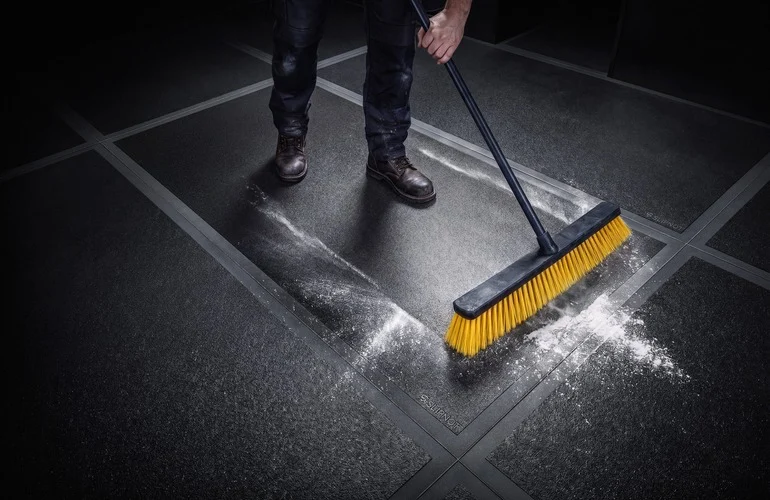
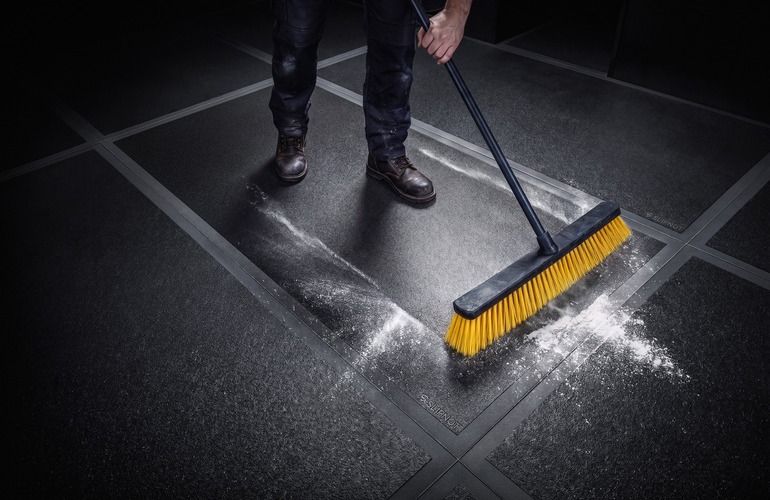
Unlike diamond plate or grit-coated surfaces, these engineered textures do not rely on voids to create grip. Instead, the microscopic valleys are filled, leaving only the abrasive, high-friction peaks exposed. This design allows for what experts call "surface sweepability." Because there are no deep crevices for flour or powder to inhabit, a standard push broom can clear the surface in a single pass. This innovation effectively bridges the gap, allowing facilities to maintain FSMA (Food Safety Modernization Act) compliance without compromising the physical safety of the workforce.
Chronology of an Industrial Evolution
The history of industrial flooring has been marked by a series of compromises, each addressing one problem while inadvertently creating another:
- The Era of Adhesive Solutions (Pre-2000s): Facilities relied heavily on anti-slip tapes and epoxy-grit paints. While easy to apply, these materials suffered from rapid degradation. Under the heavy traffic of pallet jacks and carts, the grit would flake off, creating both a contamination risk (loose grit in food products) and a return to a slippery, smooth surface.
- The Diamond Plate Period: The industry shifted to raised-pattern metal, assuming that the physical structure of the metal would provide longevity. However, as plant audits grew more sophisticated, managers realized that diamond plate offered little protection once a light film of oil or dust coated the raised patterns, essentially creating a "skating rink" effect.
- The Welded-Bead Experiment: Many plants attempted to add traction to existing floors by welding metal beads onto plates. This failed on two fronts: the beads often snapped off under heavy loads, creating sharp metal debris, and the base of the beads remained a perfect, impossible-to-clean hideout for organic matter.
- The Current Generation (2020s–Present): The focus has shifted toward integrated, engineered surfaces that are monolithic in nature. Modern solutions focus on DCOF (Dynamic Coefficient of Friction) standards rather than aesthetic appearance, marking a transition toward data-driven facility management.
The Data-Driven Standard: Beyond "Slip-Resistant"
For plant managers, the term "slip-resistant" is no longer sufficient; it is a marketing term, not an engineering specification. To make informed decisions, leadership must pivot toward the Dynamic Coefficient of Friction (DCOF).
Understanding DCOF
Unlike static tests that measure friction on a stationary object, DCOF measures grip while a person is in motion—the exact moment a slip occurs. Under ANSI A326.3 protocols, the benchmark for a safe, dry processing zone is a DCOF above 0.80 on a clean surface. However, the true test is the "contaminated" reading. A surface that registers 0.97 while clean but drops to 0.40 when covered in flour is a liability.
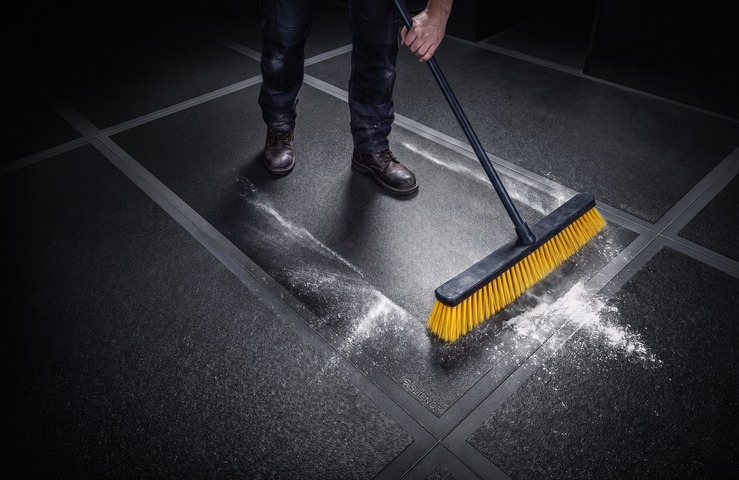
Engineered surfaces, when tested with fine powder worked into the texture, should ideally maintain a DCOF above 0.60 to be considered reliable. Documentation of these contaminated-surface tests is the gold standard for procurement.
The Cost of Inaction
The economic implications are twofold:
- Safety Costs: The Liberty Mutual Workplace Safety Index estimates that overexertion and slip-related injuries cost employers more than $13 billion annually.
- Operational Efficiency: In-house modeling of advanced flooring reveals that sweepable surfaces can save 20 minutes of labor per cleaning cycle. For a three-line facility performing two cleanings daily, this recovers over 730 hours of production time annually.
Official Compliance and Sanitation Requirements
Under the FSMA and USDA regulatory frameworks, the floor is considered part of the "food contact surface" environment. Any gap, crack, or non-welded seam is a potential violation.
A critical oversight in many flooring installations is the failure to properly seal the perimeter. If a floor is high-traction but cannot be seam-welded to the existing wall or drainage infrastructure without destroying the surface finish, the facility remains non-compliant. Plant leaders should demand that flooring suppliers provide specifications on "pre-masking"—a process where the edges are protected so that field crews can perform a full-seam weld without damaging the traction integrity of the surface.
Implications for Future Facility Design
The decision to upgrade flooring is often reactive, triggered by a failed health inspection or a workers’ compensation claim. However, forward-thinking plant leaders are beginning to view flooring as a strategic capital expenditure.
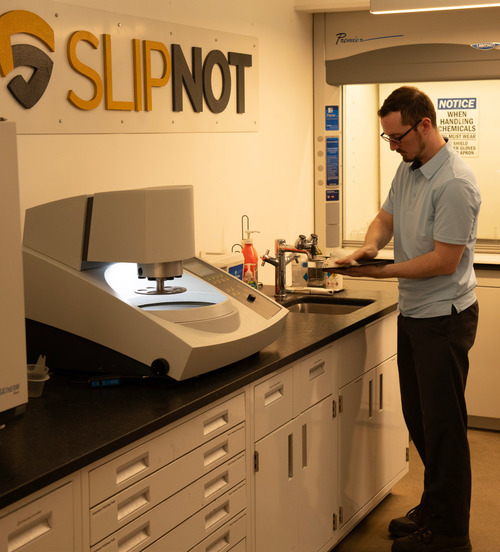
When retrofitting an active line, the costs of downtime and specialized installation can be astronomical. By contrast, specifying high-performance, sweepable, seam-weldable flooring during the initial design phase of a new facility or expansion is exponentially more cost-effective.
The Four-Question Audit
Before signing a contract with any flooring provider, management should require clear, data-backed answers to these four questions:
- DCOF Integrity: Can you provide the DCOF data for both clean conditions and fine-powder contamination?
- Debris Removal: Can you demonstrate, through comparative lab testing or visual evidence (such as UV tracer powder), exactly how much debris remains after a standard sweeping pass?
- Seam-Welding Compatibility: Does the surface finish allow for a full-seam, moisture-proof weld along the perimeter without compromising the safety texture?
- Five-Year TCO: What is the total cost of ownership, including cleaning labor savings and potential replacement frequency, rather than just the initial price per square foot?
Conclusion
The era of choosing between safety and sanitation is coming to an end. As industrial standards evolve and the financial costs of workplace injuries and production downtime continue to climb, the industry is favoring engineered solutions that address both metrics simultaneously. By moving toward surfaces that offer high, consistent DCOF readings and simplified, sweepable maintenance, plant managers can finally close the book on a compromise that has challenged the industry for decades. The path forward is not just about installing a floor; it is about building a foundation for operational excellence.