Introduction and Main Facts
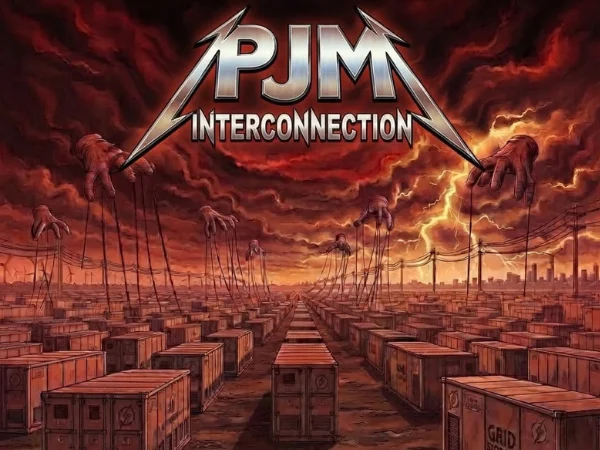
The North American energy landscape is undergoing a monumental transformation, driven by surging electricity demand, the rapid buildout of artificial intelligence data centers, and an urgent race to avert looming capacity shortfalls. At the epicenter of this crisis is the PJM Interconnection—the largest grid operator in the United States—which faces a staggering 7-gigawatt (GW) capacity shortfall by 2028. To stave off rolling blackouts and integrate intermittent renewable energy at an unprecedented scale, regulatory bodies, independent power producers (IPPs), and virtual power plant (VPP) operators are aggressively deploying new market mechanisms, battery storage systems (BESS), and large-scale solar facilities.

Recent milestones underscore this shift: PJM has greenlit its first projects under a newly established expedited interconnection track, utilities and IPPs are bringing massive solar-plus-storage complexes online ahead of schedule, and distributed energy resource providers are securing hundreds of millions in funding to turn commercial and residential demand flexibility into a foundational grid resource.

Chronology of Key Industry Developments
The acceleration of renewable energy infrastructure and grid-stabilizing assets has unfolded through several critical milestones over recent years:

- 2019–2020: Projects like the Black Hollow Sun solar complex in Colorado are selected, while states like California begin aggressively scaling utility-scale storage, expanding CAISO’s fleet from approximately 500 MW to multi-gigawatt levels.
- September 2025: Phase I of ContourGlobal’s Black Hollow Sun complex (185 MWp / 150 MWac) enters commercial operation, marking the company’s first large-scale solar PV construction project in the United States.
- July 31, 2026: PJM Interconnection officially opens its temporary Expedited Interconnection Track (EIT) to fast-track large-scale energy projects backed by primary siting authorities capable of operating within three years.
- Late September 2026: ContourGlobal and the Platte River Power Authority complete Phase II of the Black Hollow Sun project, bringing northern Colorado’s largest solar installation fully online four months ahead of schedule. Simultaneously, Northland Power achieves commercial operation at its 80 MW / 160 MWh Jurassic BESS in Alberta, Canada—currently the province’s largest battery storage facility.
- Early October 2026: Construction formally commences on ContourGlobal’s Project Sterling in Mohave County, Arizona. Doral Renewables also celebrates the imminent commercial operation of the final three phases (Mammoth South, Mammoth Central I, and Mammoth Central II) of its 1.3 GW Mammoth Solar project in Indiana.
- Mid-October 2026: PJM accepts its first three EIT projects—comprising two ENGIE battery storage sites and a natural gas generator upgrade totaling over 2,100 MW of combined nameplate capacity. Meanwhile, virtual power plant provider Voltus closes an oversubscribed $225 million Series D funding round. Pivot Energy similarly finalizes a $173 million term loan facility for a 135 MWdc community solar portfolio.
Supporting Data and Market Metrics
The scale of capital investment and infrastructure deployment across the continent reflects an industry moving at breakneck speed to meet modern electricity demands:

- PJM Capacity Deficit & Interconnection: PJM faces a projected 7 GW capacity deficit by 2028. Despite this, the grid operator has accepted over 60 GW of storage into the first cycle of its reformed interconnection process.
- Battery Storage Expansion: U.S. total battery capacity surged from 43.6 GW at the end of 2025 to over 52 GW, with an additional 54 GW slated to come online through 2028. California’s CAISO now houses more than 16 GW of battery storage, while ERCOT’s capacity has eclipsed 15 GW—nearly doubling from roughly 8 GW at the start of 2025.
- PJM Storage Deficit: PJM currently accounts for roughly 686 MW of utility-scale battery storage across 42 operating projects (alongside ~90 MW behind-the-meter). According to a Brattle Group report, PJM will need at least 16 GW by 2032, 23 GW by 2040, and 43 GW by 2045 to maintain baseline reliability.
- Project Metrics:
- Black Hollow Sun (Colorado): 324 MWp (257 MWac) total capacity across two phases, generating roughly 608 GWh annually to power over 73,000 homes.
- Project Sterling (Arizona): 509 MWp / 450 MWac solar PV paired with 360 MW / 1.4 GWh battery storage across 2,000 acres, projected to produce over 1.1 TWh annually.
- Jurassic BESS (Alberta): 80 MW / 160 MWh capacity paired with a 220 MW solar project as part of a $500 million capital investment.
- Mammoth Solar (Indiana): A 1.3 GW operational complex following the commercialization of its final 900 MWac phases, built with peak deployment rates reaching 20,000 solar panels per day.
- Pivot Energy Portfolio: 135 MWdc across 51 community-scale solar projects spanning six states, refinanced via a $173 million term loan facility.
Official Responses and Stakeholder Insights
Industry leaders and utility executives have emphasized collaboration, regulatory innovation, and technological flexibility as core pillars for overcoming current grid constraints:

- Addressing PJM’s Shortfall: PJM’s Expedited Interconnection Track allows individual states to prioritize critical assets. The acceptance of ENGIE’s battery projects and natural gas upgrades injects over 2,100 MW of combined capacity slated for mid-2029, offering a vital buffer against the 2028 deficit.
- Jason Frisbie, General Manager and CEO of Platte River Power Authority: Reflecting on the completion of the Black Hollow Sun project, Frisbie noted, "This project represents years of commitment, perseverance and partnership. From project selection in 2019 through global supply chain disruptions, inflationary pressures and construction challenges, our teams remained focused on delivering a resource that advances our shared energy goals while supporting reliability and affordability for our owner communities."
- Christine Healy, President and CEO of Northland Power: Commenting on the delivery of the Jurassic BESS ahead of schedule and under budget, Healy stated, "Achieving commercial operations at Jurassic BESS demonstrates Northland’s ability to consistently deliver energy infrastructure safely, efficiently, and as planned."
- Dana Guernsey, CEO of Voltus: Highlighting the role of distributed energy resources in bridging the capacity gap, Guernsey remarked, "Electricity is now the constraint behind almost every major ambition we have, but it doesn’t have to be. The question is no longer whether the grid needs flexibility, it’s how quickly we can make it foundational."
- Dave Easton, Partner at Generation Investment Management: Emphasizing the economic and environmental efficiency of virtual power plants, Easton added, "As electricity demand rises, the fastest, most cost-effective and lowest-carbon source of new capacity is often the one already connected to the grid. Voltus turns the flexibility of businesses, homes and batteries into reliable power, helping the AI buildout meet its growing energy needs while reducing pressure to build new fossil-fuel infrastructure."
- Nick Cohen, President and CEO of Doral Renewables: Celebrating the finalization of Mammoth Solar, Cohen shared, "We started this project as a vision to bring a major economic development project to the county and an energy project to the state, and it grew beyond our wildest dreams. We are hoping to make this one of the leading dual-use sites in the country and further grow the partnership between Doral and local farmers."
Implications for the Future of North American Energy
The concurrent advancement of utility-scale battery deployment, massive hybrid solar farms, virtual power plants, and community solar portfolios signals a profound evolution in how modern power grids are managed.
- Reliability Through Flexibility: As data center loads and electrification efforts drive electricity demand to unprecedented heights, traditional thermal generation alone can no longer guarantee grid stability. The integration of fast-responding battery energy storage systems—exemplified by ERCOT, CAISO, and emerging pipelines in PJM—proves that storage is essential for smoothing out the intermittency of renewable generation, regulating frequency, and shaving peak demand.
- Regulatory Adaptation: Grid operators like PJM are being forced to rethink legacy interconnection queues. Temporary programs like the EIT demonstrate that administrative bottlenecks can be bypassed when regional reliability is directly threatened, setting a potential precedent for future market reforms.
- The Rise of Distributed Resources: The massive influx of capital into VPP platforms like Voltus highlights a decentralized paradigm shift. By unlocking latent flexibility in residential and commercial appliances, heating systems, and behind-the-meter batteries, the industry can secure gigawatts of capacity faster and cheaper than constructing new centralized fossil-fuel power plants.
- Dual-Use Land Innovation: Mega-projects such as Mammoth Solar and Black Hollow Sun demonstrate that large-scale renewable developments can successfully coexist with local economies through agricultural integration, agrivoltaics, and community partnerships. This holistic approach mitigates local pushback and ensures long-term socio-economic viability for the clean energy transition.