Europe’s digital transformation has reached a curious, paradoxical plateau. Across the continent, the physical architecture of the future is largely in place: 191 million households—roughly 76.8% of the EU27 and the UK—now have fiber optic cables running to their doorsteps. Yet, the anticipated surge in mass-market adoption has failed to materialize with equal vigor.
According to the latest data from IDATE’s FTTH/B Market Panorama for the FTTH Council Europe, only 105 million households currently subscribe to these services, representing a take-up rate of just 54.9%. The industry’s primary objective has consequently shifted from the frantic, capital-intensive race to "pass" homes to the nuanced, complex challenge of monetizing them. Nowhere is this struggle more evident than in the European Multi-Dwelling Unit (MDU)—the apartment block.
The Main Facts: A Disconnect Between Density and Adoption
Conventional wisdom in the telecommunications industry long held that high-density living would be the catalyst for fiber adoption. Logic suggested that if you pass a building with 50 apartments, you essentially gain 50 customers. However, the data proves otherwise.
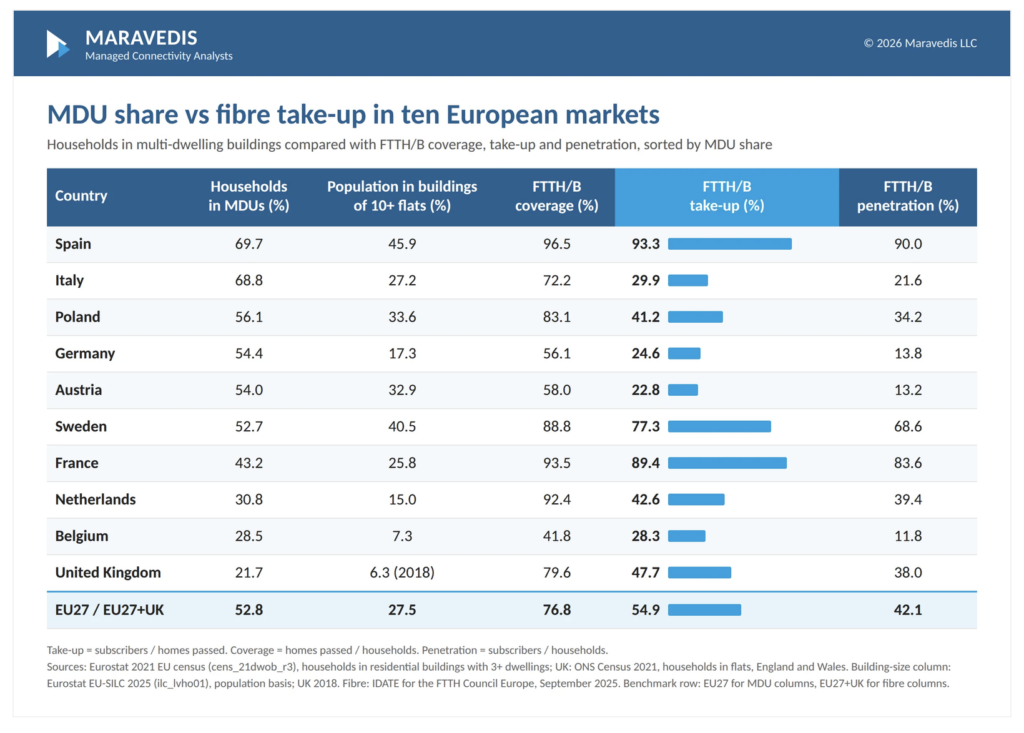
Market analysis conducted by Maravedis reveals a startlingly low correlation (0.17) between the share of households living in multi-dwelling buildings and actual fiber take-up rates. In Spain, where vertical living is the norm, fiber adoption is stellar. Conversely, in Germany and Austria—markets with high MDU concentrations—fewer than one in four households passed by fiber actually convert to a subscription.
This gap signifies that the "last mile" is no longer a distance problem; it is a structural, regulatory, and psychological hurdle located within the riser, the basement, and the living room of the resident.
Chronology of a Market Pivot
The trajectory of European fiber rollout can be divided into three distinct phases that help explain the current bottleneck:
- 2015–2020: The Era of Infrastructure Deployment. This period was defined by aggressive government targets and massive private investment to bridge the digital divide. The focus was entirely on "homes passed" metrics, with little regard for the complexities of in-building integration.
- 2021–2024: The Implementation Gap. As networks expanded into urban centers, operators encountered the reality of "brownfield" deployments. Legacy copper and cable networks, combined with aging building infrastructure, made the "last 10 meters" of cabling prohibitively expensive and legally complex to navigate.
- 2025–Present: The Monetization Mandate. The current phase is defined by a realization that building the network is insufficient. Stakeholders are now pivoting toward "take-up" strategies, focusing on fiber-ready building mandates, the professionalization of in-building wiring, and the integration of value-added services like managed Wi-Fi.
Supporting Data: The Four Clusters of European Connectivity
To understand why some markets thrive while others stall, Maravedis categorizes the European landscape into four distinct clusters based on their approach to MDU connectivity.

1. The Vertical Success Stories (Spain and Sweden)
These markets are the gold standard. Spain leads with a 93.3% take-up rate, while Sweden sits at 77.3%. Their success is rooted in institutional foresight. Spain implemented common telecom infrastructure rules years ago, mandating shared in-building wiring. Sweden utilized municipal open networks and housing companies to treat the building—rather than the individual tenant—as the unit of sale.
2. The Regulatory Pioneers (France)
France boasts an 89.4% take-up rate despite having a lower-than-average MDU share (43.2%). Their secret is a robust regulatory framework that mandates fiber-readiness in new builds and enforces symmetric, non-discriminatory access to in-building infrastructure. France proves that sound policy can override demographic disadvantages.
3. The Stalled Vertical Markets (Germany, Italy, Austria, Poland)
This cluster represents the largest untapped opportunity in Europe. In these nations, between 54% and 69% of the population live in MDUs, yet take-up remains stuck between 22.8% and 41.2%.
- Germany suffers from the "basement bottleneck," where fiber often terminates before reaching the apartment.
- Italy is hampered by a fragmented wholesale market and a legacy copper base that remains "good enough" for most consumers.
- Austria faces stiff competition from high-performance mobile broadband, which acts as a substitute for fixed-line fiber.
4. The Low-Rise, Cable-Heavy Markets (Netherlands, Belgium, UK)
These countries operate in a different paradigm. With fewer than one-third of households in MDUs, these markets are dominated by incumbent cable providers offering gigabit speeds. While the UK is showing significant momentum with a rapid jump in take-up (reaching 47.7% in the last year), the primary hurdle remains convincing customers to switch from existing, high-performing cable connections.
Official Responses and Policy Shifts
The European Commission has recognized that the "build it and they will come" model has reached its limit. The Gigabit Infrastructure Act is the most significant policy response to date. By requiring that new and majorly renovated buildings be "fiber-ready" starting in February 2026, the EU is attempting to institutionalize the infrastructure standards that enabled success in France and Spain.
Furthermore, national reforms are gaining traction. Germany’s ongoing legislative updates aim to grant operators a legal right to wire entire buildings, effectively stripping landlords of the power to block fiber deployment—a recurring issue that has slowed adoption in the German market for years.
Implications for the Future: Who Wins the Building?
The transition from "passed" to "subscribed" creates winners and losers across the value chain.
For Fiber Operators and Altnets
The immediate opportunity lies in targeting large, professionally managed portfolios. Operators must stop viewing every apartment as an individual acquisition target and start viewing buildings as bulk, long-term contracts. This reduces acquisition costs and streamlines the technical rollout.
For Property Owners and Housing Companies
The building owner has transformed into a critical gatekeeper. In an era where "connectivity as a service" is a primary selling point for real estate, fiber-ready, open-access buildings are becoming a significant value driver for institutional investors. Owners who invest in the "riser" infrastructure today will command higher rents and enjoy better tenant retention.
For Managed Service Providers (MSPs)
The true battleground is now the "in-flat experience." Once the fiber reaches the unit, the job is not done. The demand for seamless, managed Wi-Fi, smart building integration (proptech), and cybersecurity services provides a massive opening for MSPs. By layering these services on top of a fiber connection, operators can move from being "dumb pipe" providers to essential service partners.
For Equipment Vendors
The market is bifurcated. In established markets like Spain and France, the focus is on replacement and upgrading in-home Wi-Fi gear. In the "stalled" markets of Central and Southern Europe, the opportunity is in greenfield, in-building design—helping operators solve the technical complexities of retrofitting older, vertical architecture.
Conclusion: The Road to Amsterdam
As the industry looks toward the RISER Summit in Amsterdam (April 6–8, 2027), the consensus is clear: the era of the "street cabinet" is over. The next chapter of European broadband growth will be written in the basements and risers of the continent’s apartment buildings.
The gap between the 191 million homes passed and the 105 million subscribed is not merely a statistical curiosity; it is an economic opportunity worth billions of euros. To capture this value, stakeholders must move beyond the basic utility model and embrace a holistic approach to building connectivity—one that treats the MDU as a living, digital ecosystem. As the policy tide shifts and the technical hurdles are systematically addressed, the race is on to ensure that Europe’s fiber potential is finally, fully realized.