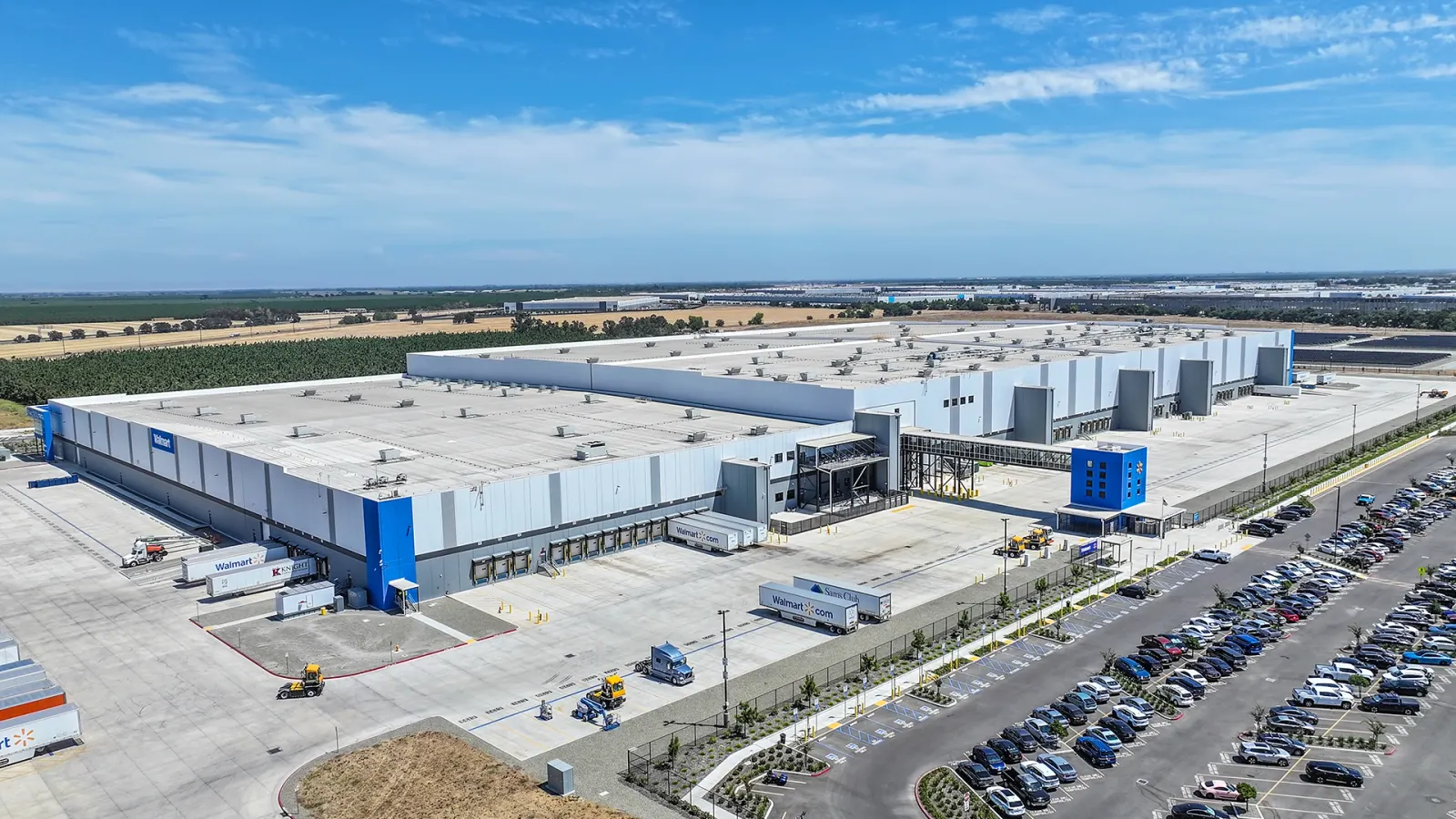
STOCKTON, Calif. — In a sweeping move designed to tighten its grip on the fiercely competitive retail and e-commerce landscape, retail titan Walmart has officially unveiled its massive, state-of-the-art "next-generation" fulfillment center in Stockton, California. Spanning over 900,000 square feet, the newly operational facility represents a pivotal milestone in the company’s multi-year strategy to revolutionize its supply chain infrastructure through advanced automation, machine learning, and cutting-edge robotics.
The Stockton site serves as Walmart’s fifth next-generation fulfillment center nationwide, a designation reserved for elite facilities engineered to dramatically scale order capacity, minimize manual labor, and slash delivery times for millions of customers across the West Coast. As consumer expectations for rapid, reliable shipping continue to accelerate—largely driven by the dominance of online retail giants—Walmart’s heavy investment in high-tech warehousing signals a definitive shift in how the world’s largest retailer plans to handle the future of merchandise distribution.
Main Facts
The new Stockton fulfillment center is a technological marvel designed to optimize every inch of its nearly one-million-square-foot footprint. At the core of the facility’s operations is an advanced high-density automated storage and retrieval system (ASRS). Unlike traditional warehouses where human workers traverse vast aisles to pick and pack items manually, Walmart’s next-gen approach brings the products directly to the associates.
By integrating machine learning and sophisticated software algorithms, the facility streamlines what was historically a grueling 12-step fulfillment process down to just five streamlined steps. This drastic reduction in manual touchpoints not only accelerates throughput—allowing the center to process a significantly higher volume of daily orders compared to legacy warehouses—but also radically transforms the daily work experience for warehouse employees by eliminating repetitive, physically taxing movements.
The Stockton site anchors Walmart’s broader operational presence on the West Coast, working in tandem with the company’s extensive network of regional distribution centers, traditional warehouses, and local brick-and-mortar stores. Together, these facilities form an interconnected web designed to ensure that goods move seamlessly from international ports and domestic manufacturers straight to the consumer’s doorstep with unprecedented speed.
Chronology of the Next-Generation Initiative
Walmart’s journey toward total supply chain automation is a calculated multi-year evolution that began in earnest during the summer of 2022. Understanding that legacy logistics frameworks could not sustainably support the explosive growth of its e-commerce business, company leadership announced a sweeping plan to introduce a new class of high-tech fulfillment centers.
- June 2022: Walmart officially pulls back the curtain on its next-generation fulfillment center initiative, announcing initial plans for facilities designed to leverage advanced automation. At the time, executives projected that the strategic placement of these high-tech hubs would ultimately extend next-day or two-day shipping services to 75% of the U.S. population.
- September 2022: The retailer opens its very first next-generation fulfillment site in Joliet, Illinois, setting a new benchmark for automated warehouse efficiency.
- Late 2022 – 2023: Walmart rapidly expands the footprint of the initiative. High-tech facilities come online in quick succession, including sites in Lancaster, Texas, and Greencastle, Pennsylvania, followed by a fourth major facility near Indianapolis, Indiana, in June 2023.
- January 2026: Continuing its aggressive push into supply chain modernization, Walmart announces a massive $330 million investment to install cutting-edge robotics and automation systems at an existing distribution center in Opelousas, Louisiana, aiming to double that facility’s throughput capacity.
- June 2026: The company outlines the final phase of a major distribution center remodel in Texas, incorporating state-of-the-art electrical infrastructure and advanced material-handling equipment.
- October 2026: Walmart officially opens its fifth next-generation fulfillment center in Stockton, California, marking a major milestone in extending next-gen logistics capabilities to the West Coast.
Supporting Data and Scale of Investment
Walmart’s transition to automated logistics is backed by staggering financial investments and expansive operational metrics. The retail giant is not merely tinkering at the edges of its supply chain; it is executing a comprehensive, enterprise-wide overhaul.
Central to this capital expenditure strategy is Walmart’s ongoing initiative to upgrade all 42 of its traditional U.S. distribution centers with advanced automation technologies. As of late 2026, more than 20 of these massive facilities are actively undergoing or have recently completed technological transformations.
The financial scale of these projects is immense. For instance, individual facility upgrades—such as the $330 million overhaul slated for the Opelousas, Louisiana distribution center—demonstrate the company’s willingness to commit hundreds of millions of dollars per site to secure long-term operational efficiencies.
When Walmart initially debuted the next-generation concept in 2022, logistics analysts noted that the combination of high-density ASRS, intelligent software routing, and automated packing systems could increase storage capacity exponentially within the exact same physical square footage as older warehouses. By turning vertical space into high-density storage zones managed entirely by autonomous bots, facilities like the one in Stockton can hold vastly broader product selections while requiring a fraction of the floor space previously needed.
Furthermore, the geographic distribution of Walmart’s five next-generation fulfillment centers—spanning Illinois, Indiana, Texas, Pennsylvania, and now California—was meticulously planned using geographic and demographic modeling. This strategic dispersion ensures that population-dense coastal and interior corridors alike fall well within the radius required to guarantee next-day or two-day delivery windows.
Official Responses and Corporate Strategy
Walmart executives have consistently framed these technological upgrades not just as efficiency plays, but as vital investments in the company’s most important assets: its customers and its workforce.

During the rollout of the initiative, corporate leadership emphasized that the integration of artificial intelligence, machine learning, and robotics is fundamentally reshaping retail employment. Rather than replacing human workers outright, Walmart’s automated systems are designed to elevate associates into higher-value, technology-enabled roles. By taking over mundane, repetitive tasks—such as walking miles across concrete floors to pull individual items from high shelves—automation drastically reduces physical strain, lowers employee turnover, and creates a safer, more sustainable work environment.
"Our next-generation fulfillment centers represent a monumental leap forward in how we serve our customers," supply chain leadership has repeatedly noted in corporate releases. "By combining the power of our store footprint with advanced robotics, machine learning, and high-density storage, we are building a supply chain that is faster, more accurate, and more resilient than ever before."
Industry analysts point out that Walmart’s aggressive automation strategy is also a direct counter-offensive against competitors like Amazon, which has long set the gold standard for e-commerce fulfillment speed. By modernizing its legacy network—infusing old-school brick-and-mortar logistics power with ultra-modern software and robotics—Walmart is successfully blurring the lines between physical retail and digital fulfillment. With thousands of brick-and-mortar stores located within ten miles of 90% of the U.S. population, Walmart can leverage its automated fulfillment centers to feed regional stores and local delivery networks with unprecedented agility.
Industry Implications and the Future of Retail Logistics
The opening of the Stockton fulfillment center carries profound implications for the broader supply chain and logistics ecosystem, signaling several macro-trends that are reshaping modern commerce:
1. The Redefinition of Warehouse Labor
The widespread adoption of high-density ASRS and collaborative robotics is permanently altering the skill sets required of warehouse workers. As manual picking and packing give way to system monitoring, maintenance, and robotic oversight, logistics employers are placing a premium on technical literacy. Walmart’s training pipelines, which frequently accompany these technological upgrades, serve as a bellwether for how legacy retail employers are adapting to the demands of Industry 4.0.
2. Real Estate Optimization
With land and construction costs soaring, traditional horizontal warehouse expansion is becoming increasingly economically unviable. Walmart’s success in utilizing vertical space through automated high-density storage proves that future logistics hubs must grow up rather than out. Other major retailers and third-party logistics (3PL) providers are closely watching the performance metrics of the Stockton and Joliet facilities to gauge the ROI of dense vertical automation.

3. Supply Chain Resilience and Agility
Global supply chain disruptions over recent years exposed the vulnerabilities of lean, highly centralized inventory models. By decentralizing its high-tech fulfillment network across strategic regional hubs—while simultaneously retrofitting dozens of traditional distribution centers with automated material-handling systems—Walmart is creating a localized, highly resilient network. If one region experiences bottlenecks, neighboring automated hubs can dynamically reroute and absorb excess volume, ensuring continuous service to consumers.
4. Environmental and Energy Efficiencies
Modernizing facilities with next-generation automation also opens pathways for improved energy management. Newer facilities frequently incorporate advanced LED lighting, optimized climate control systems for automated equipment, and energy-efficient conveyor systems. Furthermore, by packing orders more efficiently into fewer boxes and optimizing delivery routes through machine learning algorithms, Walmart significantly reduces its overall carbon footprint associated with final-mile transportation.
Looking Ahead
As Walmart continues its march toward modernizing all 42 of its U.S. distribution centers alongside its crown-jewel next-gen fulfillment hubs, the retailer is establishing a formidable competitive moat. The Stockton facility is not merely an isolated warehouse opening; it is a preview of the fully digitized, autonomous supply chain of tomorrow. For consumers, it means faster arrivals and wider product availability; for the retail industry, it serves as proof that the future belongs to those willing to aggressively automate, adapt, and scale.