By Rob Marshick, National Sales Manager – Americas
In the modern industrial landscape, the mandate for manufacturing is clear: do more, do it faster, and do it with flawless precision. As production facilities worldwide pivot toward Industry 4.0, the integration of robotics, high-speed automation, and advanced electrification has transformed the factory floor. While these technological leaps have unlocked unprecedented levels of throughput, they have simultaneously birthed a silent, pervasive challenge that threatens to undermine long-term ROI: the management of dynamic shock and vibration.
Today, energy absorption and vibration isolation are no longer optional "supporting components" relegated to the final stages of machine design. They are the bedrock of reliable, high-speed performance. As companies push their equipment to run around the clock with minimal maintenance, the engineering community must rethink how it manages the kinetic energy inherent in every acceleration and deceleration cycle.
The New Reality: Kinetic Energy as a Constraint
Main Facts and the Shift in Operational Demands
Modern manufacturing is defined by speed. Whether it is a pick-and-place robot sorting thousands of items per hour or an automated storage and retrieval system (AS/RS) moving heavy payloads across a warehouse, every movement generates kinetic energy. This energy must go somewhere. If it is not effectively absorbed or dissipated, it is transferred directly into the machine’s structural frame, fasteners, and sensitive electronics.
This creates a paradox: manufacturers invest heavily in faster motors and lighter, more dynamic actuators, but the resulting "impact penalty" often leads to structural fatigue, premature component failure, and increased downtime. In an environment where every second of unscheduled downtime translates to thousands of dollars in lost revenue, the ability to control this kinetic energy is the difference between a competitive edge and a maintenance nightmare.
Chronology of Motion Control Evolution
From Passive Dampening to Active Engineering
To understand the current state of motion control, one must look at how the industry has evolved over the past several decades:
- The Early Industrial Era: Motion control was largely mechanical. Heavy, over-engineered steel frames were used to absorb shock, relying on mass rather than smart engineering to stabilize equipment.
- The Automation Boom (1990s–2000s): As PLC-controlled systems and servo-driven actuators became the standard, the focus shifted to speed. Manufacturers realized that rigid mechanical stops caused catastrophic failure in high-cycle environments, leading to the early adoption of basic hydraulic shocks.
- The Precision Era (2010s–2020s): The proliferation of machine vision, laser sensors, and ultra-precise assembly tools changed the requirements. It was no longer enough to just "stop" a load; the stop had to be vibration-free to prevent measurement errors.
- The Industry 4.0 Era (Present): Today, we are seeing the rise of "smart" integration. Energy absorption is now synchronized with software-driven motion profiles, allowing for predictive maintenance and digital twins that simulate stress loads before a single bolt is tightened on the shop floor.
Supporting Data: The Hidden Costs of Unmanaged Vibration
The implications of neglecting vibration in high-speed manufacturing are not merely theoretical; they are quantifiable.

The Cost of Neglect
Industry studies suggest that nearly 30% of unplanned maintenance events in automated facilities are linked to mechanical fatigue caused by unmanaged shock and vibration.
- Structural Fatigue: Repeated cycles of high-impact deceleration create micro-fractures in metallic frames, leading to cumulative structural failure that is often invisible until it is too late.
- Precision Degradation: In industries such as medical device manufacturing or semiconductor assembly, a vibration deviation of even a few microns can render an entire production batch non-compliant.
- Total Cost of Ownership (TCO): When shocks are not properly mitigated, the duty cycle of actuators and bearings is effectively halved. The cost of replacing these high-value components, combined with the labor costs of installation and the loss of production capacity, creates an unsustainable TCO loop.
Enidine’s experience in the field confirms that by implementing high-performance hydraulic shock absorbers, manufacturers can extend the mean time between failures (MTBF) by as much as 40–60% in high-duty-cycle applications.
Official Perspective: The Enidine Approach
Engineering Solutions for a Demanding World
At Enidine, the philosophy is simple: motion control should facilitate performance, not restrict it. We provide the tools that allow engineers to push their equipment to the physical limit without fearing structural degradation.
"Our mission is to provide the critical interface between high-speed automation and physical longevity," says the Enidine engineering team. "We don’t just supply parts; we provide the damping characteristics that ensure a machine’s motion profile is smooth, consistent, and repeatable over millions of cycles."
Our portfolio is categorized to meet the diverse needs of modern industry:
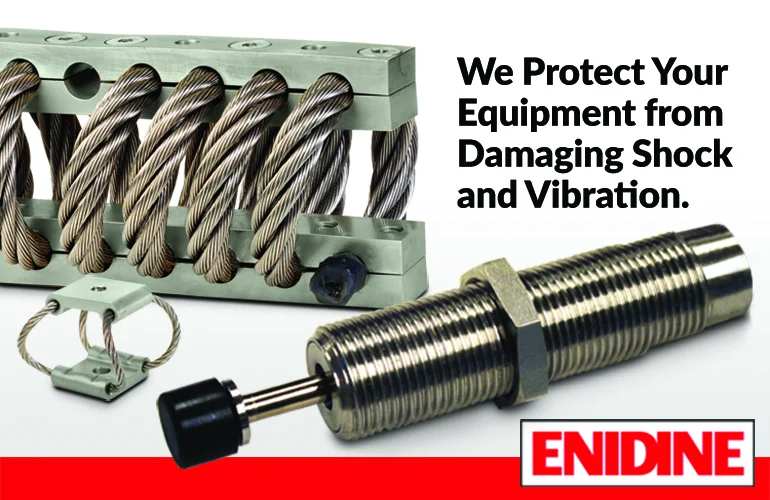
- PXR Series (Platinum Extended Range): Designed for the rigors of modern conveyor systems. These are corrosion-resistant, high-cycle components built to handle the heat and physical stress of 24/7 automated sortation.
- CRS Series (Corrosion Resistant): Specifically engineered for washdown environments in food and beverage or pharmaceutical manufacturing, where stainless steel construction is non-negotiable for hygiene and durability.
- HD/HDN Series (Heavy Duty): When dealing with the massive kinetic energy of overhead bridge cranes or large-scale AS/RS units, these shock absorbers act as the final line of defense, protecting both personnel and the multi-million-dollar infrastructure.
For vibration isolation, our Wire Rope Isolators utilize all-metal, corrosion-resistant construction to provide damping for loads up to 100,000 pounds. Unlike rubber mounts, which degrade over time when exposed to oils or extreme temperatures, our wire rope solutions maintain their mechanical properties for the life of the machine.
Implications for the Future of Manufacturing
Designing for Reliability
As we look toward the future, the integration of AI-driven analytics and edge computing will place even higher demands on mechanical systems. Equipment will be expected to operate at higher "jerk" rates—the rate of change of acceleration—which will inherently increase the demand for sophisticated energy absorption.

The implications for engineers are twofold:
- Early-Stage Involvement: Energy absorption must be a primary design consideration, not a retrofit. By using tools like Enidine’s Enisize® software, engineers can calculate the exact damping requirements during the CAD phase, ensuring the machine is optimized before it is ever built.
- Sustainability and Efficiency: Effective energy absorption isn’t just about protecting hardware; it is about energy efficiency. Machines that move fluidly, without the wasted energy of jarring impacts, consume less power and operate with higher overall equipment effectiveness (OEE).
Closing Thoughts
The transition toward more autonomous, faster, and more precise manufacturing is inevitable. As we continue to integrate smarter equipment, the "physics" of the shop floor remains constant: force must be managed.
By prioritizing advanced energy absorption and vibration isolation, OEMs and manufacturers can do more than just survive the demands of modern production—they can thrive. The next generation of industrial machinery will not be defined solely by its speed, but by its reliability, its precision, and its ability to harness kinetic energy to achieve superior performance.
At Enidine, we are committed to providing the solutions that make this future possible, ensuring that as your production lines accelerate, your equipment remains steady, efficient, and built to last.
For more information on optimizing your motion control systems, or to explore our full range of hydraulic shock absorbers and vibration isolation solutions, please visit our online inquiry portal.
Sponsored content by ITT Enidine