CHATTANOOGA, Tenn. — The journey of artificial intelligence in the logistics and transportation sector has long been defined by high ambitions, expensive pilot projects, and a persistent struggle to prove tangible return on investment (ROI). For years, logistics providers and fleet operators have been pitched transformative software capabilities, only to find that translating general-purpose technology into practical tools for the back office or the truck cab is an uphill battle.
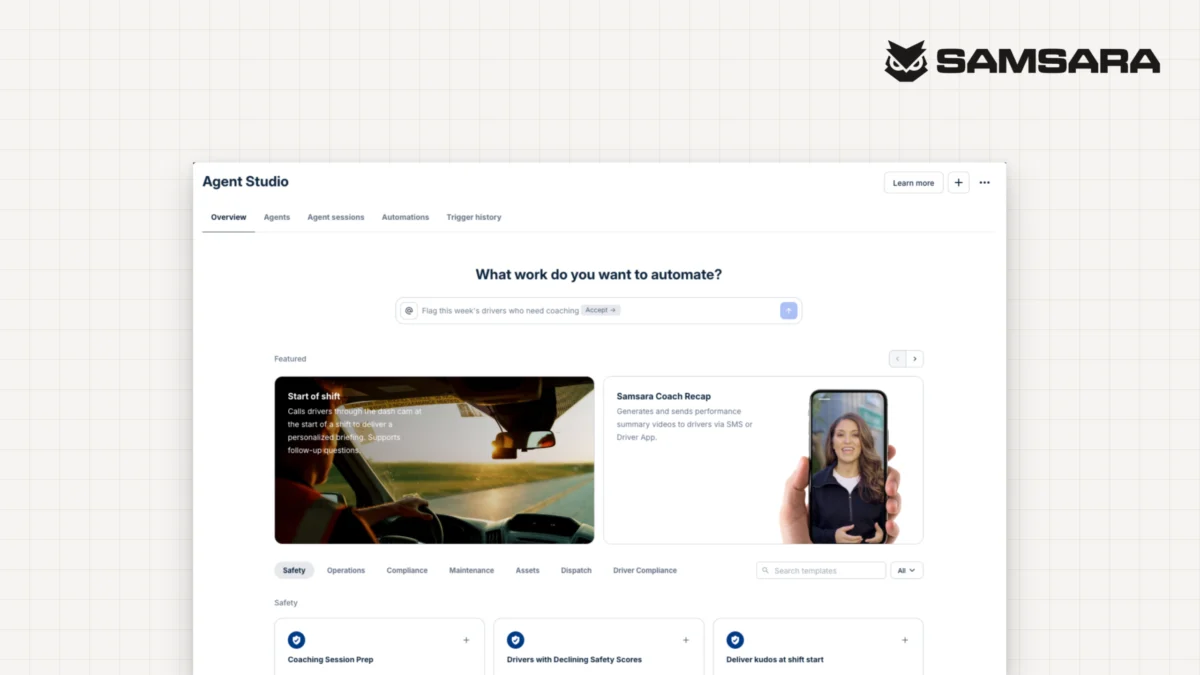
Samsara, a prominent connected operations cloud provider, is looking to change that narrative. The company has officially announced the general availability of Agent Studio, opening its no-code AI agent builder to all customers and embedding custom automation deep into the operational workflows of fleets, shippers, and industrial operators.
While the general availability rollout marks a significant milestone for Samsara, it also arrives at a critical juncture for the freight industry. As logistics companies increasingly demand concrete proof of financial returns from emerging tech, Samsara’s latest metrics point to rapid adoption—even as industry analysts urge caution regarding long-term, scalable financial impact.
Main Facts: What is Agent Studio?
At its core, Agent Studio is a no-code development platform integrated directly into existing Samsara subscriptions. First introduced in a limited rollout in June, the platform empowers organizations to build custom artificial intelligence agents powered by their own proprietary operational data.
These AI agents are designed to execute specialized, repetitive tasks that traditionally consume valuable administrative and management hours. Key capabilities of Agent Studio include:
- Automated Reporting: Compiling complex multi-division forms, asset tracking metrics, and inspection data into streamlined summaries.
- Compliance Monitoring: Flagging potential hours-of-service (HOS) violations and tracking driver activity to prevent regulatory infractions before they occur.
- Driver Communication & Support: Answering driver inquiries in real time based strictly on internal company policies and operational procedures.
- In-Cab Voice Interaction: Deploying hands-free voice agents via dash cameras to deliver contextual instructions directly to drivers on the road.
According to Samsara, more than 1,000 organizations are already utilizing its AI agents on a weekly basis. The platform functions alongside other components of Samsara’s AI ecosystem, including Samsara Assistant (for dashboard-level natural language queries) and Samsara MCP (which connects authorized operational data to external large language models like ChatGPT, Claude, and Microsoft Copilot).
Chronology: The Evolution of Samsara’s AI Push
Understanding the trajectory of Samsara’s AI strategy requires looking back at how the company has rolled out and accelerated its automation tools over the past several months:
- June: Samsara officially unveils Agent Studio, offering early-access tools for customers to experiment with custom AI workflows and automation.
- Mid-2026: Voice agents are introduced to the platform. Remarkably, within just four weeks of launch, voice interactions outpace traditional chat volumes—a trend that has persisted every single week since.
- Late Summer / Early Fall 2026: Interaction velocity explodes. Samsara notes that its AI-agent interactions are recording approximately seven times faster than when the tools first launched. While the initial 500,000 interactions took 112 days to accumulate, the most recent milestone of 500,000 interactions is reached in a mere 16 days.
- October: Samsara makes Agent Studio generally available to its entire global customer base as part of their standard software subscriptions, eliminating barriers to entry for fleets of all sizes.
Supporting Data: Adoption Rates, Usage Metrics, and Early Results
Samsara measures AI adoption primarily through “interactions,” defined as a complete agent session conducted either via chat or voice. The dramatic acceleration in interaction velocity signals that once organizations configure these agents, employees and drivers actively rely on them. Notably, agent-initiated outbound phone calls configured by operations teams make up the bulk of voice interactions to date.
To demonstrate the practical value of these tools, Samsara highlighted several early customer success stories:
- Grand Isle Shipyard: By deploying an agent to compile various forms, inspection reports, and asset data into comprehensive monthly reports, the company reduced report-generation time by 99%. The process now takes roughly five minutes per division, freeing up an estimated $100,000 in annual specialist capacity.
- S. Bertram Foods: Utilizing an agent to continuously monitor remaining stops, driving time, and shift time, the company can now flag potential hours-of-service violations three hours in advance. This predictive monitoring reduced weekly manual review time by 84%.
- StreamTech Industrial: This industrial operator deployed an agent to pinpoint trips where drivers failed to log into their vehicles. Over a two-month period, the system successfully slashed unassigned driving by 500 hours.
The Broader Industry Landscape
Samsara’s internal success stories paint an optimistic picture, but they sit against a backdrop of broader caution across the logistics and supply chain technology sectors. Two major industry surveys conducted in 2026 illustrate the uphill battle tech providers face when convincing logistics executives to scale AI:
- Boston Consulting Group (March 2026 Survey): Polling more than 180 logistics providers and shippers, BCG found that while roughly 40% of logistics service providers had deployed AI beyond initial pilot programs, only about 10% had managed to scale it across core operations. Furthermore, a mere 13% reported measurable business value from their AI initiatives. Unclear ROI and a shortage of internal capabilities were cited as the primary roadblocks.
- Descartes (September 2026 Survey): A separate study revealed that just 19% of shippers and 15% of logistics service providers were utilizing AI at scale.
These findings suggest that while transportation and logistics companies are eager to test emerging technologies, bridging the gap between localized pilot programs and enterprise-wide deployment remains a significant hurdle.
Voice Agents Bring AI Directly into the Truck Cab
One of the most distinct technical and operational features of Samsara’s ecosystem is its emphasis on in-cab voice agents. Rather than forcing drivers to look at screens or pull over to read text messages, Samsara’s voice agents deploy directly through vehicle dash cams, operating entirely hands-free.
This design choice is crucial from a regulatory standpoint. Under Federal Motor Carrier Safety Administration (FMCSA) guidelines, commercial motor vehicle drivers are strictly prohibited from holding a mobile phone or dialing manually while driving. However, hands-free voice communication triggered automatically via geofencing or specific operational events complies with federal regulations.
When a truck arrives at an unfamiliar facility, for example, Samsara’s voice agent can automatically place a call to the driver. The agent can provide crucial site-specific instructions—such as designated loading dock entrances, parking availability, yard speed limits, and required personal protective equipment (PPE). Drivers can also ask verbal follow-up questions, while logistics managers can utilize the resulting operational data log to audit facility dwell times and investigate bottlenecks.
Official Responses and Perspectives
Samsara’s leadership emphasizes that the key to overcoming enterprise hesitation is building tools that seamlessly integrate into the daily realities of blue-collar, physical operations.
"AI is quickly adopted when it’s useful, and in physical operations that means an agent has to understand the operation and meet people where the work happens," said Johan Land, Samsara’s chief product officer.
By designing Agent Studio to operate on top of real-time telemetry, location data, and compliance logs, Samsara aims to eliminate the friction that typically plagues enterprise software adoption. Instead of requiring developers or data scientists to write complex scripts, operations managers can build custom workflows using plain-language instructions.
However, industry observers note that while Samsara has provided compelling anecdotal evidence, the company has not publicly disclosed the exact methodologies behind all customer-reported financial metrics (such as Grand Isle Shipyard’s $100,000 capacity savings) nor the exact breakdown of how many distinct organizations are actively running custom agents in production versus utilizing pre-built templates.
Implications for the Freight and Logistics Industry
The general availability of Samsara’s Agent Studio raises important considerations for fleet managers, logistics providers, and technology investors alike:
1. The Shift from Passive Dashboards to Active Automation
For years, telematics platforms functioned primarily as passive windows into fleet activity—displaying maps, speed alerts, and HOS countdowns on a screen that managers had to actively monitor. AI agents represent a fundamental shift toward proactive management. By having software flag HOS violations three hours ahead of time or automatically compile compliance paperwork, operations teams transition from reactive firefighters to strategic planners.
2. Overcoming the "Pilot Purgatory"
The logistics tech sector has long suffered from "pilot purgatory"—a phenomenon where companies test innovative software tools for months without ever rolling them out broadly. By bundling Agent Studio directly into existing software subscriptions rather than charging an opaque, enterprise-tier add-on fee, Samsara is lowering the financial barrier that often stalls AI deployment.
3. The Demand for Verifiable Financial Return
As logistics providers face tighter margin pressures, technology budgets are under intense scrutiny. Tools that save "hours of manual review" are compelling, but chief financial officers ultimately demand proof of sustained bottom-line impact. Moving forward, the success of platforms like Agent Studio will not be measured merely by how many millions of interactions occur, but by whether fleets can permanently trim operational overhead, reduce insurance liabilities, and driver turnover.
Conclusion
Samsara’s move to make Agent Studio generally available signals that conversational and generative AI is rapidly moving past the novelty phase in commercial transportation. With voice agents navigating the complex regulatory environment of the truck cab and no-code tools automating administrative drudgery, the technology is undeniably finding practical footholds.
Yet, as the broader logistics industry continues to grapple with unclear ROI and integration hurdles, the true test for Samsara—and its customers—will be whether these conversational agents can graduate from impressive productivity hacks into permanent, enterprise-grade pillars of modern freight management.