Modern agriculture stands on a paradox: it has achieved unprecedented yields by relying on a chemical process that is energy-intensive, volatile, and environmentally taxing. Synthetic nitrogen fertilizer—produced at massive industrial scales from ammonia, urea, and nitrates—fuels global food production because crops require massive amounts of nitrogen to build chlorophyll, proteins, and structural mass. Yet, most major crops cannot directly harness the atmospheric nitrogen gas that envelops the planet.
This reliance ties global food security directly to natural gas prices and industrial energy expenditures. Furthermore, when excess nitrogen escapes into waterways and the atmosphere, it creates severe environmental externalities. For years, ag-tech innovators have attempted to untangle this knot through biology and advanced agronomy. However, as recent market analysis shows, reducing farming’s multi-billion-dollar nitrogen bill is not a matter of dropping in a single "miracle" biological product. Instead, the future of crop nutrition resembles an integrated technology stack where multiple interventions must be carefully managed, tested, and balanced.
Main Facts: The Anatomy of Modern Agricultural Nitrogen
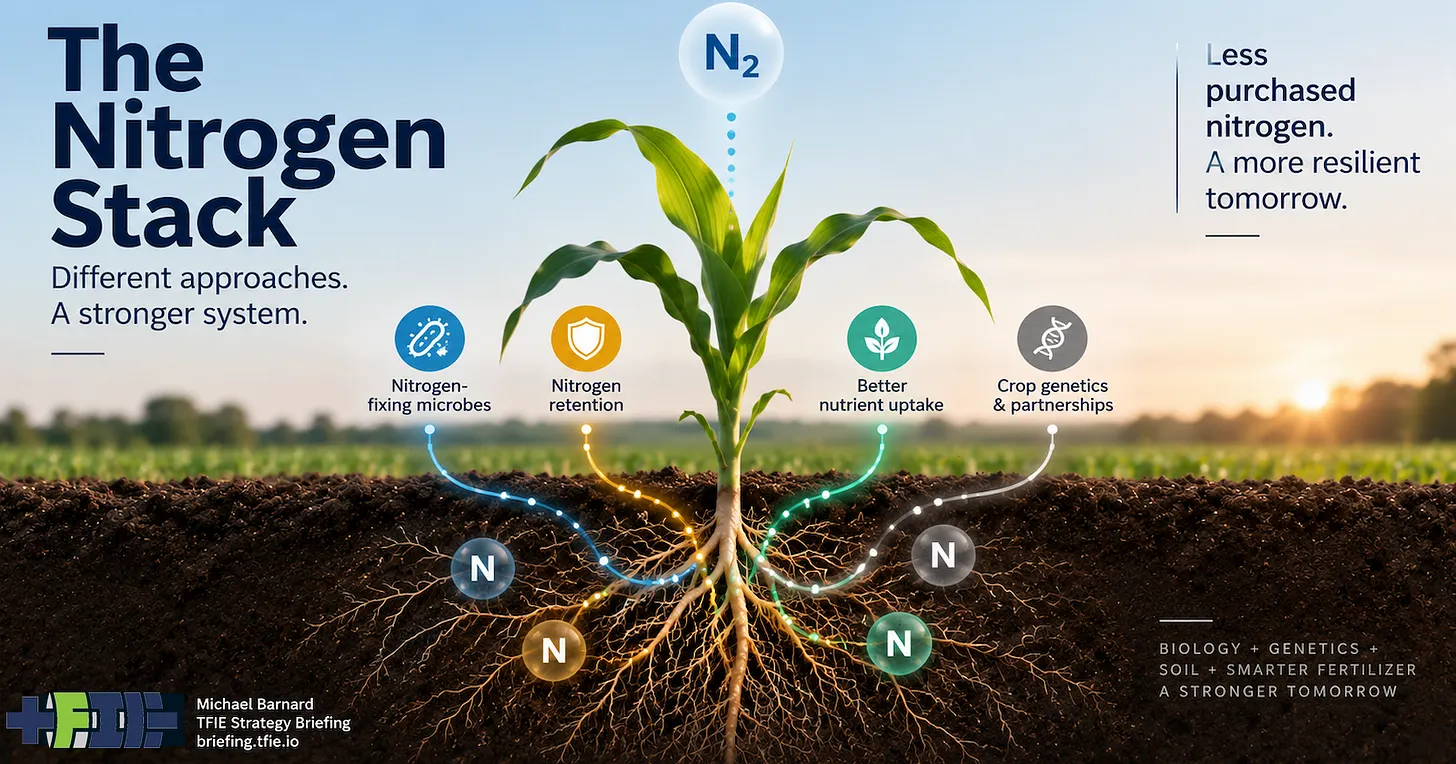
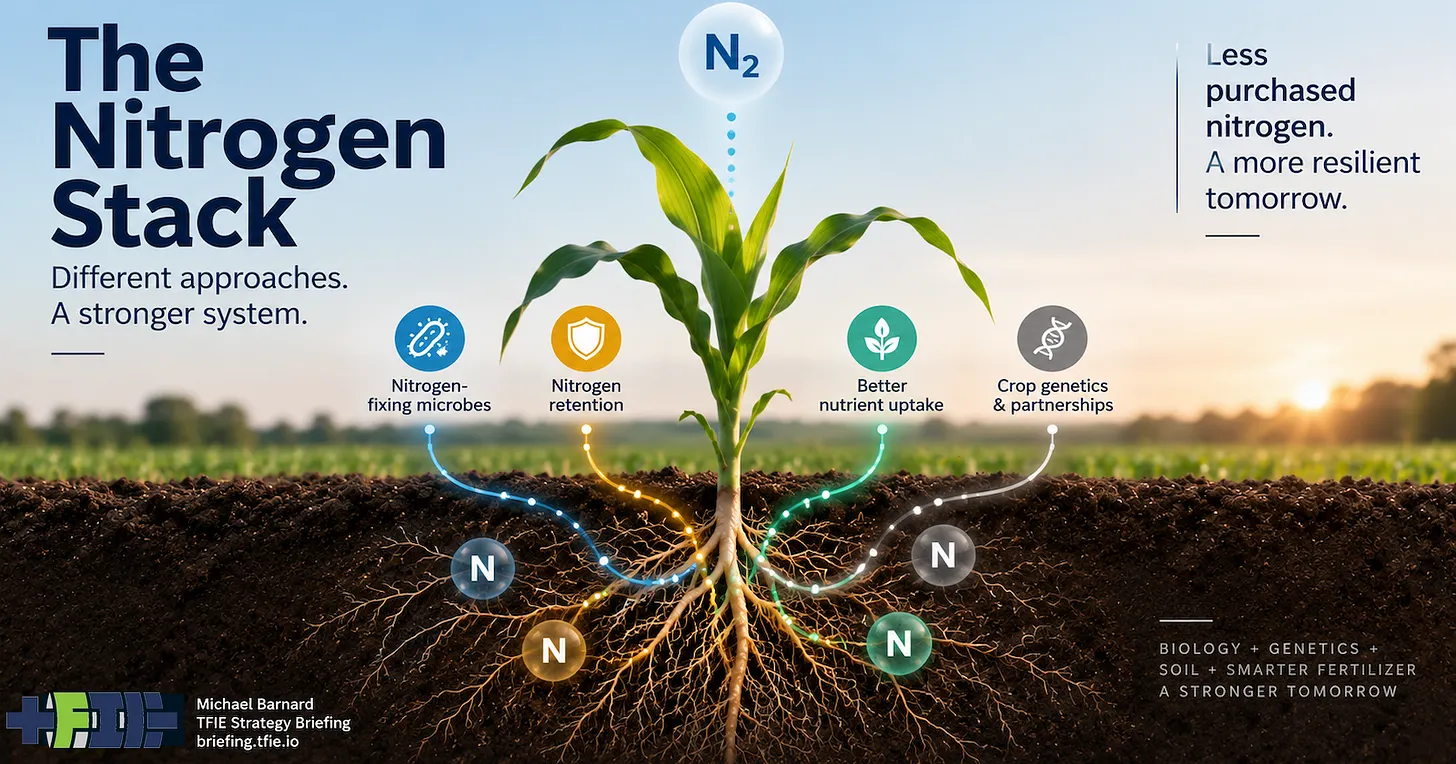
At the heart of the agricultural transition is a shifting suite of products designed to cut down synthetic fertilizer dependence. These innovations approach the problem from fundamentally different biological and chemical angles:
- Biological Nitrogen Fixation (BNF): Pioneered by companies like PivotBio (whose co-founder, Karsten Temme, has long discussed the microbe-driven reduction of agricultural greenhouse gases), these innovations introduce specialized microbes into the root zone. These microorganisms convert inert atmospheric nitrogen into bio-available forms that plants can readily absorb.
- Nitrification and Retention Inhibitors: Operating downstream, these chemical or biological agents slow down the natural soil processes that convert fertilizer into volatile forms prone to leaching into groundwater or escaping into the atmosphere.
- Root-Growth & Nutrient-Efficiency Treatments: These products stimulate root architecture and physiological functions, helping crops scavenge and recover nutrients—including legacy nitrogen—that are already present in the soil profile.
- Advanced Crop Genetics: Plant breeders are engineering crop varieties designed to interact more productively with beneficial soil microbiomes and optimize internal nutrient usage.
While each of these technologies generates marketing claims centered around reduced fertilizer inputs, they operate via entirely distinct mechanisms. Crucially, when applied to the same field, their benefits do not automatically add together.
Chronology: The Evolution of Biological Alternatives
Early 2000s to 2010s: The Hunt for the Biological Substitute
The early wave of agricultural biologicals focused heavily on single-strain inoculants and basic seed treatments. Companies promised dramatic reductions in synthetic fertilizer use, pointing to lab-scale nitrogen fixation or root stimulation. However, independent field trials often yielded inconsistent results, leaving farmers skeptical as yields occasionally failed to match the marketing hype.
The Mid-2010s to 2020s: Rise of the Microbiome and Molecular Ag
As genetic sequencing and biotechnology advanced, startups like PivotBio shifted the paradigm from general soil inoculants to targeted, genetically tuned microbes capable of functioning reliably in commercial farming conditions. Investors poured billions into the ag-tech space, banking on the premise that biologicals could directly displace synthetic ammonia and urea.
The Present Day: Transitioning to a "Tech Stack" Reality
Recent strategic analyses—such as assessments of the emerging nitrogen technology stack—highlight a necessary pivot in industry thinking. Rather than viewing products as isolated miracle cures, researchers, investors, and corporate strategists are beginning to evaluate nitrogen technologies as interacting layers within a complex, living crop system.
Supporting Data: Why "Stacking" Math Fails Without Field Trials
The core challenge facing modern agronomy is that biological and chemical interventions frequently interact, overlap, or outright compete when introduced into the same acre of soil.
Consider a hypothetical farming scenario involving three distinct commercial products:
- Product A is advertised to replace 30 pounds of nitrogen per acre via biological fixation.
- Product B claims to retain 20 pounds of nitrogen per acre that would otherwise be lost to the environment.
- Product C claims another 20 pounds of recovery through enhanced root efficiency.
If a farmer simply adds these marketing claims together, they might expect a reduction of 70 pounds of synthetic nitrogen per acre. Yet, agronomic reality is rarely so mathematically linear.

[Synthetic Fertilizer Baseline]
       │
       ├──> Product A (Nitrogen Fixation) ──┐
       ├──> Product B (Retention Agent)   ──┼──> Overlapping/Competing Effects?
       └──> Product C (Root Efficiency)   ──┘
       │
       ▼
[Empirical Field Response Curve Validation Required]
The Physics and Biology of Overlap
- Recycled vs. New Nitrogen: Some of the nitrogen preserved by a retention product (Product B) may be the exact same nitrogen that an improved root system (Product C) subsequently captures. The net gain is smaller than the sum of the individual claims.
- Suppression Pathways: High levels of readily available nitrogen in the soil can alter or outright suppress natural nitrogen-fixation responses in microbes.
- Microbial Competition: When multiple microbial products are applied together, they may compete for physical root surfaces, pore space, or plant-derived carbon exudates, neutralizing each other’s efficacy.
- Baseline Fertilizer Rates: Many trials fail to account for whether the farmer’s starting fertilizer program was already above the economic optimum—meaning some "reductions" could have been achieved simply by scaling back fertilizer without using any biological product at all.
To bypass faulty arithmetic, agricultural researchers rely on traditional yet rigorous testing methods. By running crop trials across a spectrum of fertilizer rates—starting from deficient levels up to the point of diminishing economic returns—agronomists can map a true fertilizer-response curve. Testing treatments individually and in combination across these gradients reveals whether products are genuinely additive, independent, overlapping, or antagonistic.
Official Responses and Industry Perspectives
The commercial landscape is divided by differing incentives and strategic priorities across the agricultural sector:
- Input Startups and Pure-Play Biological Companies: Focused heavily on valuation and market disruption, early-stage startups often emphasize single-metric proofs of concept—such as proving that a microbe can successfully colonize a plant root or trace atmospheric nitrogen via isotope testing. However, industry veterans emphasize that proving colonization is a far cry from proving safe synthetic fertilizer reduction without risking yield or crop quality.
- Large Agribusiness Giants: Major multinational players leverage their massive footprint across seeds, crop protection, biologicals, and agronomic distribution networks. Their perspective leans toward integrated portfolio management, ensuring that biologicals complement existing chemical and seed technologies rather than cannibalize them unpredictably.
- Digital Agronomy and Data Platforms: A growing chorus of agronomists argues that the ultimate winners will not be the companies with the flashiest single-product claims, but those capable of accumulating dense, multi-year field data. These platforms aim to dictate precisely which combinations of products belong in which specific soil types, weather zones, and crop varieties.
Implications: The Future of Farm Economics and Environmental Policy
The commercial winners of the next agricultural era will likely be determined by factors far less glamorous than raw nitrogen-replacement claims. Traits such as shelf-life stability, manufacturing consistency, compatibility with existing seed treatments, and, above all, field repeatability across erratic weather patterns will dictate whether farmers and ag advisors embrace a product. A treatment that yields a modest, highly dependable 10% to 15% reduction in nitrogen fertilizer across millions of acres is far more valuable to a grower than a volatile product boasting a 40% reduction that only materializes under ideal laboratory conditions.
What This Means for Growers and Investors
- Systemic Integration: Nitrogen management must be viewed as an interconnected stack—combining plant genetics, microbial inoculants, retention agents, variable-rate sensing, and precision synthetic fertilizer application.
- Pragmatic Reduction Over Elimination: Farmers do not need a biological silver bullet that entirely eradicates synthetic fertilizer for a technology to be economically and environmentally transformative. Even modest, reliable reductions cut input costs and drastically lower greenhouse gas emissions.
- Defensible Economics: For corporate strategists and investors, the most robust companies will be those that build transparent, empirically verified portfolios capable of lowering a grower’s nitrogen bill without introducing unacceptable yield and financial risk.
Ultimately, the story of agricultural nitrogen is shifting away from sensationalist marketing and toward rigorous, systems-level agronomy. By acknowledging the complex biological interplay beneath the soil, the agricultural industry can build a more resilient, cost-effective, and environmentally sustainable future—one well-managed acre at a time.