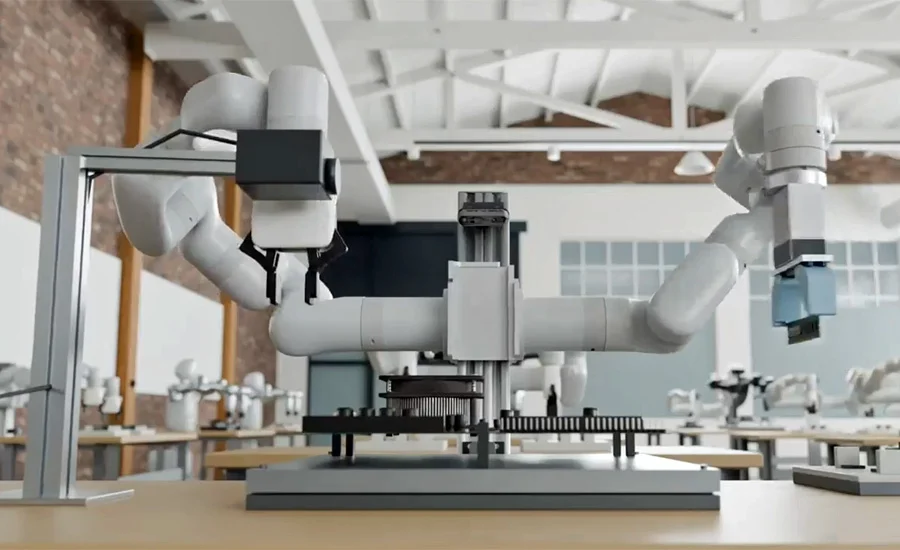
SAN FRANCISCO — In a milestone development for the intersection of artificial intelligence and advanced manufacturing, AI and robotics startup Industry Next has officially unveiled a first-of-its-kind research and validation facility at its headquarters. Dubbed the Real2Sim2Real (R2S2R) Arena, the expansive 10,000-square-foot testing ground is designed to tackle one of the most persistent bottlenecks in modern robotics: translating virtual simulation training into reliable, real-world physical deployment.
The launch comes at a time when industrial automation is undergoing a seismic shift. While generative AI and large language models have transformed digital spaces, the physical embodiment of AI—often referred to as "Physical AI"—has struggled with the "reality gap." Impressive laboratory demonstrations frequently collapse when exposed to the chaotic, unpredictable variables of factory floors. Industry Next’s new facility aims to change that paradigm by establishing a continuous closed-loop ecosystem that unites simulation, robot learning, and real-world execution.
Main Facts: Inside the R2S2R Arena
At the core of Industry Next’s latest initiative is a massive infrastructure investment aimed at standardizing how physical AI models are created, tested, and validated. The R2S2R Arena houses a diverse fleet of more than 50 robotic systems, ranging from mobile bimanual units to stationary industrial setups equipped with highly dexterous hands designed specifically for intricate manipulation research.
The facility operates on a continuous feedback loop divided into three primary stages:
- Real-to-Sim: Every task performed by a physical robot within the arena is captured, digitized, and recreated within high-fidelity simulation environments.
- Simulation-at-Scale: These digital twins are used to massively scale up the training and validation of physical AI algorithms, running millions of iterations in virtual space that would take decades to complete in the physical world.
- Sim-to-Real: The resulting decision-making frameworks—known in robotics as "policies"—are deployed back onto physical robots in the arena to prove their efficacy under real-world physical laws.
In the context of physical AI, a "policy" functions as the cognitive core of the robotic system. Formally defined as a mathematical function, a policy takes in complex sensory observations (such as high-resolution camera feeds, depth data, and the robot’s current joint states) and instantly outputs precise physical commands, such as trajectory adjustments or gripper forces.
Furthermore, the facility acts as the physical backbone for Sim2World, an open benchmarking platform designed to unite academic labs, innovative startups, and enterprise manufacturing teams. Through Sim2World, external collaborators can contribute novel tasks, train AI policies remotely, and validate their performance on physical hardware.
Chronology: The Evolution of Physical AI and Industry Next
To understand the significance of the R2S2R Arena, it is helpful to trace the technological trajectory that led to its creation:
- The Era of Rigid Automation (Pre-2020): For decades, industrial robots were marvels of precision, but slaves to rigidity. Every movement had to be meticulously hand-coded via complex teach pendants or specialized programming languages. Reprogramming a production line to handle a new part often required weeks of downtime.
- The Rise of Machine Learning (2020–2023): As computer vision and deep learning advanced, robots began to perceive their environments better. However, training them required gathering massive amounts of real-world physical data, which was slow, expensive, and prone to hardware wear-and-tear.
- The Simulation Boom (2023–2025): Developers increasingly turned to physics engines and synthetic data generation. While simulation allowed models to train exponentially faster, the "reality gap" meant that policies trained entirely in virtual worlds often failed when faced with real-world lighting, friction, and sensor noise.
- The Launch of Industry Next’s R2S2R Arena (Present): Recognizing that neither pure simulation nor pure real-world training was sufficient, Industry Next integrated both approaches into a unified physical-digital facility in San Francisco, introducing a collaborative ecosystem for the global robotics community.
Supporting Data and Technological Architecture
The economic and operational implications of bridging the simulation-to-reality gap are immense. Traditional manufacturing lines are built for mass production of a single item; adapting them to shifting consumer demands or complex product variations incurs massive capital expenditure and lost productivity.
Industry Next is addressing this by building AI-driven, self-contained robotic production stations powered by proprietary foundation models. These models seamlessly connect three vital pillars of robotics:
- Vision: Interpreting unstructured visual data in real time.
- Task Context: Understanding the overarching goal of an assembly process rather than just executing blind mechanical loops.
- Motion: Translating goals into fluid, human-like physical dexterity.
According to the company’s engineering roadmap, this technology is engineered to enable a modern manufacturing production line to be completely retooled and reprogrammed in a matter of minutes rather than weeks. By eliminating traditional, manual programming, the system opens the door to automating delicate, high-variability tasks that have historically required human hands—such as delicate cable routing, flexible material handling, and intricate small-parts assembly.
The platform’s capability is already being put to the test through high-profile enterprise validation. Industry Next has entered into a strategic partnership with the BMW Group to evaluate AI-powered dexterous manipulation for automotive manufacturing applications.
Official Responses and Industry Perspectives
The launch of the R2S2R Arena has drawn attention from across the technology and manufacturing sectors, emphasizing the necessity of collaborative approaches in solving complex AI challenges.
"We believe simulation is the most data-efficient path to solving physical AI, yet bridging it to the real world remains an open challenge," stated Lukas Pankao, co-founder and CEO of Industry Next.
Pankao emphasized that while the tech industry frequently witnesses stunning simulated or controlled-environment robot demos, these achievements often collapse upon deployment in messy, real-world environments.
"Impressive demos often fail at deployment, and closing that gap requires open collaboration across startups, industry, and academia," Pankao added, positioning the Sim2World benchmarking platform as an open invitation to the global engineering community to pool their insights and accelerate safe, reliable deployment.
Industry analysts note that facilities like the R2S2R Arena represent a maturing of the AI sector. The initial hype cycle surrounding generative text and image models is steadily giving way to an era of tangible industrial utility—where the ultimate test of an AI model is its ability to manipulate the physical world with safety, speed, and reliability.
Implications for the Future of Manufacturing and Labor
The implications of Industry Next’s technological suite extend far beyond the walls of its San Francisco headquarters. As physical AI matures, several key transformations are expected to ripple through global supply chains:
1. The Death of the Fixed Production Line
For over a century, Henry Ford’s assembly line model dictated that efficiency came from repetition. Robots were deployed to repeat the exact same motion millions of times. With foundation models capable of generalizing task context and vision, robots can now handle high-mix, low-volume manufacturing economically. A factory can pivot from assembling one electronic device to an entirely different product category with minimal physical retooling.
2. Redefining Human Labor and Ergonomics
Manufacturing sectors globally face persistent labor shortages and an aging workforce. By taking over delicate, repetitive, and ergonomically hazardous tasks—such as working in cramped vehicle interiors or handling abrasive materials—AI-driven robotics can protect human workers while elevating them into supervisory, programming, and maintenance roles.
3. Democratizing Advanced Robotics via Open Benchmarking
Through initiatives like Sim2World, smaller enterprises and academic institutions that lack the capital to maintain massive physical robot fleets can still train, test, and benchmark their policies against industrial-grade hardware. This democratization could spark an explosion of specialized robotic software applications tailored to niche manufacturing sectors.
4. Accelerating the Time-to-Market
By utilizing the Real2Sim2Real closed-loop architecture, development cycles that traditionally spanned years can be compressed into months. Validating robot behaviors in simulation before letting them loose in the physical arena drastically reduces hardware breakage, safety incidents, and engineering overhead.
Conclusion
As the boundaries between digital intelligence and physical execution continue to blur, facilities like Industry Next’s R2S2R Arena offer a glimpse into the next industrial revolution. By tackling the reality gap head-on through massive scale, open collaboration, and advanced foundation models, the startup is helping to transform autonomous manufacturing from a futuristic aspiration into an accessible, scalable reality.