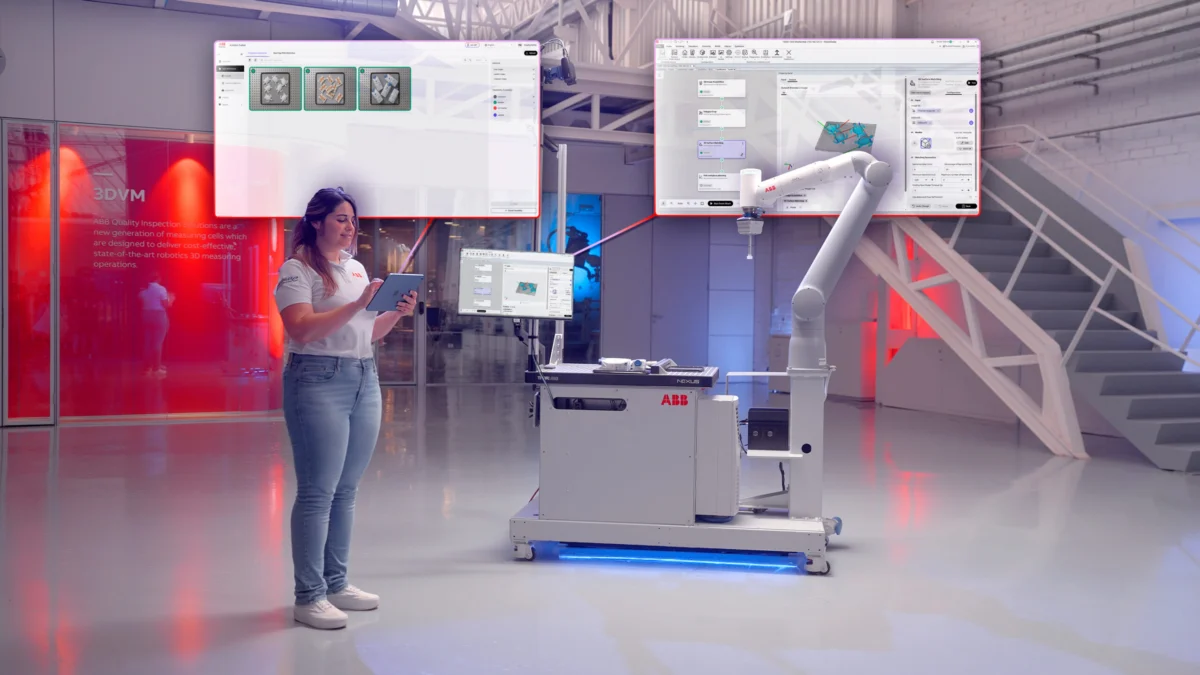
In a significant leap forward for the industrial automation sector, ABB Robotics has announced the expansion of its OmniCore EyeMotion platform, now bolstered by the groundbreaking AI Robot Trainer. This technological advancement is set to redefine how manufacturing facilities deploy, manage, and scale AI-based vision systems. By eliminating the traditional requirement for building complex AI models from the ground up, ABB is effectively democratizing advanced robotics for system integrators and automation partners alike.
The new suite serves as a unified ecosystem that bridges the gap between raw visual data and precise robotic movement. By integrating image acquisition, model training, and deployment into a single, streamlined workflow, ABB is addressing one of the most persistent bottlenecks in modern factory automation: the time-consuming and often prohibitive cost of customizing robotic vision systems for diverse production environments.
Main Facts: A Paradigm Shift in Robotic Vision
The core mission of the OmniCore EyeMotion with AI Robot Trainer is to lower the barrier to entry for intelligent manufacturing. Historically, implementing AI in a factory setting required high-level expertise in data science, custom programming, and lengthy calibration cycles. ABB’s new solution flips this script.
Key Capabilities and Features:
- Unified Workflow: The system consolidates the entire lifecycle of a vision application—from initial image capture and model training to deployment and continuous updates—into a single digital environment.
- Collision-Free Path Planning: The software utilizes advanced algorithms to translate vision-acquired data directly into optimized, collision-free movement, ensuring safety and precision without manual path programming.
- Hybrid Data Training: The platform intelligently combines synthetic data with real-world imagery, allowing models to reach high accuracy levels even when physical data is limited.
- Vendor Agnostic Architecture: Recognizing the diverse nature of factory floors, the system is designed to be compatible with a broad range of third-party cameras and sensors, preventing vendor lock-in.
- AI-Guided Support: A built-in AI chatbot assists operators throughout the configuration process, providing real-time troubleshooting and guidance for adapting systems to new SKUs or environmental changes.
Chronology of Development: From Concept to Industry Standard
The journey to the current iteration of the AI Robot Trainer reflects ABB’s long-term strategy of "Software-Defined Robotics."
- Early 2020s: ABB began shifting focus toward modular, AI-powered control systems as part of its OmniCore controller family, recognizing that hardware alone would soon reach a performance plateau.
- Mid-2026: The initial iterations of OmniCore EyeMotion were introduced to facilitate high-speed motion control, but the industry expressed a need for more intuitive, non-code-based training interfaces.
- Late 2026: ABB responded to these market demands by launching the AI Robot Trainer, a dedicated toolset designed to simplify the "learning" phase of machine vision.
- Current State: The platform is currently being rolled out globally, with a focus on industries requiring high-frequency changeovers, such as consumer electronics, logistics, and automotive component assembly.
Supporting Data: Quantifying the Productivity Gain
The economic impact of the AI Robot Trainer is most clearly evidenced by the dramatic reduction in operational metrics. According to internal ABB testing and early pilot programs, the deployment of this technology results in:
Operational Efficiency Metrics
- Commissioning Speed: System integrators have reported a reduction in commissioning time by up to 90%. Tasks that previously required weeks of manual fine-tuning can now be completed in a fraction of the time.
- Cycle Time Reduction: By leveraging automatic, collision-free path planning, the robot’s physical movement becomes more efficient, yielding a cycle time improvement of up to 50%.
- Flexibility & Agility: The system is specifically engineered to handle the "High-Mix, Low-Volume" production model. Whether dealing with variations in lighting, SKU changes, or shifting factory layouts, the AI adapts with minimal human intervention.
Application Versatility
The system is already being deployed across a wide spectrum of industrial use cases, including:

- 2D Pick-and-Place: Optimized for high-speed logistics and distribution centers.
- 3D Bin Picking: Enabling robots to identify and retrieve items from cluttered environments with unprecedented accuracy.
- Quality Inspection: Real-time visual analysis to detect defects on the assembly line.
- Sorting and Assembly: Automating complex, multi-step tasks that previously required human cognitive oversight.
Official Responses and Strategic Vision
ABB Robotics has positioned this launch as a cornerstone of its digital transformation strategy. In recent briefings, company leadership emphasized that the future of robotics is not just in the strength or speed of the mechanical arm, but in the "intelligence" of the controller.
"We are moving away from the era of ‘programming’ robots and into the era of ‘training’ them," said an ABB spokesperson. "By providing our partners with the tools to train AI models using synthetic data, we are enabling them to build robust, scalable vision applications that can handle the unpredictability of modern manufacturing. Our goal is to make industrial automation as flexible as the human workforce it supports."
Industry analysts have noted that by opening up the AI training process to system integrators, ABB is effectively creating a massive ecosystem of innovation. Rather than relying solely on ABB’s own software engineers, the company is empowering thousands of integrators to build custom, vertical-specific AI solutions, which will ultimately drive the entire robotics market forward.
Implications: The Future of the Factory Floor
The integration of AI-driven vision into the standard robotics workflow carries profound implications for the manufacturing sector.
1. Democratization of Advanced Automation
Small and medium-sized enterprises (SMEs) that previously found the cost and complexity of AI-based robotics prohibitive can now compete on equal footing with large-scale manufacturers. The ease of use provided by the AI-guided workflow means that companies do not necessarily need a dedicated team of robotics engineers to maintain their lines.
2. Resilience Against Supply Chain Volatility
As global supply chains become more volatile, the ability to rapidly reconfigure a production line is a competitive advantage. The AI Robot Trainer allows manufacturers to pivot from producing one product to another with a different SKU or shape in minutes rather than days.

3. The Shift to "Software-Defined" Hardware
This launch confirms that the competitive advantage in robotics is shifting from hardware specifications to software intelligence. Robots are becoming "learning machines" that improve over time. As more data is collected through the OmniCore system, the AI models become more accurate, creating a virtuous cycle of performance improvement that benefits all users of the platform.
4. Safety and Human-Robot Collaboration
The automatic collision-free path planning is not merely an efficiency feature; it is a critical safety advancement. By ensuring that robots inherently understand their spatial constraints, the risk of damage to property and injury to human workers is significantly mitigated, facilitating smoother collaboration in shared workspaces.
Conclusion
The expansion of ABB’s OmniCore EyeMotion with the AI Robot Trainer represents a major milestone in the evolution of industrial robotics. By simplifying the path to AI adoption, ABB is not only helping its customers save time and money but is also laying the groundwork for a more agile, responsive, and intelligent manufacturing industry.
As the lines between digital intelligence and physical execution continue to blur, tools like those introduced by ABB will be the standard by which all industrial automation is measured. For system integrators and manufacturers looking to stay ahead of the curve, the message is clear: the future is not just automated—it is intelligent, adaptive, and, thanks to these new tools, more accessible than ever before.
For further technical specifications, documentation, or to explore integration opportunities, interested parties are encouraged to visit the official ABB Robotics website.
Filed Under: AI & Machine Learning | Tagged With: ABB Robotics, Industrial Automation, Machine Vision, Robotics, Industry 4.0