The industrial landscape is undergoing a profound structural evolution, defined not by the outright replacement of human labor with artificial intelligence, but by a pragmatic recalibration of how software, automation, and veteran engineering expertise intersect. Recent industry developments from the first half of 2026 demonstrate that while generative AI, advanced machine learning, and cloud-connected data fabrics are dramatically compressing development timelines, raw computational power remains insufficient on its own.
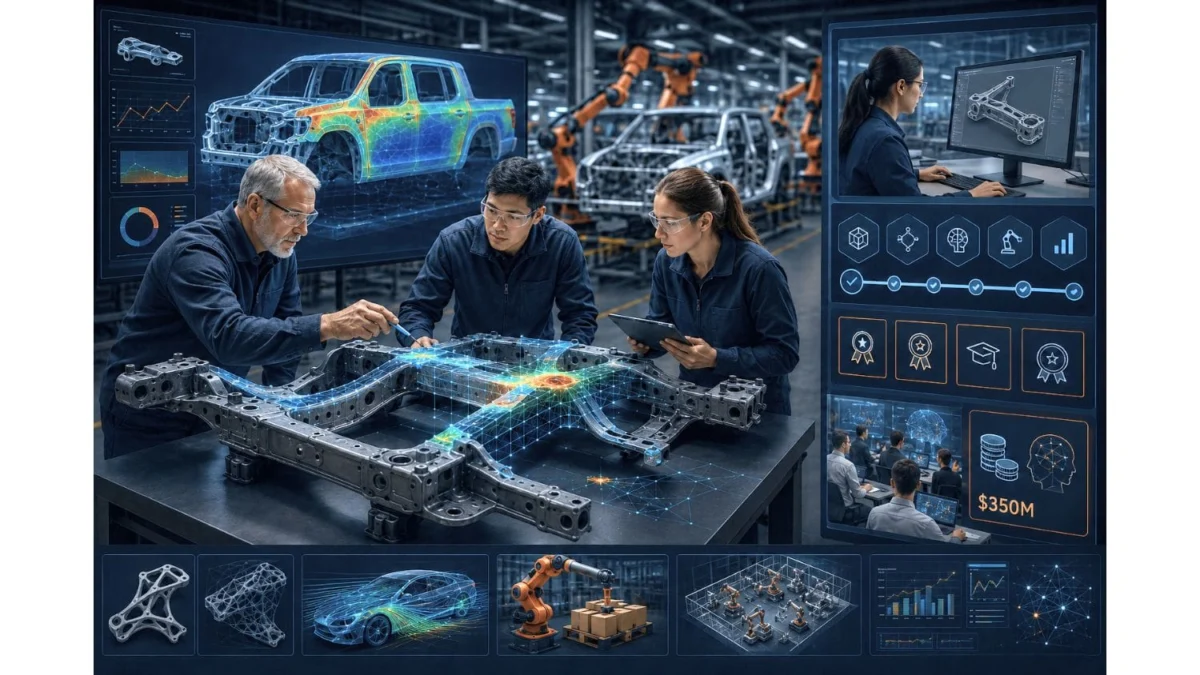
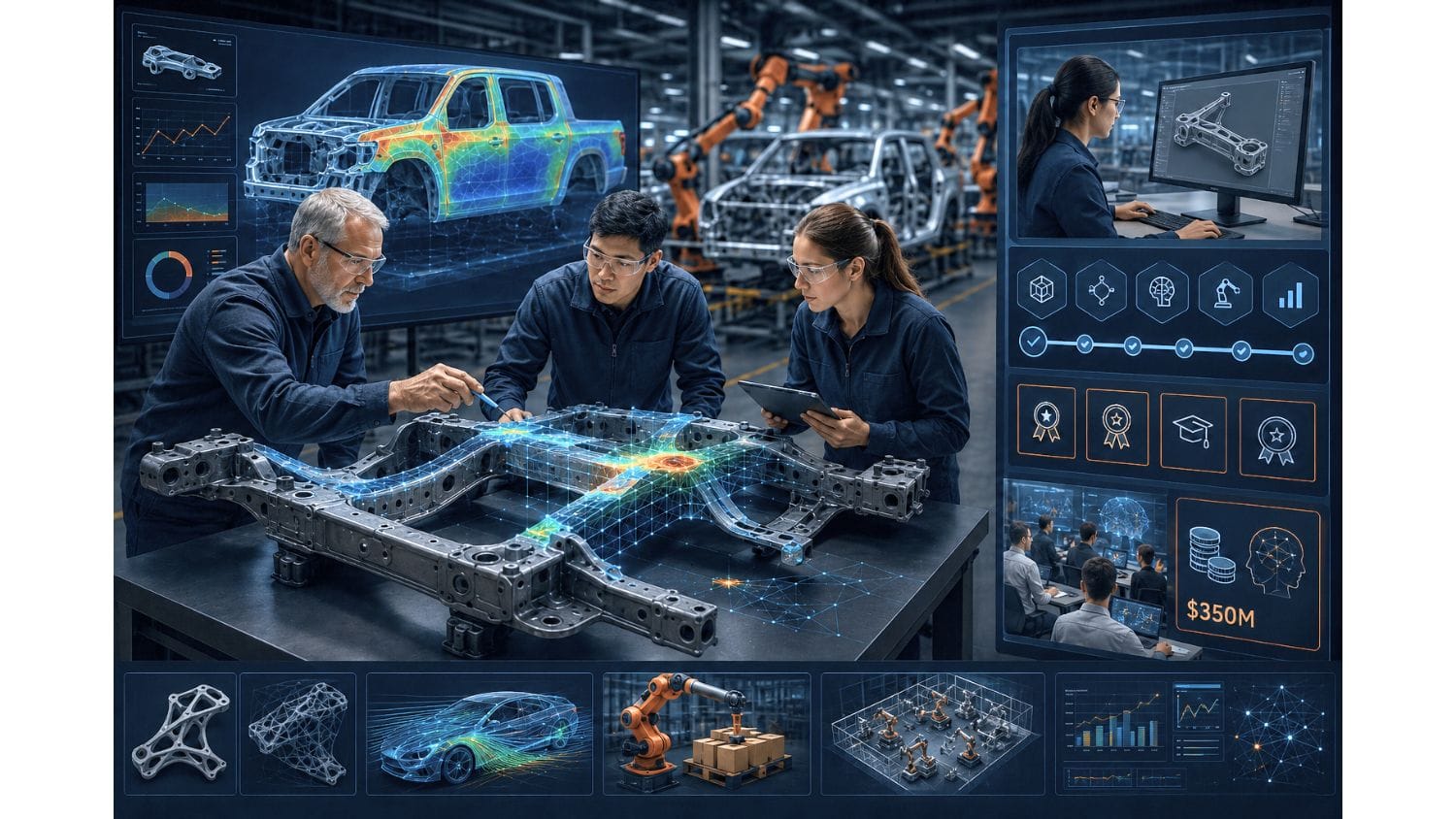
Across automotive manufacturing, industrial design, automated logistics, and software-driven machining, market leaders are discovering that successful deployment requires a balanced ecosystem. Ford Motor Company’s recent triumph in the J.D. Power 2026 Initial Quality Study illustrates this shift, highlighting a strategy that pairs algorithmic defect detection with the re-engagement of hundreds of veteran technical specialists. Concurrently, investments are surging: Autodesk has committed $350 million to address a 147% two-year surge in demand for AI-related industrial roles, while technology giants like Siemens, General Motors, AVEVA, Vention, Teradyne, and Doosan Robotics roll out advanced AI integrations designed to streamline the physical world’s most complex engineering bottlenecks.
Chronology of Key Developments (2023–2026)
2023: Ford initiates a comprehensive internal quality reset, recognizing that automated processes alone cannot flag deeply hidden manufacturing vulnerabilities or predict nuanced warranty liabilities.
2024–2025: Industrial software adoption accelerates rapidly. Autodesk data records explosive growth in design and manufacturing roles requiring specific AI competencies, prompting industry-wide calls for structured workforce reskilling.
Early 2026: Autodesk releases its definitive AI Jobs Report, quantifying the 147% multi-year growth in specialized roles and prompting its $350 million, three-year training commitment.
June 2026: A convergence of major product launches and industry disclosures reshapes the engineering sector:
Ford claims the top spot in the J.D. Power 2026 Initial Quality Study—its first win since 2010—fueled by the reintegration of roughly 350 veteran engineers alongside AI automation.
Siemens launches Simcenter PhysicsAI Generate (in Simcenter Hypermesh 2026.1) and updates NX X Manufacturing 2606, bringing generative AI directly into initial concept creation and CAM programming.
General Motors publishes milestone validation metrics, demonstrating that machine learning can reduce roof-crush analysis simulations from up to 40 hours down to under five minutes.
Doosan Robotics debuts the PalletizHD+ AI palletizing system at Automate 2026, targeting rapid changeover bottlenecks in end-of-line manufacturing.
Vention and Teradyne Robotics announce a collaborative digital-twin design platform optimized for Universal Robots (UR) cells.
AVEVA introduces industrial-scale AI connective updates across its CONNECT and PI Data Infrastructure portfolios at AVEVA World 2026, prioritizing clean plant data as a prerequisite for effective machine learning.
Supporting Data and Metrics
The quantitative footprint of AI integration in physical product design and manufacturing reveals staggering efficiency gains, alongside a critical talent deficit:
147% Growth: According to Autodesk’s AI Jobs Report 2026, specialized AI roles across architecture, engineering, construction, product design, and manufacturing have expanded by 147% over a two-year window, showing a robust 33% year-over-year increase.
$350 Million Investment: Autodesk’s three-year capital deployment aims to train nearly one million people and secure over 200,000 industry-recognized certifications by the end of 2028.
350 Veteran Specialists: Ford reversed a reliance on pure automation by recruiting, promoting, or bringing back approximately 350 experienced technical specialists since 2023 to oversee its quality reset.
Under 5 Minutes vs. 40 Hours: General Motors reports that advanced machine learning and simulation models have slashed the execution time for complex vehicle roof-crush analyses from a historical window of 8 to 40 hours down to less than five minutes.
Sub-10-Second Concept Generation: Siemens’ Simcenter PhysicsAI Generate successfully produces physics-aware 3D concepts for complex geometries (such as electronics housings) based on dimensional and displacement targets in under 10 seconds.
11 Boxes Per Minute: Doosan Robotics’ PalletizHD+ processes up to 11 boxes per minute while dynamically optimizing travel paths and automatically generating stacking parameters.
Official Responses and Industry Insights
Ford Motor Company: The Limits of Pure Automation
Ford executives offered a candid admission regarding the limits of artificial intelligence in heavy manufacturing. While AI tools excel at scanning vast datasets to flag surface-level patterns and statistical risks, they lack the institutional memory required to anticipate complex root causes.
"AI and automation were not enough on their own," noted Ford leadership following their J.D. Power victory. "AI can flag patterns and risks. Veteran engineers know where failures hide, why they repeat and which ‘minor’ issue becomes a warranty nightmare."
Siemens: Redefining Design Workflows
Siemens positions its generative AI tools not as autonomous decision-makers, but as cognitive catalysts designed to eliminate writer’s block in CAD environments and entrenched habits in CAM shops. By introducing tools like Simcenter PhysicsAI Generate and NX X Manufacturing 2606, Siemens aims to bypass historic limitations.
Industry spokespeople emphasize that while generative algorithms can propose fresh geometries from performance targets or create parametric tool definitions from scratch, "this is not autopilot." Programmers and engineers remain the indispensable arbiters of safety, fixturing, and real-world machine capabilities.
AVEVA: The Data Foundation Imperative
At AVEVA World 2026, corporate messaging drilled down into the foundational plumbing required for successful industrial AI deployment. Executives stressed that advanced algorithms are entirely constrained by the fidelity of the underlying plant data.
For manufacturing engineers, AVEVA underscored that “useful factory AI starts with trustworthy data,” warning that legacy naming conventions, missing metadata, and siloed plant-floor exceptions will consistently undermine machine learning initiatives unless unified.
Implications for the Engineering Sector
1. The Renaissance of Human Experience
The primary narrative emerging from Ford’s quality milestone and broader industry trends is the rehabilitation of tribal knowledge. For years, corporate efficiency drives sought to streamline headcounts by substituting experienced personnel with software suites.
The 2026 manufacturing landscape has forcefully debunked this thesis. Algorithms process historical records, but human intuition—honed through decades of physical prototyping, failure analysis, and shop-floor troubleshooting—remains the ultimate safeguard against catastrophic field failures.
2. Accelerated Validation Loops vs. Physical Reality
When simulation tasks like GM’s roof-crush analysis drop from 40 hours to five minutes, the entire product development lifecycle accelerates. Engineers are no longer restricted to evaluating two or three design iterations due to computational bottlenecks; they can explore dozens of permutations.
However, this speed introduces new risks. Faster virtual models increase the temptation to skip rigorous physical validation. Industry leaders emphasize that accelerated simulations are only as valuable as the engineer’s comprehension of the model’s underlying assumptions, boundary conditions, and real-world anomalies.
3. The Digital Cell and End-of-Line Agility
In robotics and automation—typified by Vention and Teradyne’s digital cell-design platforms and Doosan’s PalletizHD+—the focus has shifted away from the standalone hardware toward the surrounding environment. The most expensive friction points in deployment are rarely the robot arms themselves; they are the fixtures, guarding, reach constraints, variable part geometries, and recovery routines.
Digital twins allow teams to iron out these variables virtually, yet the ultimate test remains the shop floor, where real products meet variable manufacturing pressures.
4. Resskiling and the Workforce Transformation
With Autodesk injecting $350 million into AI education and reporting a 147% surge in specialized job roles, the engineering workforce faces a generational pivot. The traditional silos separating CAD technicians, simulation analysts, and manufacturing programmers are dissolving.
Future-proof professionals must master not only traditional engineering fundamentals but also the orchestration of AI-driven design tools, clean data infrastructures, and multi-variable simulation suites. The firms that win in the coming decade will be those that successfully marry the unyielding precision of artificial intelligence with the irreplaceable wisdom of veteran engineering talent.