





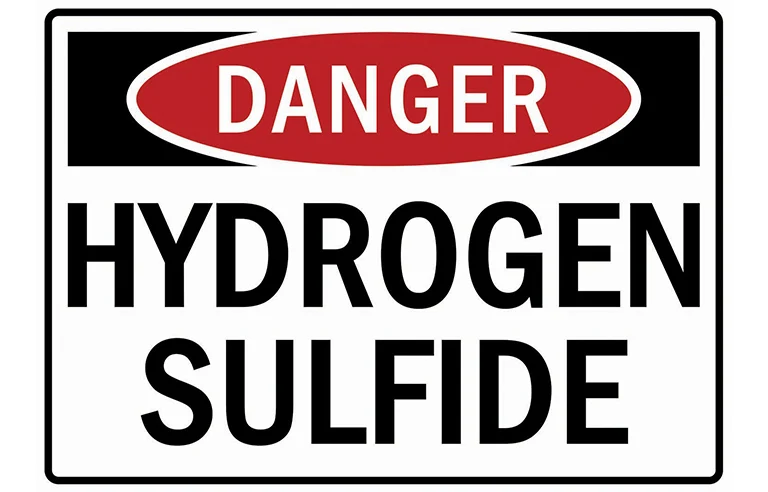
In the industrial landscape, dangers often manifest as high-voltage machinery or heavy equipment. However, one of the most insidious threats to worker safety is entirely invisible, odorless at high concentrations, and frequently lurking in the mundane corners of infrastructure: hydrogen sulfide ($H_2S$). Often colloquially identified by its distinct "rotten egg" odor, this colorless, toxic gas represents a persistent hazard that OSHA identifies as one of the leading causes of workplace gas inhalation deaths in the United States.
Main Facts: The Nature of the Hazard
Hydrogen sulfide is more than just a nuisance odor; it is a chemical compound that poses severe physiological risks. Chemically, it is a highly flammable, explosive gas that occurs naturally in crude oil, natural gas, and volcanic gases. It is also a byproduct of the anaerobic decomposition of organic matter, meaning it is commonly generated in sewer lines, manure pits, and wastewater treatment facilities.
The primary danger of hydrogen sulfide lies in its deceptive properties. While the human nose can detect the gas at very low concentrations—often as low as 0.01 to 0.5 parts per million (ppm)—the gas quickly induces "olfactory fatigue." Once a worker is exposed to higher concentrations, the gas deadens the sense of smell, leading the individual to mistakenly believe the threat has dissipated when, in reality, the concentration has reached lethal levels.
Chronology: A History of Invisible Dangers
The history of hydrogen sulfide incidents is a sobering chronicle of oversight and environmental conditions. Throughout the 20th century, the expansion of underground infrastructure—from telephone vaults to massive municipal sewer systems—brought workers into closer proximity with the gas.
Early Industrial Recognition
In the mid-1900s, the oil and gas industry began formalizing safety protocols as the correlation between crude oil extraction and toxic gas pockets became undeniable. Despite these efforts, "confined space" fatalities continued to occur with alarming regularity. In the 1970s and 80s, as occupational safety regulations became more robust, the focus shifted from mere awareness to the implementation of mandatory monitoring.
The Modern Era of Regulation
The Occupational Safety and Health Administration (OSHA) solidified its stance on hydrogen sulfide by categorizing it as an Immediately Dangerous to Life or Health (IDLH) substance. Recent years have seen a spike in localized tragedies, particularly in rural settings where agricultural runoff and subterranean gas pockets intersect with maintenance work. Each incident serves as a grim reminder that despite decades of technological advancement, the basic principles of ventilation and testing remain the only true defense against this silent killer.
Supporting Data: The Science of Toxicity
The physiological impact of hydrogen sulfide is dose-dependent, meaning the severity of the symptoms correlates directly with the concentration of the gas and the duration of exposure.
Symptom Progression
- Low Exposure (0.01 – 10 ppm): At these levels, workers typically report irritation of the eyes, nose, and throat. Coughing and a feeling of dryness in the airways are common.
- Moderate Exposure (10 – 50 ppm): Symptoms intensify to include severe headaches, dizziness, nausea, and noticeable difficulty breathing. At this stage, cognitive function may begin to decline, impairing a worker’s ability to evacuate.
- High Exposure (50 – 100 ppm): Exposure here can lead to pulmonary edema (fluid in the lungs) and severe respiratory distress.
- Lethal Exposure (Above 100 ppm): Concentrations exceeding 100 ppm are classified as IDLH. At this level, the gas causes rapid paralysis of the respiratory system, often leading to immediate collapse, convulsions, and death within minutes if the worker is not removed and provided with supplemental oxygen.
Environmental Accumulation
The gas is denser than air, which leads to a dangerous physical behavior: it "pools." Hydrogen sulfide collects in low-lying and enclosed, poorly ventilated areas such as basements, manholes, sewer lines, and underground telephone or electrical vaults. Because it settles at the bottom of these spaces, a worker entering a vault may feel perfectly safe while standing, only to be overcome the moment they kneel or descend to a lower level.
Official Responses and Safety Protocols
OSHA’s regulatory framework is stringent because the margin for error is nonexistent. The agency mandates a hierarchy of controls to mitigate exposure, prioritizing engineering controls over personal protective equipment (PPE).
The Testing Mandate
Before any worker enters a confined space, a "qualified person" must test the air. This is not a task for the inexperienced; it requires calibrated, multi-gas detectors capable of measuring $H_2S$ concentrations in real-time. Testing must be performed at multiple levels—top, middle, and bottom—to account for the fact that the gas settles in low-lying areas.
Ventilation and PPE
If testing reveals the presence of $H_2S$, the workspace must be ventilated immediately using forced-air blowers. If the gas concentration cannot be reduced below permissible exposure limits, entry is prohibited unless the worker is equipped with specific respiratory protection.
For concentrations exceeding 100 ppm, a self-contained breathing apparatus (SCBA) is strictly required. No air-purifying respirator can offer protection against such high levels, as these masks are designed to filter particulates or low-level vapors, not to provide oxygen in a life-threatening, oxygen-deficient, or high-toxic environment.
Rescue and Communication
OSHA further emphasizes that no worker should enter a confined space without a pre-planned rescue strategy. This includes having a dedicated "attendant" stationed outside the space, equipped with two-way communication and the necessary extraction equipment (such as tripods and winches) to pull a fallen worker to safety without entering the hazard zone themselves.
Implications: The Cultural Shift in Workplace Safety
The persistent threat of hydrogen sulfide has profound implications for workplace culture, liability, and technological innovation.
The Liability of Negligence
Employers who fail to provide gas detection equipment, ventilation, or mandatory training face severe legal and financial consequences. Beyond the regulatory fines, the human cost is immeasurable. The legal precedent set by OSHA ensures that employers are held responsible for the "known dangers" of the work environment. Ignoring the existence of $H_2S$ in known high-risk areas is increasingly viewed as a failure of basic safety management, opening the door to criminal negligence charges in cases of workplace fatalities.
Technological Advancements
The industry is responding with smarter, more integrated technology. Modern gas detectors are now smaller, wireless, and capable of transmitting data to a centralized command center in real-time. If a worker’s monitor detects a spike in $H_2S$, an alarm can trigger an automatic alert to supervisors and emergency responders. Furthermore, wearable technology is evolving to track a worker’s vital signs, providing an extra layer of oversight in high-risk zones.
Training and Preparedness
Ultimately, the most effective tool against hydrogen sulfide is education. Training programs are shifting away from passive "safety meetings" toward active simulations. By utilizing virtual reality and hands-on drills, companies are teaching workers to recognize the signs of gas exposure and, more importantly, to respect the "stop-work authority." Encouraging a culture where any employee can halt operations if they suspect the presence of a hazardous gas is the cornerstone of a modern, safety-first organization.
Conclusion
Hydrogen sulfide remains a formidable challenge for industries involved in energy, infrastructure, and waste management. It is a silent, invisible, and lethal opponent that exploits human complacency and environmental conditions. By adhering strictly to OSHA’s protocols—testing, ventilating, and providing robust respiratory protection—employers can prevent these tragedies.
However, safety is not merely a list of rules; it is a commitment to the well-being of the individuals who descend into the dark, confined spaces of our infrastructure. As we look toward the future, the integration of advanced detection technology and a culture of radical transparency regarding safety hazards will be essential to ensuring that no worker’s life is claimed by the invisible vapors lurking beneath our feet. The "rotten egg" smell may be a warning, but in the world of high-concentration gas, we must learn to trust our instruments, not our senses, to ensure every worker returns home safely at the end of the day.