In the current gold rush of robotics, the industry has been obsessed with "vision." From sophisticated vision-language-action (VLA) models to high-resolution camera arrays, modern robots are better at "seeing" than ever before. Yet, there is a fundamental bottleneck: vision is not enough. When a robot attempts to handle flexible fabrics, insert precision components, or manipulate delicate glass, it often fails because it lacks the one thing humans take for granted—the sense of touch.
Daimon Robotics is emerging as a critical architect in this space. Rather than competing in the crowded race to build a "general-purpose robot brain," the company is positioning itself as the foundational infrastructure provider for tactile intelligence. By bridging the gap between physical sensors, high-fidelity simulation, and artificial intelligence, Daimon is attempting to give the next generation of robots the "nerves" they need to operate in the unpredictable real world.
The Tactile Gap: Why Robots Struggle with Reality
The limitations of vision-only robotics become painfully apparent the moment a machine is tasked with complex manipulation. Cameras struggle with occlusion, changing lighting conditions, and, most critically, the inability to perceive physical properties like friction, surface tension, and internal pressure.
"Vision has become central to modern robotics, but cameras alone cannot tell a robot everything it needs to know about physical contact," explains the team at Daimon Robotics. When a robot reaches for an object, it can calculate the trajectory, but it cannot "feel" if the object is slipping through its grip until it is already on the floor.
Daimon Robotics is addressing this by creating a specialized pipeline that treats tactile data with the same rigor that visual data receives in autonomous driving. Their strategy involves a holistic integration of hardware sensors, data collection devices like the "Umi," and a sophisticated simulation-to-reality pipeline. By operating tactile feedback at a 30 Hz frequency, the company enables robots to make real-time, millisecond-level adjustments during contact-intensive tasks.
Chronology: From Concept to Industrial Reality
The trajectory of Daimon Robotics reflects the rapid maturation of embodied AI.
- Foundation Phase: The company began by identifying the "sim-to-real" gap as the primary barrier to adoption. Recognizing that current simulations of physical contact are often "terrible," as described by Partner and VP of Technology Dr. Zhu, the team focused on calibrating virtual environments against real-world measurements.
- Data Collection Initiatives: Moving beyond theoretical frameworks, the company launched its data acquisition strategy. Currently, the company has compiled over 10,000 hours of high-fidelity tactile data. This serves as the bedrock for their long-term project, "Daimon-Infinity," which aims to amass over 1 million hours of tactile embodied data.
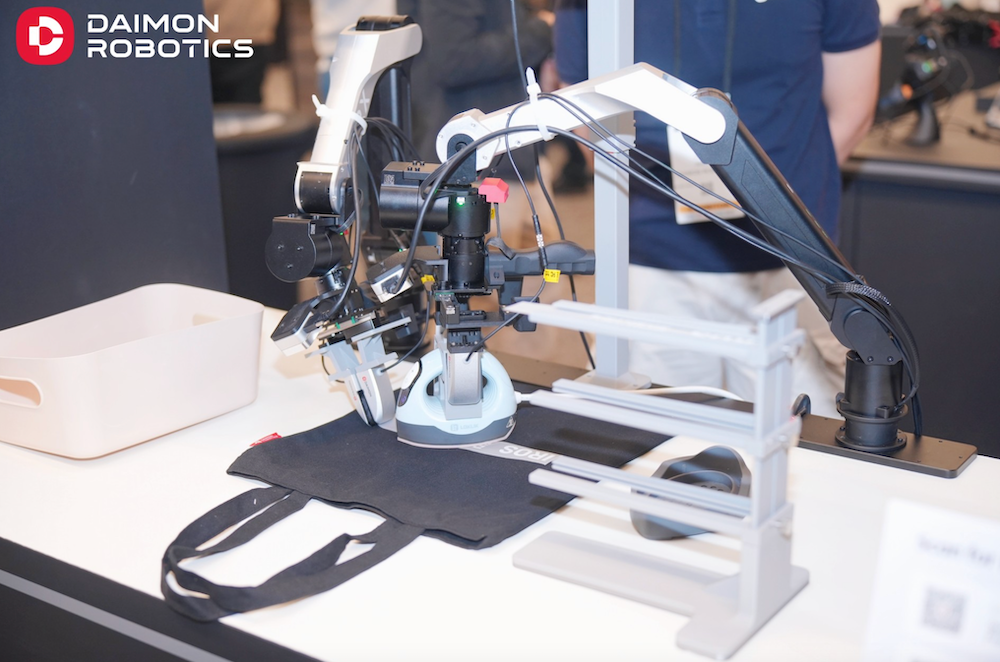
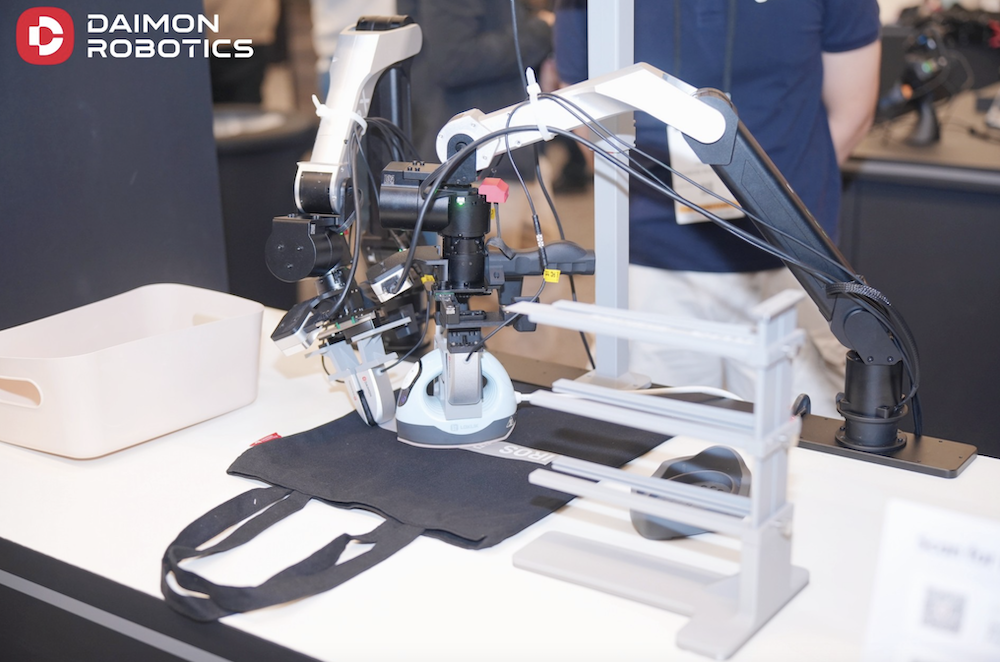
- IROS 2026 Breakthroughs: At the 2026 International Conference on Intelligent Robots and Systems (IROS), Daimon showcased the fruit of this labor. Demonstrations included delicate tasks—such as applying heat-transfer designs to tote bags, threading bracelets, and, notably, safely handling broken glass. These demonstrations served as a proof-of-concept for their "Daimon-TWM" (Tactile-grounded World Model).
- Industrial Deployment: Today, the company has shifted from experimental demonstrations to active partnerships. With key alliances including Lenovo Capital and Inovance Technology, Daimon is now integrating its technology into industrial assembly lines and warehouse environments, moving the technology from the lab into the factory floor.
Supporting Data: Scaling the "Touch" Infrastructure
The challenge with tactile data is that it is inherently local and variable. Unlike images, which are ubiquitous on the internet, tactile data must be generated through specific, physical interactions.
The Sim-to-Real Pipeline
Daimon’s approach to solving the sim-to-real problem is rooted in calibration. By measuring the physical properties of materials—friction coefficients, elasticity, and contact resistance—and feeding this into their simulation engines, they reduce the "reality gap." This ensures that when a robot learns a manipulation task in a virtual environment, the muscle memory transfers effectively to the physical hardware.
High-Frequency Control
The 30 Hz control loop is a pivotal performance metric for the company. In assembly tasks, such as inserting a pin into a hole, a robot must detect resistance almost instantly. If the feedback loop is too slow, the part can be damaged or jammed. By prioritizing high-frequency processing, Daimon enables robots to act with the nuance of a human hand.
The Daimon-Infinity Initiative
The ambition to reach 1 million hours of data is not merely a quantitative goal; it is a strategic one. As Dr. Zhu notes, the company is not trying to be a foundation model developer itself. Instead, it provides the "raw materials" for others. By creating a massive repository of tactile experiences, they allow downstream developers to train models that are "tactile-aware" from the ground up, rather than trying to retroactively teach a robot to feel.
Official Perspectives: The Infrastructure Provider Mindset
In an exclusive discussion with The Robot Report, Dr. Zhu provided clarity on the company’s strategic positioning. "By building tactile intelligence, we’re actually playing the role as an infrastructure provider," he stated. "We’re not aiming to be a foundation model developer. We are providing the infrastructure for doing so for those downstream customers."
This philosophy of "infrastructure over application" is a calculated move. The robotics market is saturated with companies trying to build the next "ChatGPT for robots." Daimon, however, has opted to be the company that supplies the training data and sensory pipelines that those general-purpose companies will inevitably need.
Zhu is refreshingly candid about the state of the industry. He admits that current AI models are not as "intelligent" as the marketing hype suggests. He identifies that current models often suffer from "in-domain generalization"—meaning they work perfectly in the lab but falter when moved to a slightly different factory environment. Daimon’s goal is to mitigate this by providing the robust, high-quality data necessary to make these models truly generalize across varied industrial contexts.
Implications for the Future of Robotics
The shift toward tactile-integrated robotics has profound implications for global manufacturing and logistics.
1. The Death of Rigid Programming
Currently, most industrial robots are "blind" to contact. They follow pre-programmed trajectories, which makes them fragile; if a box is moved by even a few millimeters, the robot may fail. With Daimon’s tactile infrastructure, robots can "feel" their way through a task. If a component is misaligned, the robot can sense the resistance and adjust its position dynamically. This moves us away from rigid, cage-bound automation toward flexible, adaptive manufacturing.
2. Human-Robot Collaboration (Cobots)
As robots enter environments with humans, they must understand force. A robot that can distinguish between the soft touch of a human hand and the cold resistance of a steel beam is a much safer, more capable partner. Tactile intelligence is the prerequisite for the next wave of humanoid and dual-arm robotic systems intended for domestic and complex industrial use.
3. Economic Scalability
By providing the tools and data, Daimon is lowering the barrier to entry for other robotics firms. Instead of every company needing to spend years and millions of dollars developing their own tactile sensors and data pipelines, they can leverage Daimon’s infrastructure. This commoditization of tactile intelligence could accelerate the deployment of advanced robotics in the same way that standardized cloud infrastructure accelerated the growth of the internet.
4. The Limits of Generalization
The road ahead is not without obstacles. As Dr. Zhu pointed out, the industry still faces a massive hurdle in generalization. Even with 10,000 hours of data, a robot might still be baffled by a material or shape it hasn’t encountered before. The success of Daimon will ultimately depend on whether their infrastructure can truly enable "zero-shot" learning—where a robot learns a task in simulation and performs it perfectly on a factory floor with a brand-new object.
Conclusion
Daimon Robotics is playing the long game. By focusing on the "infrastructure layer"—the invisible but essential connective tissue between sensors, data, and logic—they are addressing the most overlooked aspect of physical AI.
The industry has mastered the art of sight; it is now entering the era of touch. If Daimon’s vision of a tactile-integrated robotic future holds, we may soon see robots that possess the dexterity and situational awareness of a human craftsman, capable of navigating the chaos of the physical world with a gentle, calculated, and—most importantly—informed touch. As the company continues to scale its data initiatives and deepen its industrial partnerships, it remains a company to watch for anyone interested in the true future of embodied artificial intelligence.