




INDUSTRIAL INTELLIGENCE — As manufacturers race to capitalize on the promise of artificial intelligence, a central operational dilemma persists: how to deploy agentic AI that is fast, open, scalable, secure, and above all, reliable on the factory floor.
Addressing this critical industrial need, Velotic has officially announced ThingWorx 10.2, establishing the mature industrial intelligence platform as the foundational cornerstone of the company’s broader agentic AI strategy. Notably, these advanced AI capabilities are being delivered natively within the platform and included at no extra cost on existing customer subscriptions.
Main Facts
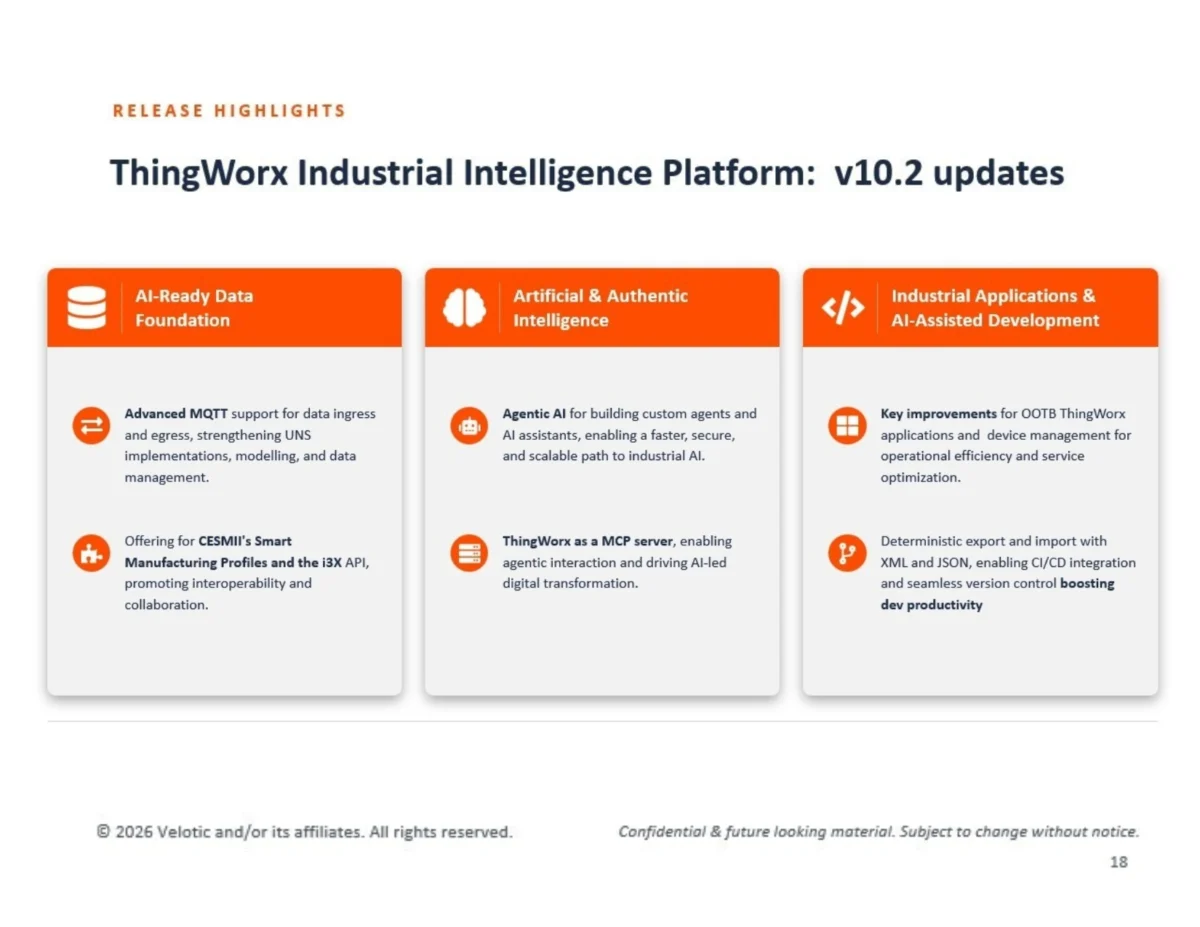
ThingWorx 10.2 introduces a sweeping suite of capabilities designed to merge authentic human expertise with autonomous artificial intelligence. At its core, the release features a native, in-app AI assistant and powerful tools enabling industrial enterprises to build custom agents and virtual assistants securely tied to connected enterprise data sources.
Key highlights of the ThingWorx 10.2 release include:
- In-App AI Assistant & Custom Agents: Out-of-the-box and custom agentic frameworks designed for analysis, insights, configuration, integration, and development.
- Deterministic Workflows & Guardrails: Designed to mitigate hallucinations and operational risks by enforcing strict structural boundaries for industrial AI operations.
- Upgraded Applications: Enhancements to out-of-the-box (OOTB) offerings like the Connected Work Cell, alongside new applications dedicated to operational efficiency and service optimization.
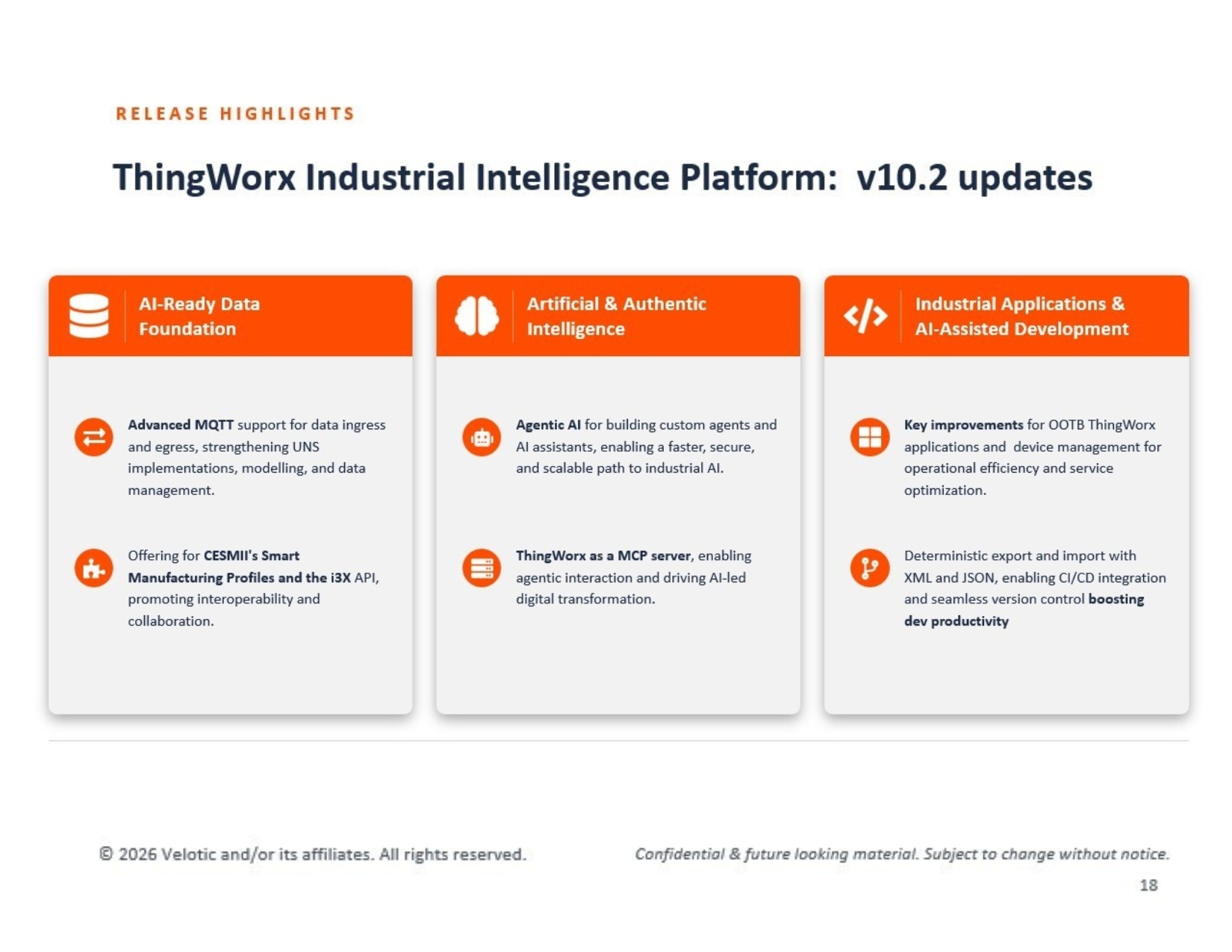
- Advanced Standards Support: Native integrations for MQTT, CESMII Smart Manufacturing Profiles/i3X API, and the Model Context Protocol (MCP)—allowing ThingWorx 10.2 to function seamlessly as an enterprise MCP server.
- Seamless Value Delivery: Native AI functionality deployed directly to an established base of over 3,300 enterprise customers without disrupting current subscription models.
Chronology: From Pioneer IIoT to Modern Agentic AI
To understand the strategic gravity of ThingWorx 10.2, it is necessary to examine the platform’s evolutionary trajectory over the past decade and a half.
- 2009 — The Genesis of IIoT: ThingWorx originates as one of the true pioneers of the Industrial Internet of Things (IIoT). Built around a robust semantic core data model, the platform is designed to ingest real-time machine data and empower non-developers to rapidly construct user interface (UI) mashups and custom operational visualizations.
- 2010s — Decade of Integration: Over the next ten years, thousands of manufacturers adopt ThingWorx, leveraging its architecture to bridge the traditional divide between Operational Technology (OT) and Information Technology (IT), laying the groundwork for digital transformation.
- 2025 — The AI Pivot under PTC: As part of PTC, ThingWorx takes its first major leap into generative and predictive AI, introducing chat-based interfaces and predictive analytics. Simultaneously, early beta iterations of agentic AI frameworks and Model Context Protocol (MCP) servers are trialed with select enterprise partners.
- Late 2026 — The Velotic Era and Version 10.2: Following strategic market shifts, Velotic emerges as a newly formed powerhouse entity boasting 1,200 employees and an expansive industrial software portfolio—including Proficy MES, SCADA, Historian, and Kepware. Velotic formalizes ThingWorx 10.2 as the definitive centerpiece of its unified AI strategy, bridging foundational IIoT heritage with cutting-edge agentic autonomy.
Supporting Data & Architectural Standards
Velotic’s strategy with ThingWorx 10.2 relies heavily on open architecture and interoperability standards, ensuring that industrial agents can communicate securely across multi-vendor factory environments.
1. Advanced MQTT Integration
ThingWorx 10.2 deepens its support for Message Queuing Telemetry Transport (MQTT), significantly optimizing OT data handling and modeling. This is a critical asset for enterprises pursuing a Unified Namespace (UNS) architecture or striving for real-time, low-latency edge-to-cloud data streaming.
2. CESMII Interoperability
Building on a strategic partnership announced in August, the new version incorporates full support for CESMII (Clean Energy Smart Manufacturing Innovation Institute) standards, including Smart Manufacturing Profiles and the i3X API. This ensures plug-and-play machine-level interoperability across diverse vendor equipment.
3. Model Context Protocol (MCP)
Perhaps the most forward-looking technical inclusion is support for the Model Context Protocol (MCP). MCP acts as the connective tissue enabling autonomous AI agents to interact with one another, query external enterprise systems, and orchestrate complex multi-step workflows. Furthermore, ThingWorx 10.2 can operate as an enterprise MCP server, exposing its rich industrial data repository securely to external agentic networks.
Early User Case: Conversational OEE and Machine Monitoring
The theoretical value of agentic AI in ThingWorx 10.2 is already being validated in real-world manufacturing environments.
A leading global HVAC manufacturer recently deployed a custom ThingWorx application across five of its 27 global production sites. Utilizing the platform’s composer and mashup builder, the company integrated real-time Overall Equipment Effectiveness (OEE) metrics, machine degradation tracking, and downtime telemetry into a unified conversational agent interface.
Plant operators and engineers can now query the system in natural language during shift handovers. The application pulls correlated data from plant-floor machinery and enterprise business systems, drastically accelerating root cause analysis, reducing unplanned downtime, and streamlining daily shift transitions.

Official Responses and Strategic Roadmap
As a newly formed corporate entity, Velotic is aggressively shaping its market identity around the convergence of heavy industrial software and advanced artificial intelligence.
With a global workforce of 1,200 professionals, Velotic has outlined an ambitious product roadmap. According to executive briefings, the agentic AI framework demonstrated in ThingWorx 10.2 is only the beginning. Over the next year, the company plans to systematically roll out integrated AI agents and virtual assistants across its entire legacy software portfolio—encompassing Proficy MES, SCADA, Historian, and Kepware.
Industry analysts participating in Velotic’s recent briefings have expressed optimism regarding the company’s trajectory. Analysts note that Velotic’s unique deep domain expertise in both manufacturing execution and lifecycle service management positions the ThingWorx engineering team to guide industrial clients safely through the complexities of the AI revolution.
Implications for the Industrial Sector
The release of ThingWorx 10.2 carries profound implications for the broader manufacturing and industrial software markets:
- Combating AI Skepticism with Structural Integrity: Many early industrial AI initiatives stalled due to concerns over hallucinations, data privacy, and a lack of deterministic guardrails. By anchoring agentic workflows within ThingWorx’s mature, model-driven core, Velotic provides the structural reliability industrial engineers demand.
- Democratizing Advanced Automation: By bundling native AI capabilities directly into existing customer subscriptions—rather than gating them behind expensive add-on licenses—Velotic lowers the barrier to entry for thousands of mid-market and enterprise manufacturers looking to scale their digital maturity.
- The Rise of Conversational Plant Floors: The transition from static dashboards to dynamic, conversational agents marks a fundamental shift in human-machine interfaces. Plant workers will no longer need specialized SCADA programming knowledge to extract deep operational insights; intuitive natural language queries will suffice.
- Ecosystem Harmonization: Through rigorous adherence to open standards like MQTT, CESMII, and MCP, Velotic is pushing the industrial software market toward greater openness, preventing proprietary data silos and enabling true multi-vendor agentic orchestration.
We extend our gratitude to Ayush Tiwari for providing technical product insights and to Carver Conway for facilitating analyst briefings on behalf of the Velotic trusted analyst community.