






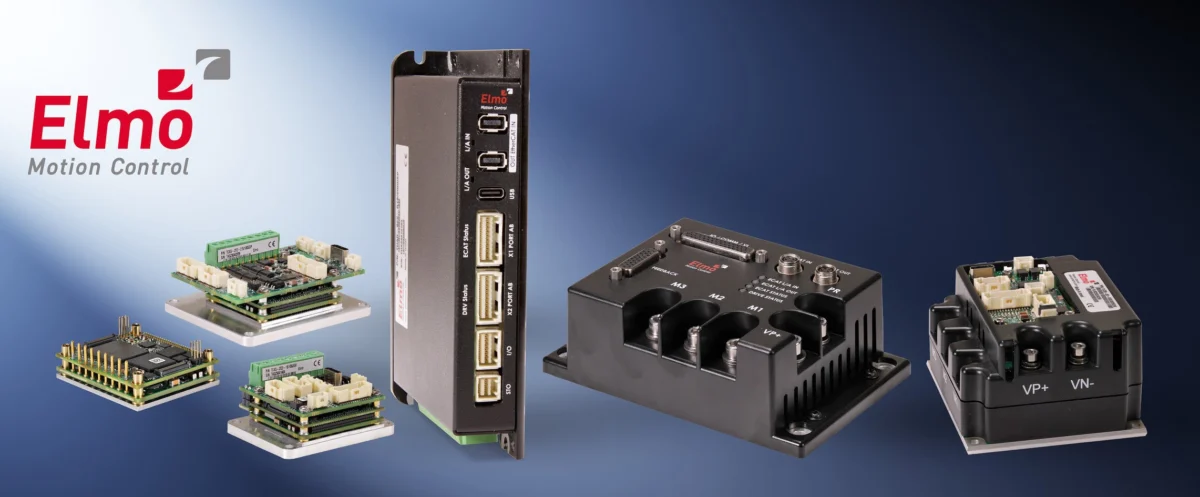
CHICAGO — In a major expansion of its industrial automation portfolio, Elmo has announced the upcoming rollout of a cutting-edge motion controller and a ruggedized series of advanced servo drives engineered specifically for harsh and demanding operational environments. Designed to withstand extreme operational stresses—ranging from severe temperature fluctuations and high altitudes to deep-sea pressures, intense humidity, and continuous structural vibration—the new hardware represents a leap forward for high-performance motion control.
The comprehensive lineup will make its official public debut later this month at Automate 2026, scheduled for June 22–25 at McCormick Place in Chicago. Industry professionals, systems integrators, and design engineers can examine the hardware firsthand by visiting the Elmo booth at S-3601.
This major product introduction not only broadens Elmo’s established Platinum line of smart motion components but also marks the official commercial arrival of the brand-new Titanium line. The Titanium series introduces highly anticipated multi-axis configurations, deep integrated intelligence, and advanced functional safety features tailored directly for ultra-compact motion systems.
Main Facts: Redefining High-Performance Motion Control
The introduction of the Titanium line and the expansion of the Platinum series address some of the most persistent bottlenecks in modern industrial engineering: spatial constraints, thermal dissipation, complex wiring architectures, and extreme environmental durability.
At the core of the new Titanium line’s engineering breakthrough is the adoption of advanced Gallium Nitride (GaN) technology. By substituting traditional silicon-based components with GaN switching devices, Elmo has drastically improved switching efficiencies, minimized thermal generation, and achieved unprecedented power densities. This allows the new servo drives to deliver massive currents and precise motor control within a fraction of the physical footprint previously required.
Furthermore, the new products embed functional safety directly at the drive level. By migrating traditional safety logic into the servo drive itself, Elmo enables engineers to significantly reduce the reliance on bulky external safety hardware, complex intermediate relays, and miles of peripheral wiring. This decentralized approach to machine safety streamlines panel layouts, cuts overall system weight, and reduces total installation costs.
Key technological highlights of the new launch include:
- Extreme Environmental Hardening: Built to operate reliably under conditions involving extreme thermal ranges, high altitudes, heavy vibration profiles, high humidity, and extreme submersible pressure environments.
- Next-Generation Gallium Nitride (GaN): Maximizes power conversion efficiency, drastically reduces switching losses, and shrinks component footprints to support miniaturized robotic designs.
- Drive-Level Functional Safety: Implements rigorous safety protocols directly onto the drive architecture, cutting down external safety-rated hardware and cabling requirements.
- High-Performance Onboard Processing: Empowers individual drives with localized intelligence to execute complex control algorithms locally without choking the host controller.
Chronology: From Concept to the Automate 2026 Global Stage
The journey toward the launch of the Titanium line and the Platinum expansions has been years in the making, born out of evolving demands from advanced robotics, aerospace, medical, and extreme industrial sectors.
- Phase 1: Research and Development of GaN Integration (2023–2024): Recognizing the physical limitations of silicon switches in high-frequency, high-power-density applications, Elmo’s R&D engineering teams initiated intensive testing on Gallium Nitride semiconductors. The objective was to design a servo architecture capable of switching faster, running cooler, and occupying significantly less board space.
- Phase 2: Architectural Harmonization and Safety Implementation (2024–2025): Engineers focused on integrating high-level functional safety features directly into the drive firmware and hardware layer. Concurrently, multi-axis topologies—such as the innovative Titanium Castanet architecture—were conceptualized to eliminate redundant bus architectures.
- Phase 3: Environmental Stress Testing and Certification (2025–Early 2026): Prototypes underwent rigorous validation testing against extreme parameters, including high-vibration shakers, thermal chambers, and simulated high-altitude and sub-sea pressure tanks. (Note: Certain advanced safety features remain currently in the formal certification process).
- Phase 4: Global Unveiling at Automate 2026 (June 2026): Elmo prepares to formally showcase the complete suite of Platinum and Titanium hardware to the global automation community in Chicago, marking the transition from R&D validation to commercial availability.
Supporting Data: Engineering Efficiency and the Titanium Advantage
To fully grasp the impact of Elmo’s latest releases, industry analysts and systems engineers must look at how the Titanium line restructures physical and logical machine layouts.
Space constraints are often the primary limiting factor in modern multi-axis machine design, particularly in articulated robotics, surgical automation, and mobile platforms. The Titanium line directly tackles this challenge through unprecedented consolidation. For instance, in select demanding applications, a single Titanium Castanet multi-axis drive can effectively replace two legacy Elmo Twitter servo drives.
This consolidation yields compounding mechanical and electrical benefits:
- Footprint Reduction: By halving the physical component count for multi-axis nodes, control cabinet and onboard robotic space requirements drop exponentially.
- Bus Synchronization: Engineers can synchronize complex X/Y positioning axes over a single, unified communication bus, completely bypassing the synchronization overhead, latency risks, and wiring complexity of managing two separate physical buses.
- Scalable Motor Control: Whether driving massive, high-torque motors utilized in heavy collaborative robot (cobot) main joints or delicate, fractional-watt motors embedded within intricate multi-fingered robotic hand assemblies, the drives scale seamlessly.
Precision Control for Advanced Robotic Systems
Modern automated guided vehicles (AGVs), autonomous mobile robots (AMRs), cobots, and motorized human exoskeletons demand absolute synchronization across multiple independent motion axes. These systems require individual servo drives to operate autonomously while maintaining sub-millisecond coordination over position, velocity, and torque.

Elmo’s hardware addresses these stringent operational parameters by providing:
- High-bandwidth current loops that ensure instantaneous torque response.
- Ultra-low harmonic distortion and smooth low-speed motor operation.
- Advanced networking capabilities to ensure deterministic, jitter-free communication across distributed robotic nodes.
Official Perspectives and Software Integration
Hardware innovation is only as powerful as the software ecosystem supporting it. To ensure machine builders can easily configure, commission, and deploy these advanced drives, Elmo backs its entire product catalog with sophisticated proprietary software suites: Elmo Application Studio III (EASIII) and Composer2.
According to Elmo representatives, these software platforms are designed to bridge the gap between advanced drive capabilities and practical engineering deployment. EASIII and Composer2 provide machine designers with intuitive graphical interfaces, automated tuning wizards, and comprehensive simulation tools to develop, test, and implement complex motion control algorithms long before physical hardware hits the factory floor.
Industry experts note that as machine complexity grows, the burden of programming multi-axis synchronized loops can quickly overwhelm development timelines. By providing streamlined software suites that complement the hardware’s onboard intelligence, Elmo aims to dramatically shorten time-to-market for OEMs developing next-generation automation equipment.
Broader Implications for the Industrial Automation Landscape
The introduction of Elmo’s Titanium line and the ruggedized Platinum expansions carries significant implications for the broader industrial automation and motion control sectors.
1. Shift Toward Decentralized Safety and Smart Hardware
For decades, machine safety has relied heavily on centralized safety PLCs, external safety contactors, and dedicated safety wiring networks that encumber control panels. By pushing functional safety features directly to the drive level, Elmo is championing a decentralized safety paradigm. This shift reduces the physical weight of mobile platforms—crucial for extending the battery life of AMRs and AGVs—while simplifying compliance procedures for original equipment manufacturers (OEMs).
2. Pushing the Boundaries of Extreme Environments
Traditional industrial automation components are frequently restricted to climate-controlled factory floors. However, modern automation demands are expanding rapidly into harsh, unstructured environments, including deep-sea exploration robotics, high-altitude aerospace applications, outdoor agricultural automation, and foundry floors characterized by extreme heat and shock loads. By engineering servo drives capable of thriving under sea-depth pressures, heavy vibrations, and wide thermal variations, Elmo opens up new frontiers for robotic deployment where electronics historically failed.
3. The Gallium Nitride Revolution in Motion Control
The widespread commercial adoption of GaN technology in motor drives signals a broader industry transition away from legacy silicon. As power electronics continue to shrink while performance demands soar, semiconductor materials that offer higher breakdown voltages, faster switching speeds, and lower thermal resistance will become the baseline standard. Elmo’s early and aggressive integration of GaN positions the company at the vanguard of this high-efficiency hardware revolution.
Conclusion and Next Steps
As industries converge on Chicago for Automate 2026, Elmo’s latest motion controllers and servo drives highlight a clear industry trajectory: smaller, smarter, safer, and tougher. By dismantling traditional compromises between performance and physical footprint, Elmo is empowering engineers to build machines that were previously deemed mechanically or thermally unfeasible.
Machine builders, systems integrators, and automation specialists attending Automate 2026 are encouraged to visit Booth S-3601 to experience live demonstrations of the Titanium line, explore the expanded Platinum series, and consult with Elmo’s technical engineering teams regarding upcoming application challenges.
For additional technical specifications, whitepapers, and software documentation regarding EASIII, Composer2, and the new hardware lineups, visit the official corporate portal at elmomc.com.