




By Energy & Policy Desk
Published November 2026
Main Facts
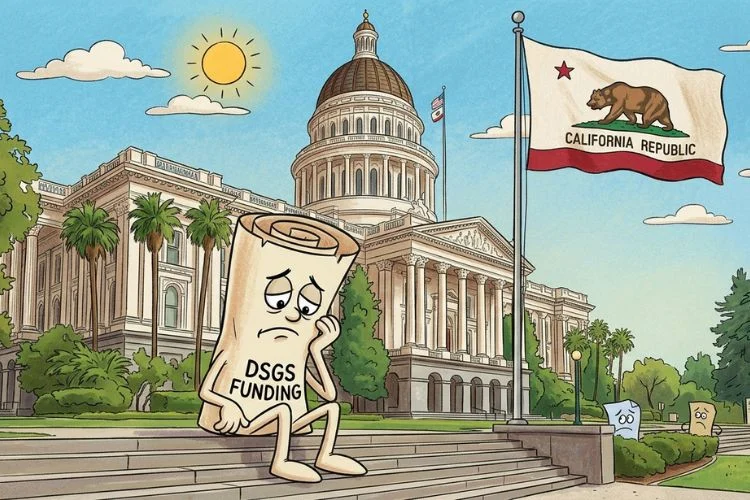
California’s Demand Side Grid Support (DSGS) program—widely regarded as the most robust virtual power plant (VPP) initiative in the United States—is rapidly running out of money. Launched in 2022, the program coordinates more than 1 gigawatt (GW) of dispatchable capacity sourced from over 200,000 unique customer sites spanning every legislative district in the state. By harnessing distributed energy resources (DERs) such as residential rooftop solar systems, home battery storage units, and smart thermostats, the DSGS program brings clean, flexible energy online precisely when the electrical grid faces emergency conditions.
Despite its undisputed operational success—including helping the California Independent System Operator (CAISO) avoid rolling blackouts and eliminating the need to issue a single voluntary energy conservation Flex Alert for more than four years—the initiative was never structured as a permanent fixture. The state legislature’s final session concluded without allocating dedicated long-term funding. While residual funds keep the program operational through the end of the year, its financial survival heading into 2027 and beyond remains dangerously uncertain.
This impending fiscal cliff arrives at a critical historical juncture for the Western grid, defined by the convergence of surging electricity demand, more frequent and severe extreme weather events, and mounting consumer affordability pressures.
Chronology: The Evolution and Peak of the DSGS Program
The trajectory of California’s virtual power plant experiment highlights both the rapid scalability of distributed resources and the bureaucratic hurdles facing state-backed clean energy funding models.
- 2022: The state launches the Demand Side Grid Support (DSGS) program in the wake of mounting climate-induced grid stress, aiming to harness residential and commercial flexible loads as emergency peaker-plant alternatives.
- 2020–2026: Backed by coordinated deployment, CAISO goes more than four consecutive years without issuing a single Flex Alert, signaling a massive stabilization of reserve margins driven by the integration of over 39,000 megawatts (MW) of new clean energy—including more than 23,000 MW of utility-scale and residential battery storage—since 2019.
- June 2026: Recognizing immediate grid vulnerability, the California legislature allocates a stopgap funding package of $27 million to keep the DSGS solvent through the remainder of the year.
- September 9, 2026: Californians set a new multi-year record for simultaneous electricity consumption. Yet, thanks to the massive buildout of grid-tied storage and VPP infrastructure, the grid absorbs the load without resorting to emergency load-shedding.
- October 5–6, 2026: During a prolonged, severe West Coast heat wave, home battery fleets managed by major aggregators Sunrun and Tesla deliver back-to-back record-breaking dispatches. Triggered by high wholesale prices meeting the program’s $200 per megawatt-hour affordability threshold, the VPPs discharge 669 MW and 745 MW respectively, successfully driving down spiking electricity prices and stabilizing the grid.
- Late 2026: Analysts warn that the intensity of the autumn heat wave severely depleted the remaining $27 million allocation, leaving the program’s 2027 operational budget effectively empty.
Supporting Data and Economic Impact
The debate over the future of the DSGS program is heavily informed by quantitative data detailing the fiscal and operational efficiency of virtual power plants.
According to a landmark report published by The Brattle Group, titled The Affordability Advantage: How Virtual Power Plants Can Alleviate Household Electricity Bill Pressure, rapidly scaling residential VPPs could slash expected near-term household electricity bill increases by more than half over the next five years. Simultaneously, these programs provide utilities with hundreds of megawatts of dependable, instantaneous capacity without the multi-billion-dollar price tags associated with constructing traditional fossil-fuel peaker plants.
During the October 2026 grid stress events, the scale of the residential response astonished industry veterans:
- 669 Megawatts: Dispatched by Sunrun and Tesla fleets on October 5, coordinated alongside the California Public Utilities Commission’s (CPUC) Emergency Load Reduction Program (ELRP).
- 745 Megawatts: Dispatched on October 6, breaking the previous day’s record.
- The San Francisco Benchmark: To contextualize these figures, industry experts note that the entire city of San Francisco typically requires roughly 500 megawatts of power to operate at peak times. Consequently, consumer-owned residential batteries effectively powered massive metropolitan areas in California entirely on demand during peak emergency windows.
- Seven-to-One Return: Citing findings from The Brattle Group, industry advocates emphasize that the total economic value created by a functional VPP exceeds seven times the cost required to enable it, with the vast majority of that value returned directly to participating consumers in the form of performance payments.
Official Responses and Expert Perspectives
The mounting uncertainty surrounding the program’s fiscal health was a central topic of discussion on a recent episode of the Factor This Policycast podcast, presented in partnership with national business association Advanced Energy United and hosted by content director Paul Gerke.
Industry Stakeholders Sound the Alarm
Brandon García, California Director for Advanced Energy United, emphasized that the rapid depletion of the state’s $27-million stopgap allocation is empirical proof of the program’s vital necessity rather than a sign of fiscal mismanagement.
"It’s unclear how much money would be left, if any, given how much it’s being used," García noted on the podcast. "And a lack of funding in 2027 means, one, that the program has been not only successful, but instrumental in addressing grid costs and grid needs. If there was no need for the program, then we would have the full $27 million. But it got used; people needed it."
García argued that if he had a "magic wand," state lawmakers would utilize early budget action to secure permanent, recurring funding streams for the initiative—a legislative maneuver that is far from unprecedented in California governance.
Lauren Nevitt, Senior Director of California Policy and Energy Markets at Sunrun, echoed these sentiments, framing the program as a definitive turning point for how society views consumer empowerment in energy markets.
"What DSGS was set out to do was to really prove that these resources could be reliable and scale, and it’s done just that," Nevitt stated. "There is no other way to frame DSGS as anything other than a resounding success… We’re thinking about using consumers as real drivers of innovation, and putting the power to the people to save our grid."
However, Nevitt also raised a pragmatic alternative regarding the program’s expiration. If stopgap funding fails to materialize, she suggested that the death of DSGS might serve as a necessary catalyst to force policymakers to build a permanent, market-integrated framework for VPPs, moving the state past one-off legislative patches.
Implications for California’s Clean Energy Future
The friction surrounding the DSGS funding cliff highlights a broader ideological and structural challenge facing California as it attempts to navigate its aggressive decarbonization mandates.
1. Regulatory Transition and Market Design
For years, programs like DSGS and the CPUC’s ELRP have functioned as emergency lifeboats. However, energy market experts argue that relying indefinitely on temporary grants is unsustainable. To institutionalize distributed energy resources, California regulators must design enduring market pathways that allow aggregators to bid residential storage fleets directly into wholesale capacity and ancillary services markets on equal footing with utility-scale generators.
2. The Political Landscape and the Next Gubernatorial Administration
With Governor Gavin Newsom’s tenure coming to a close, the incoming gubernatorial administration will inherit an energy landscape defined by high retail electricity rates, climate-driven grid volatility, and intense legislative friction. Beyond VPP funding, lawmakers this cycle tackled a complex suite of energy bills—including SB 868 and SB 905—aimed at reshaping the state’s energy future.
Advanced Energy United representatives remain optimistic that the sheer unsustainability of the current status quo will force proactive political action. As García remarked during the policy discussion, the current environment demands boldness:
"The situation we’re in right now is so untenable that people want change… We can make the world better, and I don’t know why we’re scared to do so."
3. National Precedent
Because California serves as the national laboratory for clean energy policy, the fate of the DSGS program carries profound implications for the rest of the United States. If the nation’s most advanced virtual power plant program is allowed to wither due to short-term budget omissions, it could send a chilling signal to energy markets nationwide regarding the political durability of consumer-sited clean tech. Conversely, successfully securing a permanent financial foundation for VPPs could establish a blueprint for decentralized grid management that states across the country can readily replicate.