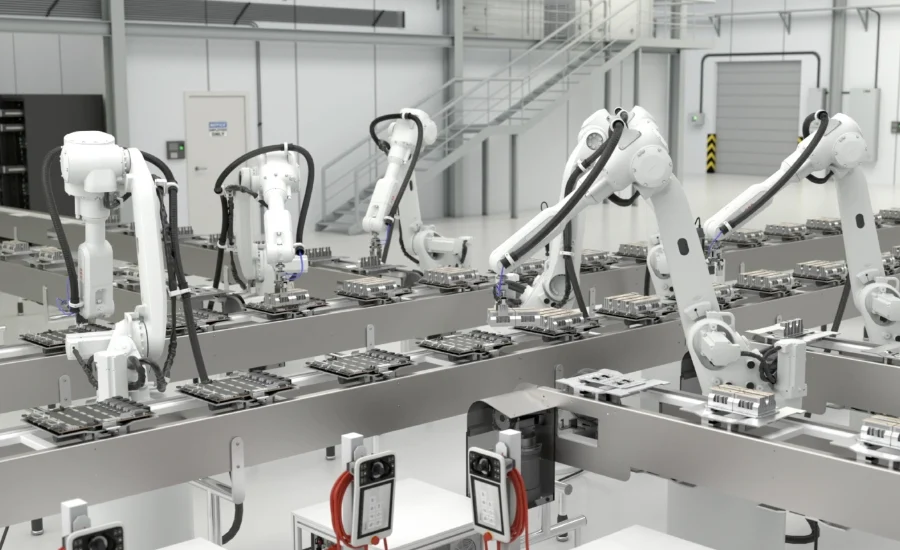
AUBURN HILLS, Mich. — In an era where modern manufacturing sectors face mounting pressure to accelerate production outputs without compromising quality or inflating overhead, industrial automation leader ABB Robotics has introduced a powerful new solution. The company has officially launched the IRB 1700 and IRB 1700ID, a pair of compact industrial robots engineered from the ground up to drastically reduce cycle times, maximize motion accuracy, and lower overall operating costs across high-demand precision manufacturing environments.
Targeting critical applications ranging from electronics manufacturing and automotive assembly to emerging high-tech sectors like AI server rack construction, the newly unveiled robot family is designed to offer manufacturers and system integrators unprecedented flexibility. According to preliminary data released by ABB, the IRB 1700 series delivers up to 20% shorter cycle times compared to competing models currently available on the global market.
Available across five distinct variants, the robots feature payload capacities ranging from 6 to 12 kilograms, bridging the gap between delicate handling tasks and heavier mechanical assembly workloads. Driven by ABB’s advanced OmniCore controller platform, the robots achieve path repeatability down to an astonishing 0.03 millimeters, paired with joint speeds reaching up to 700 degrees per second.
Beyond raw speed and precision, the architecture of the IRB 1700 series addresses long-standing industry demands for reduced energy consumption, smaller factory footprints, and minimized maintenance downtime. As global supply chains continue to navigate labor shortages and cost inefficiencies, automation platforms like the IRB 1700 represent a crucial evolutionary step for factory floors worldwide.
Chronology of Development: Evolution Toward the IRB 1700
The journey leading to the release of the IRB 1700 series reflects years of iterative engineering, customer feedback loop analysis, and the rapid maturation of artificial intelligence in industrial settings. Understanding the development timeline highlights why this particular launch marks a significant milestone for ABB Robotics.
The Foundation: The IRB 1600 Legacy
For over a decade, ABB’s IRB 1600 family stood as a dependable workhorse in global manufacturing facilities. Known for its ruggedness and reliability in material handling, arc welding, and machine tending, the IRB 1600 set high standards for mid-range payload manipulation. However, as electronics manufacturing grew increasingly miniaturized and automotive assembly lines demanded faster throughput to match electric vehicle (EV) production targets, the limitations of older architectures became apparent. Manufacturers required a machine that could maintain mechanical rigidity while operating at significantly higher velocities.
Integration of Next-Generation Control Systems
The turning point in the development of the IRB 1700 came with the maturation of ABB’s OmniCore controller ecosystem. Traditional robot controllers often struggled to balance high-speed joint movements with the micro-level path accuracy demanded by precision electronics and intricate welding tasks. By designing the IRB 1700 natively around the OmniCore platform, ABB’s engineers were able to unlock superior motion control algorithms, paving the way for features like EyeMotion and automatic collision-free path planning.
Prototype Testing and Commercial Deployment
Over the past two years, ABB subjected the IRB 1700 and IRB 1700ID variants to rigorous stress testing in simulated and live factory environments. Focus groups comprising tier-one automotive suppliers and electronics manufacturers provided critical insights into ergonomic integration, maintenance intervals, and software compatibility. The culmination of this multi-year R&D cycle is the official commercial launch in Auburn Hills, positioning the IRB 1700 as a future-proof asset for modern smart factories.
Supporting Data and Technical Specifications
To fully appreciate the capabilities of the IRB 1700 and IRB 1700ID, industry professionals must examine the underlying metrics. ABB has equipped the new series with a robust suite of technical specifications designed to outperform predecessors across every key performance indicator (KPI).
Performance Metrics at a Glance
- Cycle Time Reduction: Up to 20% faster than comparable market alternatives and previous-generation models.
- Payload Capacity: Ranges from 6 to 12 kilograms across five specialized variants.
- Path Repeatability: Exceptional precision down to 0.03 millimeters.
- Maximum Joint Speed: Up to 700 degrees per second, enabling rapid repositioning and high throughput.
- Energy Efficiency: Consumes up to 15% less power than the older IRB 1600 model when operating under identical payloads and paired with an OmniCore controller.
- Physical Footprint: Features a base footprint 50% smaller than its predecessor, significantly freeing up valuable floor space in cramped manufacturing cells.
- Maintenance Intervals: Extended service intervals of up to 20,000 hours between required oil changes, minimizing unplanned downtime.
Software Integration and AI Readiness
The hardware capabilities of the IRB 1700 are deeply intertwined with ABB’s comprehensive software portfolio. Both models support advanced programming and AI-enabled tools designed to simplify deployment and operational management:
- RobotStudio: ABB’s industry-leading simulation and offline programming software, allowing engineers to design, test, and optimize manufacturing cells virtually before physical installation.
- AI Robot Trainer: Streamlines the training process for complex manipulation tasks, reducing deployment timelines.
- OmniCore EyeMotion: Enhances visual responsiveness and path adaptation for dynamic assembly environments.
- Automatic Collision-Free Path Planning: Automatically calculates safe trajectories to prevent costly downtime caused by mechanical interference.
Official Responses and Industry Perspectives
The introduction of the IRB 1700 series has generated substantial commentary from corporate leadership and industry analysts alike. The consensus underscores a shifting market dynamic where manufacturers are no longer looking merely for speed, but for holistic efficiency encompassing energy savings, footprint reduction, and intelligent software integration.

Leadership Insights
Craig McDonnell, Managing Director of ABB Robotics’ Business Line Industries, emphasized the compounding pressures currently faced by industrial producers across multiple sectors.
"Precision manufacturing across sectors from electronics, automotive, to general industries is facing the pressure to produce more, while maintaining quality and reducing operating costs," stated McDonnell. "The IRB 1700 family addresses these challenges with a new level of speed, accuracy, reliability, and energy efficiency. It gives manufacturers and system integrators a flexible platform for high-performance automation."
McDonnell’s remarks highlight the reality of modern industrial ecosystems: profit margins are increasingly razor-thin, and factories must leverage technology that delivers immediate return on investment (ROI) while adapting to unpredictable market demands.
Perspectives from System Integrators
Early feedback from independent system integrators points to the IRB 1700’s smaller footprint and integrated internal cabling (particularly on the IRB 1700ID variant) as major engineering wins. In modern production cells, spatial optimization is paramount. By shrinking the robot’s physical base by 50% without sacrificing payload capability or reach, ABB has enabled integrators to design denser, more efficient manufacturing cells. This reduction in cell size directly translates to lower capital expenditure on facility infrastructure.
Implications for Precision Manufacturing and Beyond
The commercial release of the IRB 1700 series carries profound implications for several key industrial verticals. As global manufacturing undergoes a digital transformation driven by Industry 4.0 principles, the deployment of intelligent, high-speed automation assets reshapes competitive landscapes.
Transforming Electronics Assembly and Miniaturization
In the electronics sector, components continue to shrink while performance expectations skyrocket. Assembling smartphones, wearable devices, and micro-sensors requires sub-millimeter precision that fatigues human operators and challenges older robotic platforms. With a path repeatability of 0.03 mm and blazing-fast joint speeds, the IRB 1700 provides the exact fidelity needed for high-speed electronics placement and inspection tasks.
The Electric Vehicle (EV) and Automotive Boom
Automotive manufacturing is undergoing its most radical transformation in a century as production lines shift toward electric vehicles and advanced battery systems. These processes demand versatile automation capable of handling delicate wiring harnesses, precision arc welding for lightweight aluminum frames, and rapid machine tending for powertrain components. The IRB 1700’s multi-variant payload flexibility (6 to 12 kg) makes it exceptionally well-suited for these diverse automotive applications.
Pioneering AI Server Rack Assembly
One of the most notable application targets highlighted by ABB is AI server rack assembly. The explosive growth of generative artificial intelligence and cloud computing has fueled an unprecedented global demand for specialized server infrastructure. Assembling these dense, complex hardware racks requires high degrees of precision and repetitive reliability. By integrating the IRB 1700 into server manufacturing pipelines, tech hardware producers can accelerate production timelines to meet soaring data center expansion demands.
Sustainability and the Bottom Line
In an era defined by corporate sustainability mandates and fluctuating energy costs, the IRB 1700’s 15% reduction in power consumption is more than just a technical bullet point—it is a critical financial advantage. When multiplied across dozens or hundreds of robots operating continuously within a single mega-factory, energy savings translate to substantial reductions in carbon footprints and operational overhead. Furthermore, extended maintenance intervals of 20,000 hours reduce lubricant waste, spare parts consumption, and technician labor hours.
Conclusion
ABB Robotics’ launch of the IRB 1700 and IRB 1700ID series represents a significant leap forward in industrial automation technology. By successfully marrying a 20% increase in cycle speed with micro-level path repeatability (0.03 mm), a 50% smaller physical footprint, and a 15% reduction in energy consumption, ABB has delivered a comprehensive solution tailored to the rigorous demands of modern smart manufacturing.
As industries ranging from automotive and electronics to AI infrastructure face relentless pressure to boost output while controlling costs, platforms like the IRB 1700 provide the agility, precision, and efficiency required to stay competitive. Supported by advanced software ecosystems like RobotStudio and OmniCore, the IRB 1700 is poised to become an indispensable asset on factory floors around the globe, redefining what is possible in high-speed precision manufacturing.