Global renewable energy portfolios are expanding at an unprecedented rate, but the workforce managing them is not keeping pace. To bridge this critical efficiency gap, data platform AMMP has officially launched an innovative artificial intelligence solution tailored specifically for renewable energy asset managers.
Main Facts
Data platform AMMP has officially introduced a groundbreaking product category to the clean energy sector: an AI "coworker" engineered explicitly for renewable energy project asset management. Named Ray, this inaugural digital employee is designed to integrate seamlessly into existing asset management workflows, operating directly within the communication and operational tools teams already use every day.
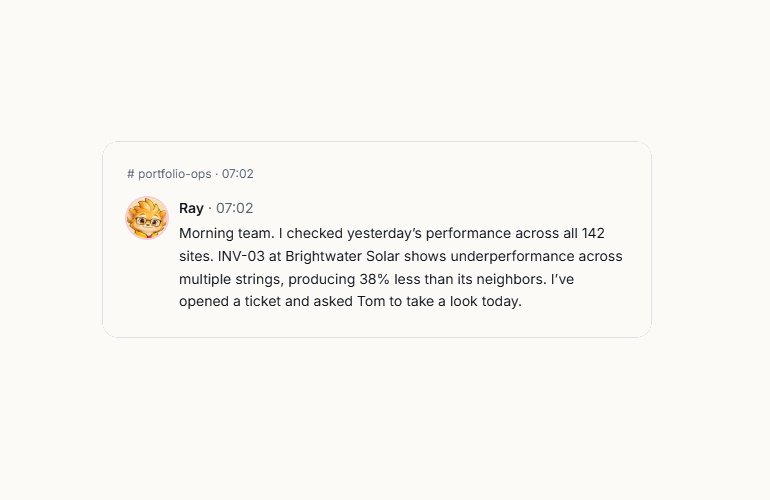
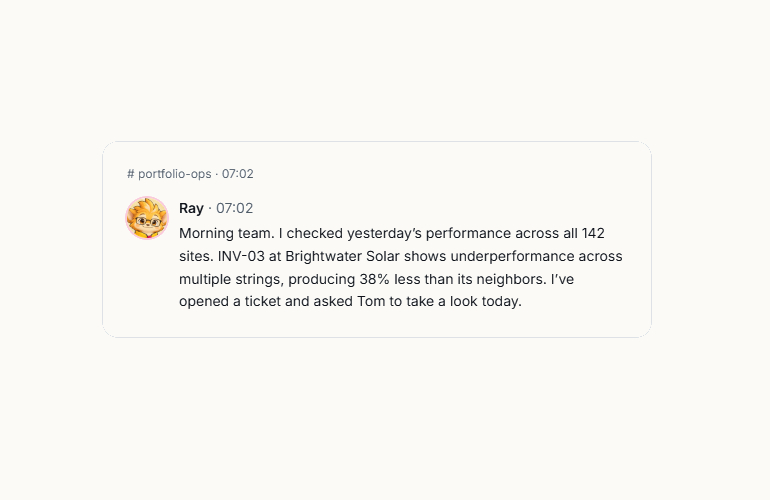
Unlike traditional monitoring software that merely alerts operators to data anomalies, Ray goes a crucial step further. It actively diagnoses operational issues, articulates root causes in plain language, and drafts the necessary reports, warranty claims, and managerial decisions that follow.
By embedding itself into popular workplace environments such as Slack, Microsoft Teams, and the proprietary AMMP OS, Ray provides comprehensive coverage across heterogeneous portfolios comprising solar photovoltaic (PV), wind turbines, and utility-scale battery energy storage systems (BESS). Rather than waiting for human prompts, Ray proactively flags emerging operational friction, coordinates cross-functional responses by bringing the right personnel into the loop, and shoulders the heavy administrative burden that currently bogs down asset management professionals.
Chronology
The launch of Ray represents the culmination of years of industry observation and technological development by AMMP, charting a strategic evolution from a pure data monitoring utility to an active AI-driven operational partner.
- The Pre-AI Era of Asset Management: For over a decade, renewable energy asset management relied heavily on fragmented dashboards. While SCADA systems and monitoring platforms excelled at collecting millions of data points from disparate wind, solar, and storage sites, they suffered from a fundamental limitation: they presented information without executing action. Asset managers remained buried in manual oversight tasks.
- Identification of the Scalability Bottleneck: As global renewable capacity exploded—often growing at double-digit compound annual growth rates—portfolio owners realized that headcount could not scale linearly with asset acquisition. A single asset manager found themselves responsible for gigawatts of capacity spread across multiple continents, disparate regulatory frameworks, and legacy data silos.
- Development of AMMP OS and Foundation Models: Recognizing that traditional software was no longer enough, AMMP began laying the groundwork for generative and analytical AI integration. The engineering teams focused on building a trusted, centralized data fabric capable of ingesting high-frequency operational data alongside complex contractual agreements.
- The Birth of Ray: AMMP conceptualized Ray not as another dashboard or plug-in tool, but as a functional team member. The AI was trained on the specific operational nuances of renewable generation, enabling it to bridge the gap between raw data streams and executive decision-making.
- Global Launch and Deployment: AMMP officially unveiled Ray to the global market, positioning the AI coworker as an immediate operational force multiplier designed to tackle day-one workloads for stretched asset management teams across solar, wind, and storage sectors.
Supporting Data
To understand the urgent necessity for an AI coworker like Ray, one must examine the staggering quantitative realities of modern renewable energy portfolios.
The Scaling Imbalance
Contemporary renewable energy portfolios are characterized by extreme hyper-growth. According to recent industry estimates, a single asset manager now frequently oversees hundreds of distinct generation and storage sites spanning multiple continents. These sites do not run on uniform technology; a typical enterprise portfolio may include poly-crystalline and thin-film solar panels, onshore wind turbines of various nameplate capacities, and lithium-ion or flow battery storage systems. Each asset class operates under entirely different original equipment manufacturer (OEM) warranties, power purchase agreements (PPAs), and grid-connection codes.
The Administrative Burden
Data indicates that up to 60% to 70% of an asset manager’s time is currently consumed by non-generating, administrative tasks rather than strategic optimization. Key time sinks include:
- Financial Reconciliation: Continuously checking real-world generation and revenue performance against complex financial models and pro forma assumptions.
- Alarm Fatigue: Triage and management of thousands of recurring, often low-priority operational alarms generated daily by SCADA systems.
- Contract Compliance: Manually reviewing hundreds of pages of Operations & Maintenance (O&M) and asset management agreements to determine liability during equipment underperformance or outages.
- Reporting Overhead: Compiling granular monthly, quarterly, and annual performance reports for institutional investors, debt providers, and asset owners using fragmented spreadsheets.
Integration Metrics
Ray is engineered to operate across the modern clean energy tech stack. By bridging the gap between raw telemetry and human execution, early benchmark testing within AMMP’s ecosystem indicates a dramatic reduction in administrative turnaround times—cutting report-drafting phases from days to minutes and drastically accelerating the identification of hidden revenue leaks, such as uncollected liquidated damages from O&M contractors.
Official Responses
The leadership at AMMP emphasizes that Ray is not designed to replace human expertise, but rather to augment human intelligence in an industry facing severe talent shortages and margin pressures.
"The energy transition needs asset management teams to do more with what they already have. Our job is to put AI to work for them, safely and on data they trust. Ray is the first step: a coworker who joins the team and takes on real work from day one," stated Svet Bajekov, CEO and Co-Founder of AMMP.
Bajekov’s remarks underscore a central philosophy of AMMP’s new strategic roadmap: trust and safety. In the energy sector, where errors can result in millions of dollars in lost revenue, grid penalties, or catastrophic equipment failure, hallucination-prone generic AI models are unacceptable. Ray operates strictly within bounded, verified operational data ecosystems, ensuring that every insight provided and every report drafted is grounded in absolute operational truth.
Industry analysts have similarly noted that the introduction of specialized vertical AI—such as Ray—marks a maturation phase in climate tech. Software is no longer just digitizing analog processes; it is taking over cognitive execution layers within enterprise workflows.
Implications
The commercialization of AI coworkers like Ray carries profound implications for the renewable energy asset management sector, the broader energy transition, and the future of white-collar work within the green economy.
1. Re-defining Asset Management Economics
Historically, scaling a renewable energy portfolio required a proportional increase in operational expenditure (OpEx) dedicated to back-office personnel, engineering oversight, and administrative staff. Ray disrupts this linear economic model. By allowing a lean team to effectively manage twice or three times as many assets without a corresponding drop in oversight quality, AMMP is fundamentally lowering the levelized cost of ongoing asset management. This margin preservation is particularly vital as subsidy regimes mature, merchant risk increases, and yield-focused institutional investors demand tighter cost controls.
2. Eliminating Revenue Leakage through Proactive Triage
In large-scale solar and wind farms, millions of dollars are lost annually due to "silent failures"—sub-optimal performance degradation that does not trigger hard system shutdowns but severely impacts yield over time. Traditional monitoring platforms log these discrepancies, but human asset managers, overwhelmed by alarm fatigue, often fail to investigate them until quarterly reviews are conducted. Ray’s continuous, proactive monitoring shifts the paradigm from reactive management to preventative optimization. By instantly drafting warranty claims or dispatching O&M teams the moment an anomaly matches a contractual breach profile, asset owners capture immediate financial upside.
3. Mitigating the Renewable Sector’s Talent Shortage
The rapid global push toward net-zero emissions has created a severe skills gap. There simply are not enough experienced renewable energy asset managers, data analysts, and compliance officers entering the workforce to keep pace with the trillions of dollars flowing into clean energy infrastructure. By delegating mundane administrative duties—such as data aggregation, initial report drafting, and routine correspondence—to an AI coworker, junior and mid-level personnel are freed up to focus on high-value strategic planning, risk mitigation, and portfolio expansion. Furthermore, Ray acts as a digital mentor, guiding newer employees through complex contractual and operational frameworks.
4. Setting a New Standard for Enterprise AI in Heavy Industry
The deployment of Ray signals a broader shift in how vertical software-as-a-service (SaaS) companies will survive and thrive in the era of generative AI. General-purpose Large Language Models (LLMs) struggle with the deterministic, high-stakes requirements of physical infrastructure management. By embedding domain-specific AI directly into operational tools (Slack, Teams, AMMP OS) where domain professionals already collaborate, AMMP has established a blueprint for how AI can safely penetrate mission-critical industrial sectors.
Conclusion
As the renewable energy transition accelerates toward terawatt-scale deployment, the complexity of managing clean energy assets will only intensify. Solutions like AMMP’s Ray demonstrate that the future of asset management lies not in building more complex dashboards for humans to stare at, but in deploying intelligent digital coworkers capable of doing the heavy lifting alongside them. For renewable energy asset managers drowning in data and starved for time, Ray’s arrival cannot come soon enough.