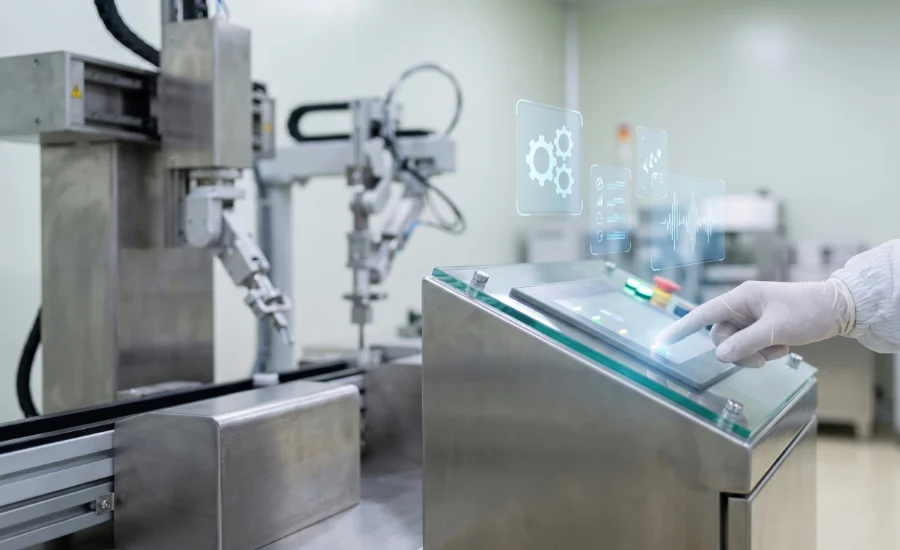
BIRMINGHAM, Mich. — In a landmark move poised to accelerate the convergence of artificial intelligence and industrial automation, Amazon Web Services (AWS) has officially unveiled an open-source Physical AI Toolchain. Designed from the ground up to empower manufacturers, systems integrators, and robotics developers, the newly launched platform provides a comprehensive suite of resources to build, train, simulate, and deploy intelligent robots and autonomous machines within complex industrial environments.
Built on robust AWS cloud infrastructure and deeply integrated with cutting-edge NVIDIA Physical AI technology, the toolchain bridges a critical gap in modern engineering. It supplies developers with a unified ecosystem of software and hardware acceleration tools needed to create machines that do not merely execute hardcoded instructions, but can actively perceive their surroundings, make autonomous decisions, and adapt dynamically to shifting shop-floor conditions.
The announcement comes at a pivotal time for global manufacturing. As supply chain volatility, labor shortages, and rising demand for customization push factories to modernize, the need for flexible, intelligent automation has never been more urgent. By streamlining the development lifecycle of everything from collaborative assembly robots (cobots) to advanced humanoid systems, AWS and NVIDIA are aiming to turn the factory of the future into an everyday reality.
Main Facts: What is the AWS Physical AI Toolchain?
The newly introduced Physical AI Toolchain is an end-to-end, open-source platform tailored explicitly for industrial robotics and autonomous machine development. Rather than forcing engineering teams to stitch together disparate software frameworks, the platform unifies the entire development lifecycle into five distinct, streamlined stages:
- Synthetic Data Generation: Creating massive, varied virtual datasets to train machine learning models without relying solely on scarce or expensive real-world data.
- Model Training: Utilizing high-performance cloud compute to train sophisticated neural networks and robotic foundation models.
- Simulation and Validation: Testing robotic behaviors, safety protocols, and operational limits in hyper-realistic virtual environments before physical deployment.
- Edge Deployment: Seamlessly pushing trained models from the cloud down to physical hardware on the factory floor.
- Continuous Improvement: Capturing real-world operational telemetry and performance data to feed back into the models, ensuring that machines continuously learn and optimize over time.
Under the hood, the architecture relies on a powerhouse of cloud and hardware technologies. It incorporates Amazon SageMaker for scalable model training, Amazon EC2 GPU instances to drive complex physics simulations, AWS IoT Greengrass for reliable edge deployment, and Amazon Bedrock AgentCore for advanced orchestration. Crucially, these AWS services are tightly integrated with NVIDIA’s Isaac Sim, Isaac Lab, GR00T, and Cosmos technologies, providing state-of-the-art simulation and generative AI capabilities tailored for robotics.
Crucially, the platform is modular. Manufacturers and developers are not locked into an all-or-nothing proposition; they can adopt the entire end-to-end development stack or cherry-pick individual components that seamlessly integrate with their existing legacy manufacturing execution systems (MES) and enterprise resource planning (ERP) software.
Chronology of Development and Industry Adoption
The release of the Physical AI Toolchain is the culmination of years of escalating convergence between cloud computing giants and specialized AI hardware developers. While cloud providers have long offered foundational machine learning tools, general-purpose IT infrastructure has historically struggled to meet the real-time, deterministic, and spatial computing demands of industrial robotics.
The journey toward this collaboration gained significant momentum as generative AI crossed over from natural language and computer vision into physical embodiment—often referred to as "Physical AI" or "Embodied AI." Recognizing that engineering teams were spending the vast majority of their time building underlying infrastructure rather than innovating on core robot intelligence, AWS accelerated its industrial robotics strategy.
Even prior to this broad commercial rollout, AWS quietly worked alongside a vanguard of pioneering robotics and AI companies to stress-test and refine the toolchain. Early adopters span several critical areas of the robotics ecosystem:
- NEURA Robotics: Collaborating with AWS to develop cognitive humanoid robots equipped with the ability to learn directly from human experience and adapt to unstructured workspace environments.
- RLWRLD: Leveraging the toolchain’s robust training infrastructure to build an 8.1-billion-parameter foundation model dedicated to complex robotic manipulation tasks, including fine-motor grasping, object rotation, and delicate material handling.
- Config: Developing a massive data pipeline containing upwards of 200,000 hours of recorded robot action data. This pipeline serves as a critical training resource, allowing developers to synthesize diverse edge-case scenarios and accelerate model training times.
These early integrations signal that the toolchain is not merely a theoretical concept, but a battle-tested architecture ready to tackle demanding commercial use cases.
Supporting Data and Technical Architecture
To understand the transformative potential of the AWS Physical AI Toolchain, one must examine the friction points it eliminates in contemporary robotic engineering. Traditionally, developing an autonomous mobile robot (AMR) or an intelligent robotic arm required navigating a fragmented landscape of proprietary software, custom middleware, and disconnected simulation environments.
Engineering teams typically spent up to 70% of their project lifecycles on non-value-added infrastructure tasks—such as provisioning GPUs, configuring ROS (Robot Operating System) bridges, managing data pipelines, and writing custom integration code for edge devices.
The AWS and NVIDIA collaboration directly targets this inefficiency through deep architectural integration:

- Simulation at Scale: By utilizing Amazon EC2 GPU instances running NVIDIA Isaac Sim and Isaac Lab, developers can run thousands of parallel simulations simultaneously. This allows an autonomous robot to experience years of operational trial-and-error in a matter of hours, safely testing edge cases—such as sudden human intervention, equipment failure, or unexpected obstacles—that would be dangerous or destructive to test in a physical facility.
- Foundation Models and Generative AI: The inclusion of NVIDIA GR00T and Cosmos technologies enables robots to leverage multi-modal foundation models. Instead of programming a robot for every single SKU it might encounter on an assembly line, developers can train models that understand general spatial concepts and object affordances, allowing the machine to generalize its skills to new, unseen objects.
- Edge Intelligence and Orchestration: Once a model is validated in simulation, AWS IoT Greengrass ensures secure, reliable deployment to physical edge hardware. Meanwhile, Amazon Bedrock AgentCore handles the complex orchestration required when fleets of heterogeneous robots—such as AMRs working alongside articulated arms and humanoids—must coordinate tasks dynamically across a sprawling shop floor.
Official Responses and Industry Perspectives
Industry leaders have been quick to highlight the strategic importance of the toolchain, emphasizing its potential to democratize advanced robotics development across enterprises of all sizes.
"Physical AI is going to touch every industry that moves, builds, or makes things, and our customers are moving fast to capture that opportunity," said Uwem Ukpong, Vice President of AWS Industries.
Ukpong underscored the core philosophy driving the platform’s creation: "We built the Physical AI Toolchain on AWS because customers told us that too much of their engineering effort was going to infrastructure instead of innovation. We want to flip that."
By lifting the heavy burden of infrastructure management off the shoulders of engineering departments, AWS is enabling smaller manufacturing firms and specialized robotics startups to compete with global conglomerates in deploying state-of-the-art automation.
Analysts point out that open-source flexibility is another critical win for the market. By allowing manufacturers to adopt modular components, AWS ensures that companies do not have to rip and replace their existing automation investments. Whether an enterprise is looking to upgrade its synthetic data generation pipeline or overhaul its entire simulation-to-edge deployment workflow, the toolchain accommodates incremental modernization.
Implications for the Future of Manufacturing and Assembly
The launch of the AWS Physical AI Toolchain carries profound implications for the future of manufacturing, assembly operations, and the broader industrial workforce.
1. Accelerated Time-to-Market for Custom Automation
Historically, commissioning a custom robotic cell for a complex assembly process could take months or even years of iterative physical prototyping. By shifting the vast majority of testing, validation, and training into hyper-realistic cloud simulations powered by NVIDIA technology, manufacturers can slash development cycles from years to weeks. This agility is vital as product lifecycles shrink and consumer demand shifts toward highly customized goods.
2. The Rise of Truly Autonomous, Adaptive Factories
Traditional industrial automation is rigid; robots execute repetitive paths with pinpoint accuracy, but they falter the moment a part is out of place or a variable changes. Physical AI changes the paradigm. Robots trained on comprehensive cloud toolchains can reason, adapt, and collaborate safely alongside human workers. Collaborative robots (cobots) and humanoid systems can learn new assembly steps simply by watching a human operator perform the task once via video demonstration or virtual guidance.
3. Bridging the Engineering Skills Gap
The manufacturing sector faces a well-documented talent shortage, struggling to recruit engineers who possess expertise in both mechanical systems and advanced artificial intelligence. By abstracting complex distributed computing, GPU provisioning, and data pipeline management into streamlined, intuitive workflows, the AWS toolchain lowers the barrier to entry. General manufacturing engineers can focus on process optimization and workflow design rather than low-level machine learning infrastructure.
4. Continuous, Data-Driven Optimization
Factory optimization has traditionally been a periodic exercise involving manual audits and engineering reviews. With edge-to-cloud telemetry loops enabled by Amazon SageMaker and AWS IoT Greengrass, manufacturing lines become living, learning systems. Operational data collected from physical machines continuously refines training models in the cloud, allowing the entire fleet of robots to become smarter, faster, and more efficient with every shift worked.
Conclusion
As global competition intensifies and customer expectations shift toward hyper-customization, the industrial sector is undergoing a generational transformation. The introduction of the AWS Physical AI Toolchain, backed by NVIDIA’s industry-leading simulation and generative AI ecosystem, represents a massive leap forward.
By providing a modular, open-source, and comprehensive platform that addresses every stage of the robotic development lifecycle, AWS and NVIDIA are not just releasing software—they are laying the foundational infrastructure for the autonomous enterprise. For manufacturers willing to embrace this shift, the promise is clear: less time spent managing infrastructure, and vastly more room for unprecedented innovation.