In a move that promises to accelerate the maturation of the robotics industry, Amazon Web Services (AWS) has unveiled an open-source "Physical AI Toolchain." This comprehensive framework is engineered to simplify the notoriously difficult journey of taking a robotic system from initial data collection to real-world deployment. By integrating AWS’s cloud infrastructure with NVIDIA’s advanced robotics software stack, the initiative aims to solve the "plumbing" problems that have long hampered the commercial scaling of intelligent, autonomous robots.
The Core Challenge: Connecting the Robotics Pipeline
For years, the robotics industry has suffered from a fragmented development ecosystem. While advancements in Large Language Models (LLMs) have thrived on the abundance of internet-scale data, physical robots face a much more hostile environment. They operate in the real world, where data is scarce, safety-critical, and highly dependent on environmental variables.
The new AWS Physical AI Toolchain is designed to act as an "easy button" for developers. According to Sri Elaprolu, director of Frontier AI Science and Engineering at AWS, the primary goal is to abstract away the underlying infrastructure so that engineers can focus on the core intelligence of the machine.
"We’re trying to make this easy button, if you will, so that people can actually focus on the problem that they’re trying to solve rather than having to worry about all of the infrastructure," Elaprolu explained. By streamlining the workflow, AWS hopes to lower the barrier to entry for startups and established enterprises alike.
Chronology: From RoboMaker to a Unified Ecosystem
To understand the significance of this launch, one must look at the evolution of AWS’s robotics strategy. In 2025, AWS shuttered "RoboMaker," its cloud-based simulation platform. While the move was seen by some as a retreat, it was, in reality, a strategic pivot.
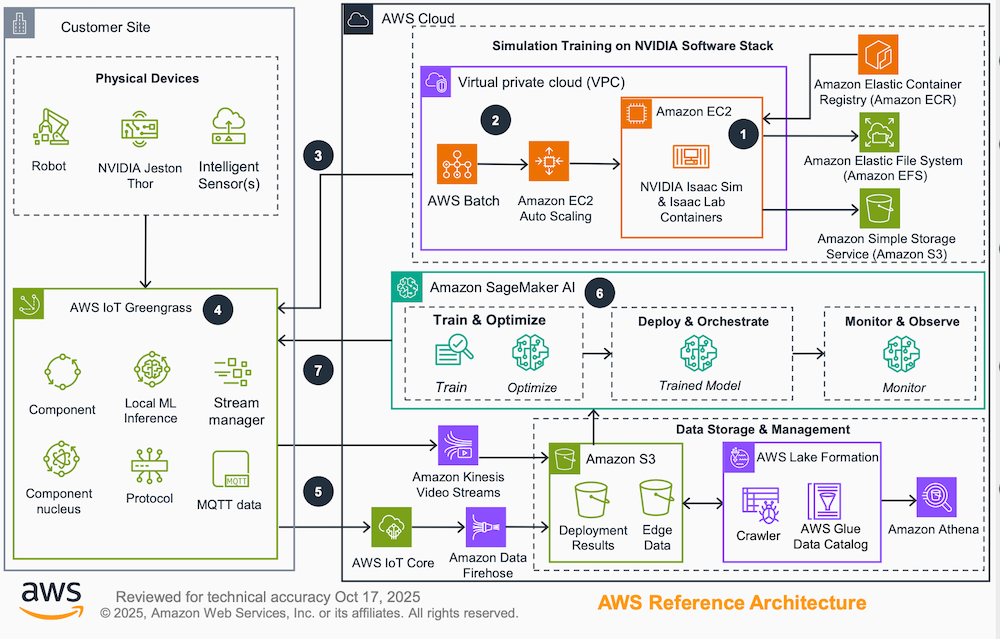
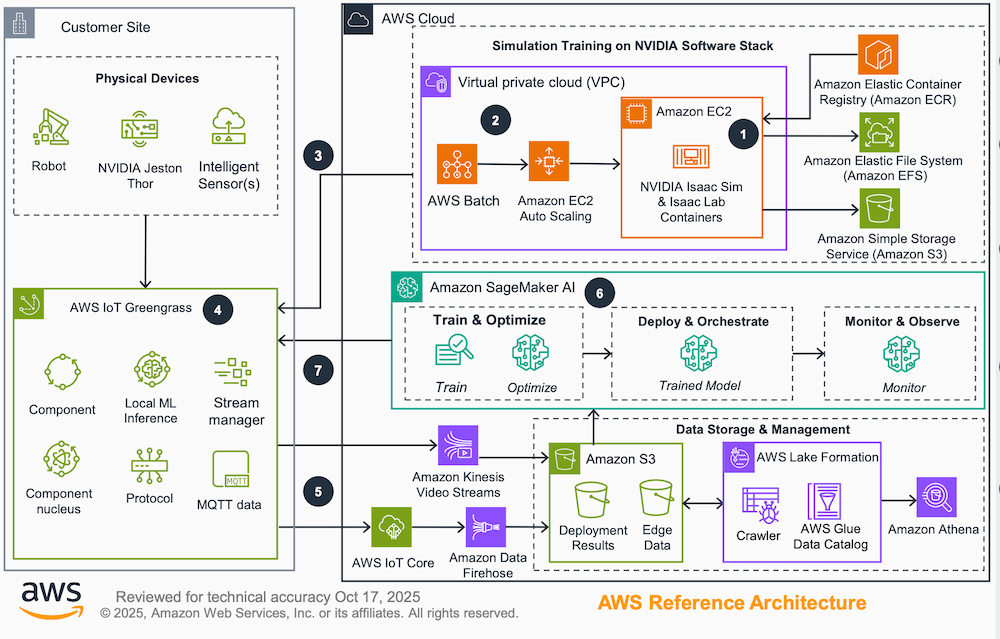
RoboMaker, while innovative, was a siloed tool. The new Physical AI Toolchain represents a departure from single-point solutions toward a holistic "development lifecycle" approach. It does not replace the utility of simulation; rather, it elevates it. The toolchain incorporates five critical pillars of AI development:
- Synthetic Data Generation: Creating high-fidelity virtual scenarios to train models where real-world data is too dangerous or expensive to acquire.
- Model Training: Leveraging Amazon SageMaker to process massive datasets.
- Simulation and Validation: Testing "the brain" in a virtual environment before a single bolt is turned on the hardware.
- Edge Deployment: Using AWS IoT Greengrass to push optimized models to robots operating in the field.
- Continuous Improvement: Closing the loop by streaming performance data from the field back into the cloud to retrain and refine the model.
Supporting Data: The NVIDIA Integration
The partnership with NVIDIA is arguably the most critical component of this release. By embedding NVIDIA’s Isaac Sim, Isaac Lab, Isaac GR00T, and Cosmos software, AWS is providing a "best-in-class" development environment.
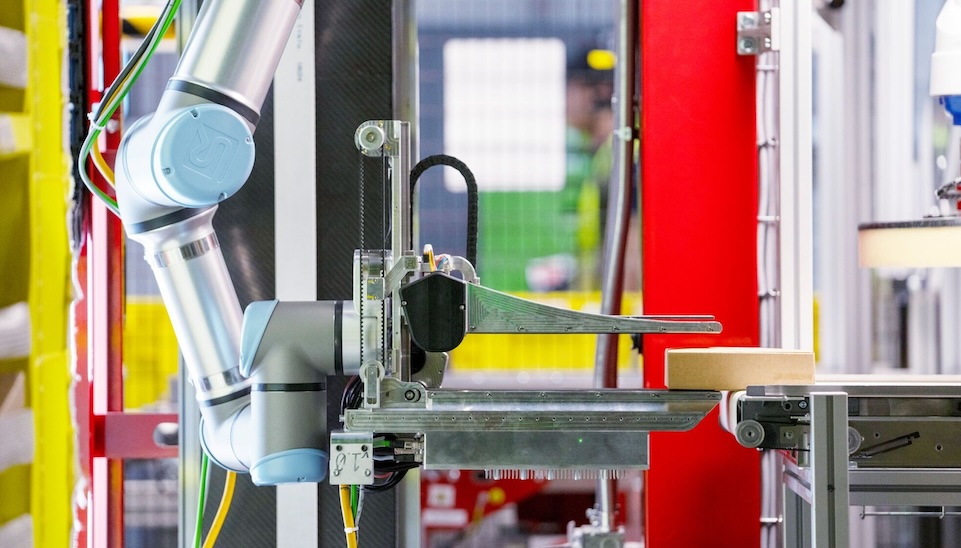
The data requirement for Physical AI is significantly more demanding than for traditional software. Because there is no "internet of robot actions," developers must rely heavily on synthetic data. As Elaprolu noted, "The amount of data that you need to train these models is significant… So how do you generate that data? How do you generate synthetic data that is representative of the real world? That’s one of the things that we’re trying to solve."
By enabling a seamless feedback loop—where a robot in a warehouse or a convenience store encounters an edge case, records that data, and sends it to the cloud for synthetic augmentation and re-training—the toolchain allows for the "continual iteration of the brain."
Lessons from the "Vulcan" Era
Amazon’s own internal robotics division serves as the most rigorous testing ground for these tools. With over one million robots deployed in its global fulfillment network, Amazon has encountered every possible failure mode in automated logistics.
The "Vulcan" robot, recently named The Robot Report’s 2026 Robot of the Year, is a prime example of the high-dexterity future AWS is targeting. Vulcan’s ability to use tactile sensing to pick and stow items—tasks that were once thought impossible for machines—is the result of the very same developmental philosophy now being made available to the public.
However, AWS recognizes that the controlled environment of a warehouse is only the beginning. The toolchain is intentionally "hardware-neutral," acknowledging that the future of robotics will not be a monolith. Whether it is a humanoid robot in a retail environment or an autonomous excavator on a construction site, the underlying AI infrastructure needs to be agnostic.
Case Studies: Beyond the Warehouse
The versatility of the toolchain is already being demonstrated through various high-stakes applications:
- Retail Humanoids: Japanese robotics company Telexistence has already deployed over 300 humanoid robots in convenience stores. These environments are high-traffic and unpredictable, requiring the "high response rates and low fault tolerance" that the AWS/NVIDIA stack is designed to support.
- Autonomous Construction: Bedrock Robotics is utilizing AWS cloud training to power autonomous excavators. By training models in the cloud and deploying them to heavy machinery, they are removing the operator from hazardous zones, showcasing how Physical AI extends far beyond stationary indoor settings.
- Dexterity and Tactile Sensing: In collaboration with South Korean firm RLWRLD, AWS has been working to overcome the limitations of five-finger dexterity. By developing specialized models that go beyond standard vision-based AI, they are pushing the boundaries of what machines can "feel."
Implications: A New Era for Roboticists
The release of this toolchain as an open-source project is a strategic "force multiplier" for the robotics industry. By providing a common foundation, AWS is essentially standardizing the "Operating System for Physical AI."
1. Accelerating Time-to-Market
Startups that previously had to dedicate 60% of their engineering hours to building custom data pipelines can now pivot that talent toward high-value application development. The "packaging" of these complex services into a cohesive, ready-to-use workflow will likely result in a surge of new, specialized robotic solutions hitting the market over the next 24 months.
2. The Standardization of "Robot Intelligence"
As companies adopt this toolchain, the industry will naturally move toward a shared language of simulation, training, and deployment. This could lead to a future where models are more portable and interoperable between different hardware platforms, potentially sparking an "App Store" moment for robotics, where specialized behaviors (e.g., "advanced gripping" or "navigating dynamic crowds") can be bought or shared.
3. Safety and Reliability
Perhaps the most significant implication is the focus on continuous improvement. By making it trivial to update a robot’s "brain" via the cloud, the toolchain addresses the fear of obsolescence. Robots deployed today can become smarter tomorrow, without requiring hardware replacements. This "over-the-air" capability for physical intelligence is critical for widespread adoption in public spaces.
Conclusion
The AWS Physical AI Toolchain is more than just a collection of software; it is an admission that the robotics industry has reached a tipping point. We have moved past the era of custom, one-off builds and into an era of scaled, intelligent autonomy. By commoditizing the infrastructure of AI-powered robotics, AWS is betting that the next wave of industrial and social innovation will be powered by machines that can not only move but also "think" and "feel" in the real world.
As companies like Telexistence and Bedrock Robotics prove, the tools are ready. The challenge now rests on the shoulders of the developers to leverage this new architecture to build a safer, more efficient, and more autonomous future. Whether the industry is ready for the pace of change this toolchain will undoubtedly trigger remains to be seen, but one thing is certain: the "easy button" for robotics has finally arrived.