For years, the manufacturing sector has been promised a revolution driven by Artificial Intelligence (AI), machine learning, and autonomous systems. Yet, as factory floors attempt to bridge the gap between legacy hardware and modern software, a recurring, systemic hurdle has emerged: the data underlying these ambitious initiatives is often siloed, unstructured, or fundamentally incompatible with advanced computational models.
In response to this widespread "data readiness" crisis, Amazon Web Services (AWS) and industrial software provider HighByte have released a comprehensive 25-page white paper titled, “A Maturity Model for Industrial Data Management.” This document serves as a strategic roadmap for manufacturing organizations struggling to move beyond pilot projects toward scalable, AI-driven operations. By providing a structured framework for assessment, the authors aim to help manufacturers diagnose their current standing and identify the critical infrastructure gaps that must be closed before AI can deliver a meaningful return on investment.
Main Facts: The Anatomy of the Data Crisis
The premise of the white paper is simple but profound: AI is only as effective as the data it consumes. In industrial environments, this data is often trapped in proprietary programmable logic controllers (PLCs), disconnected sensors, and disparate legacy databases that do not "speak" the same language.
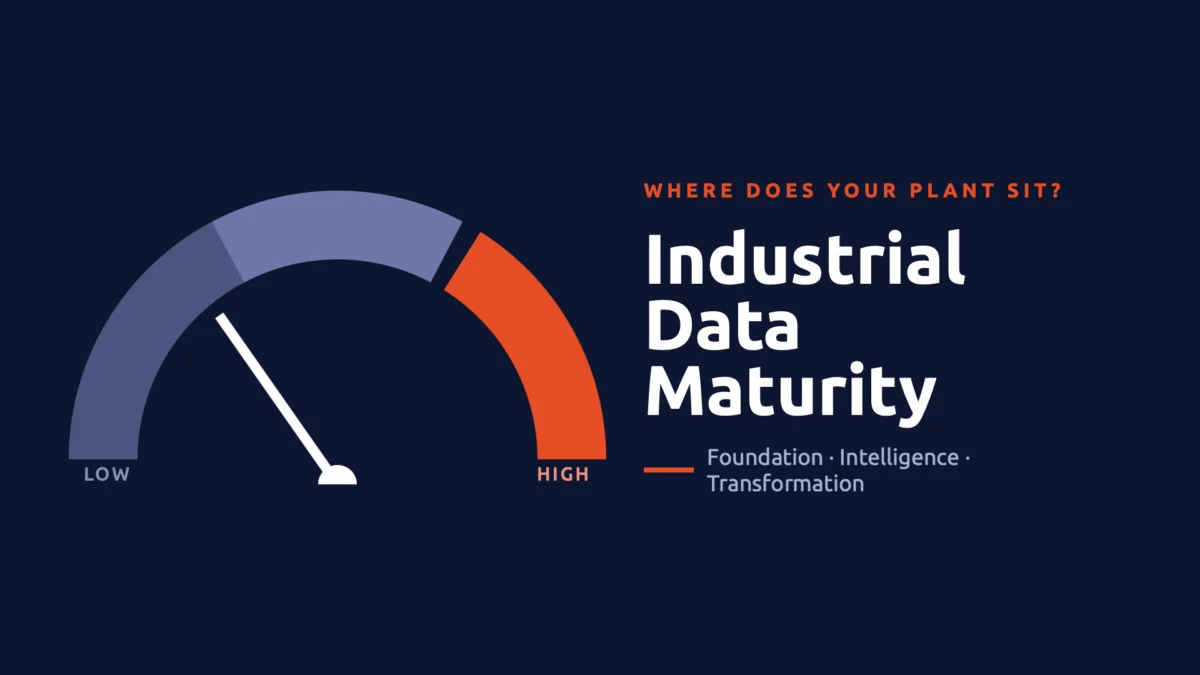
The Maturity Model for Industrial Data Management provides a tripartite framework that classifies an organization’s data health into three distinct tiers:
- Foundation: The bedrock of industrial data. This stage focuses on basic connectivity, data ingestion, and the establishment of fundamental governance policies. Without this stage, AI efforts are essentially "building castles on sand."
- Intelligence: The transition from mere data collection to actionable insight. This stage involves the implementation of advanced analytics, real-time monitoring, and the refinement of data quality to enable predictive modeling.
- Transformation: The apex of the model, characterized by autonomous operations and advanced AI integration. Here, the industrial data fabric is fully optimized, allowing for self-correcting processes and enterprise-wide automated decision-making.
By mapping these stages to specific technology stacks and operational requirements, the authors provide a diagnostic tool that prevents companies from prematurely investing in complex AI tools when their underlying data infrastructure is still in the "Foundation" phase.
Chronology: From Siloed Operations to Integrated Intelligence
The evolution of the industrial data landscape has been anything but linear. Historically, Operational Technology (OT) and Information Technology (IT) operated in separate spheres. OT focused on the stability and reliability of the plant floor, while IT focused on enterprise resource planning (ERP) and business systems.
- The Pre-Digital Era: Manufacturing data was primarily local, stored in physical logs or isolated, non-networked machines.
- The Early IIoT Wave (2010–2018): As the Industrial Internet of Things (IIoT) gained momentum, manufacturers rushed to connect machines. However, this often resulted in "data swamps"—massive collections of raw, uncontextualized data that provided little immediate value.
- The AI Hype Cycle (2019–2023): With the rise of generative AI and LLMs, the pressure to adopt AI in manufacturing reached an all-time high. Many firms pivoted toward AI projects, only to find that their data pipelines could not support the heavy lifting required for model training.
- The Current Era (2024–Present): The focus has shifted from "collecting everything" to "governing and contextualizing." The release of the AWS and HighByte white paper marks a turning point in this chronology, signaling that the industry is finally prioritizing the "plumbing" of digital transformation—data management—as a prerequisite for innovation.
Supporting Data: Why Readiness Matters
The urgency of this white paper is supported by broader industry trends. According to various industrial research reports, over 70% of digital transformation initiatives in manufacturing fail to scale beyond the pilot phase. The primary culprit? A lack of data integrity and accessibility.
The HighByte-AWS model introduces a 50-question assessment framework designed to quantify this readiness. These questions are categorized by role, ensuring that the burden of data maturity is distributed across the entire organization:
- Production Managers: Evaluated on their ability to track real-time OEE (Overall Equipment Effectiveness) and identify specific production bottlenecks.
- Maintenance Teams: Assessed on their maturity regarding predictive maintenance. Are they still using reactive "run-to-fail" strategies, or have they moved toward data-driven condition monitoring?
- Quality Personnel: Evaluated on their capacity to perform root-cause analysis by tracing defects back to specific machine parameters—a task that is impossible without clean, historical data.
- IT/OT Leaders: Examined on their data architecture. Are they relying on point-to-point integrations that are brittle and hard to maintain, or have they adopted a flexible "data fabric" approach?
The model generates a maturity score of Low, Medium, or High, providing a clear visual indicator of where leadership should direct capital expenditure. For an organization, moving from "Low" to "Medium" might involve standardizing data formats (e.g., OPC UA or Sparkplug), while moving from "Medium" to "High" might involve implementing edge-to-cloud data orchestration tools like the HighByte Intelligence Hub.
Official Responses and Strategic Perspectives
The collaboration between AWS and HighByte highlights a strategic synergy between cloud infrastructure and edge-level intelligence.
Ashtad Engineer, Worldwide Head of Manufacturing Solutions at AWS, notes that the complexity of modern manufacturing requires a unified view of the factory floor. "The goal of this white paper is to demystify the data management challenge," Engineer explains. "By leveraging the AWS Industrial Data Fabric, manufacturers can create a scalable, secure, and resilient data layer that serves as the foundation for all AI initiatives."
John Harrington, Chief Product Officer at HighByte, emphasizes the importance of the "edge" in this equation. "Many AI projects fail because the data is trapped at the edge, locked within proprietary machine protocols," says Harrington. "Our Intelligence Hub provides the necessary abstraction layer. This maturity model allows organizations to stop guessing about their readiness and start building a systematic pathway toward autonomy."
The white paper also features a dedicated section on "Generative AI Readiness," a timely inclusion given the current market frenzy. It cautions that Generative AI models are highly sensitive to "hallucinations" when fed poor-quality data. By ensuring that industrial data is contextualized at the source, manufacturers can mitigate risks and ensure that their AI models provide accurate, actionable insights rather than misleading outputs.
Implications: A Strategic Shift for Industry Leaders
The implications of adopting this maturity model are far-reaching for stakeholders across the manufacturing value chain.
1. The Death of the "Big Bang" Approach
The framework discourages the "Big Bang" approach—attempting to digitize the entire factory at once. Instead, it advocates for an incremental, stage-gate process. This reduces financial risk and allows organizations to realize value at each stage of maturity.
2. Bridging the IT/OT Divide
The model forces IT and OT teams to work from the same playbook. By providing role-based questions, it fosters a shared vocabulary between the shop floor (which values uptime and safety) and the data center (which values security and scalability).
3. Future-Proofing for Generative AI
As Generative AI continues to evolve, the ability to feed these models with "clean," high-fidelity industrial data will become a primary competitive advantage. Organizations that follow the maturity model will find themselves with a distinct "data moat" that their competitors, who remain stuck in the "Foundation" phase, will struggle to replicate.
4. Scalability Across Global Facilities
For multinational corporations, the model serves as a benchmarking tool. Executives can compare the data maturity of a plant in Ohio against a plant in Germany or Vietnam. This standardization allows for the global scaling of best practices, ensuring that a successful AI pilot in one facility can be replicated across the entire enterprise.
Conclusion: A Prerequisite for Progress
The manufacturing sector stands at a crossroads. While the allure of AI and autonomous operations is undeniable, the path forward is paved not with algorithms, but with data. The Maturity Model for Industrial Data Management by AWS and HighByte provides the necessary map for navigating this terrain.
By shifting the focus from "AI-first" to "Data-first," manufacturing leaders can avoid the pitfalls that have stalled digital transformation for the past decade. The white paper is not merely a theoretical exercise; it is a practical, actionable resource for those tasked with the difficult work of modernizing the backbone of the global economy. As industries continue to integrate the physical and digital worlds, those who master the lifecycle of their data will be the ones to define the future of production.
For those ready to undertake this journey, the framework offers a clear directive: assess where you are, identify the foundational gaps, and build a data-driven culture that can withstand the demands of the next generation of industrial technology.
For organizations looking to begin their assessment, the full white paper, “A Maturity Model for Industrial Data Management,” is available for download through the AWS and HighByte portals.