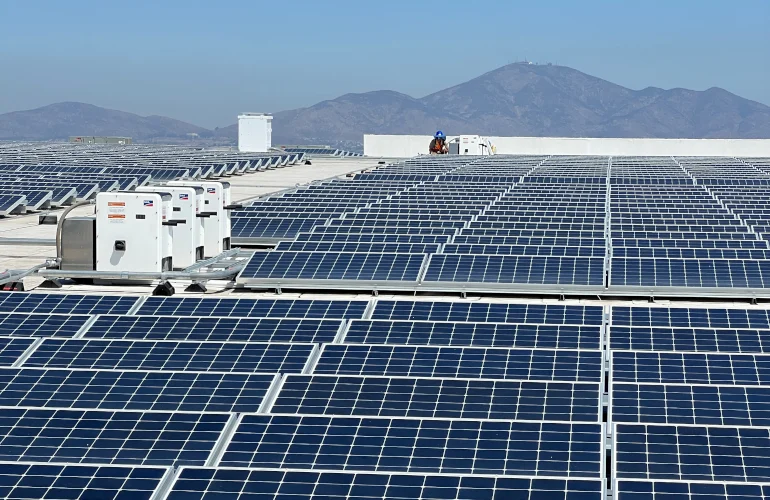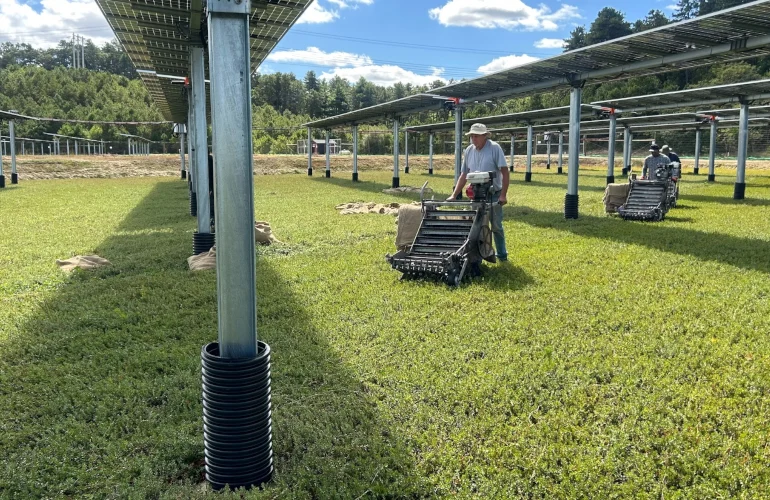
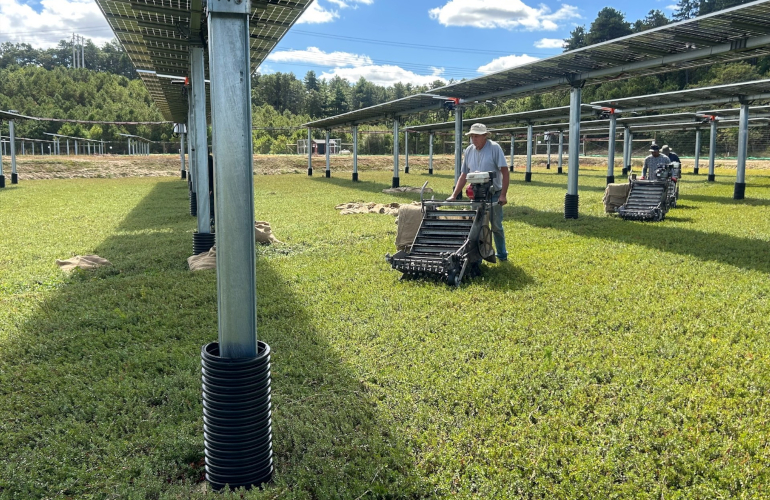
PLYMOUTH & KINGSTON, Mass. — In a groundbreaking fusion of renewable energy and heritage agriculture, the first successful commercial harvest of cranberries has been completed across two specialized agrivoltaics sites in southeastern Massachusetts. The milestone event, unfolding at the Black Cat Agrivoltaics Project in Plymouth and the Ring Road Agrivoltaics Project in Kingston, offers a compelling blueprint for how clean energy infrastructure can successfully coexist with some of the most sensitive and challenging agricultural ecosystems in the United States.
Owned by renewable energy developer Greenbacker Renewables and engineered and installed by Distributed Energy Infrastructure (DEI), the twin projects represent a paradigm shift in land-use efficiency. By erecting elevated solar arrays directly over active perennial cranberry bogs, project developers and agricultural stewards have unlocked a viable financial and ecological path forward for wetlands that were once considered economically unsustainable.
Industry analysts are watching the Massachusetts installations closely. As local land-use debates intensify nationwide over the siting of large-scale solar farms on agricultural acreage, the Black Cat and Ring Road initiatives provide empirical proof that clean energy production and traditional farming do not have to compete for space—they can thrive in symbiosis.
Main Facts
The core of this achievement lies in the innovative engineering required to bring industrial-scale solar technology into a flooded wetland environment without disrupting delicate perennial crops.
The initiative spans two distinct locations in Plymouth County, the historical heartland of American cranberry production:
- The Black Cat Agrivoltaics Project (Plymouth): This 1-megawatt (MW) solar installation is paired with a robust 2.7-megawatt-hour (MWh) battery energy storage system (BESS).
- The Ring Road Agrivoltaics Project (Kingston): A larger 4.4-MW solar array coupled with a substantial 13.5-MWh battery energy storage system.
Both projects are owned by Greenbacker Renewables, a leading independent power producer focused on sustainable infrastructure, and were constructed by DEI. Crucially, the dual-use installations are not merely aesthetic; they are fully functioning agricultural operations managed by veteran cranberry farmer Iain Ward. Under the operational model, the landowner receives predictable, diversified income through long-term land leasing for the solar infrastructure, while Ward earns a dual revenue stream encompassing agricultural management fees alongside the proceeds from the harvested cranberry crops.
The initiative’s technical and operational excellence has already drawn national industry recognition. Both the Black Cat and Ring Road projects were named finalists for the prestigious North American Agrivoltaics Awards. Furthermore, key stakeholders Ward and DEI are founding members of the Solar & Farming Association (SAFA), a vital coalition dedicated to championing the interests of agricultural producers, renewable energy developers, and livestock managers within the burgeoning agrivoltaics sector.
Chronology
The realization of the Black Cat and Ring Road agrivoltaics projects was far from an overnight success; it represents years of careful planning, regulatory navigation, engineering adaptation, and community collaboration.
Phase 1: Decline and Abandonment
Prior to the intervention of Greenbacker and DEI, both the Black Cat and Ring Road cranberry bogs were facing severe economic headwinds. Decades of fluctuating market prices for cranberries, combined with rising operational and water management costs, rendered the bogs financially unviable. Consequently, the parcels lay fallow for many years. Without intervention, these historical agricultural lands faced the continuous threat of commercial real estate development or permanent ecological degradation.
Phase 2: Conceptualization and Design (2022–2023)
Recognizing the untapped solar potential of the sun-drenched, open wetland footprints, project planners began conceptualizing a dual-use framework. However, building solar infrastructure over a wetland dedicated to a perennial fruit crop presented unprecedented engineering hurdles. Unlike standard dry-land installations utilizing pile-driven racking systems, cranberry bogs require seasonal flooding, specific soil hydrology management, and delicate handling of low-lying vines.
Iain Ward was brought into the planning process from its earliest stages. Working hand-in-hand with DEI’s engineering teams, Ward provided critical on-the-ground insights regarding root systems, harvesting machinery clearance, and water flow dynamics. This collaboration ensured that every design iteration prioritized the biological health of the cranberry vines.
Phase 3: Construction and Interconnection (2023–2025)
Construction required specialized low-impact machinery capable of navigating soft wetland soils without compacting the earth or damaging the underlying root network. Engineers designed elevated mounting structures tailored to the unique topography of the bogs. Simultaneously, electrical infrastructure and high-capacity battery energy storage systems (BESS) were integrated on the perimeter of the bogs to capture, store, and dispatch the generated solar energy cleanly to the local grid.
Phase 4: The Inaugural Harvest (Autumn 2026)
The multi-year effort culminated in the fall of 2026 with the gathering of the very first commercial crop grown beneath overhead solar panels. The successful harvest proved that the engineering adaptations were not only effective at protecting the plants during the construction phase, but that the perennial cropping system could continue to produce viable, high-quality yields under a canopy of photovoltaic modules.
Supporting Data and Technical Specifications
To fully understand the magnitude of the Black Cat and Ring Road achievements, it is necessary to examine the technical parameters and economic mechanics underpinning modern agrivoltaic systems.
| Project Name | Location | Solar Capacity (MW) | Storage Capacity (MWh) | Developer | Installer | Key Agricultural Manager |
|---|---|---|---|---|---|---|
| Black Cat | Plymouth, MA | 1.0 MW | 2.7 MWh | Greenbacker Renewables | DEI | Iain Ward |
| Ring Road | Kingston, MA | 4.4 MW | 13.5 MWh | Greenbacker Renewables | DEI | Iain Ward |
Economic Resiliency for Family Farms
The economics of traditional agriculture—particularly in legacy sectors like cranberry farming—are notoriously volatile. Crop yields fluctuate based on weather patterns, pest pressures, and global market gluts. By introducing agrivoltaics, landowners transform unproductive or marginally profitable acreage into dual-revenue-generating assets.
- Land Lease Revenues: The landowner receives a steady, inflation-hedged lease payment from Greenbacker Renewables for the use of the airspace and perimeter land.
- Agricultural Yields: Because the bogs are brought back into active cultivation rather than paved over or retired, the farmer continues to generate revenue from selling the harvested fruit.
- Management Compensation: Farmers like Iain Ward are compensated directly for their agricultural expertise, ensuring that traditional farming knowledge is preserved and monetized rather than displaced.
Grid Support and Energy Storage
The inclusion of massive battery energy storage systems—2.7 MWh at Black Cat and 13.5 MWh at Ring Road—highlights a critical evolution in solar deployment. Cranberry bogs often occupy rural or semi-rural distribution feeders where grid congestion can be an issue. By pairing solar generation with localized BESS, the projects can store excess midday generation and inject power into the ISO New England grid during peak demand hours, enhancing regional grid stability and maximizing the economic value of the generated clean energy.
Official Responses and Industry Perspectives
The success of the Massachusetts projects has generated considerable excitement across both the renewable energy and agricultural sectors. Leaders from across the development, farming, and advocacy spectrum have praised the collaborative approach taken at Black Cat and Ring Road.
Iain Ward, the cranberry farmer who manages the bogs and guided the project’s physical implementation, emphasized the cooperative nature of the build:
"The DEI team was phenomenal at understanding and adapting solar construction so that energy production could coexist without damage to the perennial cropping system. These projects prove that with the right approach, dual-use solar can be applied to a wide variety of agricultural environments. If we can build over such challenging wetland areas and have successful harvests, we can build almost anywhere."
Prateek Tare, Executive Vice President and co-founder of Distributed Energy Infrastructure (DEI), highlighted the engineering triumphs and the necessity of farmer collaboration:
"Building solar projects over active perennial wetland crops was an exciting challenge, and we’re thrilled to see the success of these harvests. Iain’s collaboration and input at every stage was essential for us to ensure a reliable, cost-effective build while safeguarding the productivity of these heritage bogs."
The ethos of cooperation demonstrated by Ward and DEI extends beyond these two specific sites. As founding members of the Solar & Farming Association (SAFA), both men are actively working to establish best practices, policy frameworks, and industry standards that will govern future agrivoltaic developments across North America. SAFA serves as a vital bridge between agricultural producers who wish to protect their land and renewable energy companies seeking viable sites for decarbonization.
Implications for the Future of Agrivoltaics
The successful harvest at the Black Cat and Ring Road bogs carries profound implications for the future of land-use planning, climate policy, and agricultural economics, both in Massachusetts and nationwide.
1. Overcoming the "Food vs. Fuel" Debate
One of the most persistent criticisms leveled against utility-scale solar development is the conversion of productive farmland into industrial energy installations—often framed as a zero-sum game between food security and clean energy production. Agrivoltaics dismantles this false dichotomy. By proving that solar panels can be elevated above sensitive, flooded wetland crops like cranberries, the Massachusetts projects demonstrate that land can simultaneously generate zero-emission electrons and agricultural commodities.
2. A Blueprint for Challenging Terrains
Cranberry bogs are among the most ecologically sensitive and hydrologically complex agricultural environments in the world. They require specific sandy soils, intricate canal and ditch networks for seasonal flooding, and delicate management of perennial vines. If engineering firms can successfully construct multi-megawatt solar and storage facilities over active wetland bogs without destroying yields, the barrier to entry for other complex agricultural settings—such as orchards, vineyards, and rolling pastures—drops significantly. As Ward noted: "If we can build over such challenging wetland areas and have successful harvests, we can build almost anywhere."
3. Revitalizing Heritage Agriculture and Rural Economies
Many small- and medium-sized family farms struggle to survive economic pressures, generational transition hurdles, and climate volatility. Agrivoltaics offers a lifeline. By providing landowners with a guaranteed, long-term secondary income stream via lease payments, solar energy infrastructure can subsidize the high costs of farming, keeping heritage lands in agricultural hands rather than forcing sell-offs to residential or commercial developers.
4. Policy and Regulatory Evolution
State and local regulatory bodies have historically struggled to evaluate dual-use solar projects, often applying rigid zoning codes designed for either pure agriculture or standard ground-mounted solar fields. The verified success of the Plymouth and Kingston projects provides municipal planners, state legislators, and environmental regulators with real-world data to draft progressive, supportive zoning frameworks. States seeking to meet ambitious net-zero carbon reduction targets while preserving their rural heritage would do well to study the regulatory and design framework established by Greenbacker, DEI, and Iain Ward.
Conclusion
The harvest of the first cranberries from beneath the solar panels of Black Cat and Ring Road marks more than just a successful agricultural season—it represents a milestone in sustainable infrastructure design. By treating agriculture and renewable energy as partners rather than adversaries, these Massachusetts projects have charted a sustainable, resilient course forward, proving that the future of farming and the future of clean energy can grow hand-in-hand under the same sun.