As the global transition to renewable energy accelerates, the solar photovoltaic (PV) industry faces a mounting, yet frequently overlooked, crisis: installation quality. A landmark study published today by solar engineering and inspection firm HelioVolta reveals that poor workmanship and systemic quality defects can inflate a solar asset’s Levelized Cost of Energy (LCOE) by more than 20%.
The findings are part of the Fourth Annual SolarGrade PV Health Report, which synthesizes rigorous field data collected by HelioVolta engineers from over 1,500 solar assets across the United States. By introducing a revamped evaluation rubric—the HelioVolta Quality Standard (HQS)—the report bridges the gap between subjective workmanship observations and concrete financial metrics, proving that asset quality is no longer just a technical detail, but a fundamental driver of profitability.
Main Facts: The True Financial Cost of Substandard Solar
The core revelation of the 2026 SolarGrade PV Health Report is the direct correlation between construction quality and the long-term economics of solar generation. According to HelioVolta’s predictive modeling, the financial penalty for tolerating subpar engineering, procurement, and construction (EPC) practices is severe.
- The 20% LCOE Penalty: The gap in performance and cost between an "A-rated" pristine solar system and an "F-rated" asset plagued by unresolved defects can raise the lifetime cost of energy production by over 20%.
- The Margin of Profitability: In an increasingly competitive energy market—and one facing shifts in federal tax credit landscapes—a 20% spike in LCOE is often the difference between a high-performing financial asset and a stranded investment.
- Empirical Quality Grading: The report relies on the HQS framework, which assigns every inspected project a starting baseline of 1,000 points. Points are systematically deducted based on the volume, severity, and remediation status of documented defects, translating into a traditional A–F letter grade.
“Quality in solar is no longer a matter of opinion; it’s a number you can put in a contract,” said David Penalva, co-founder and CEO of HelioVolta. “This year’s report proves that excellent workmanship is empirical, not subjective.”
James Nagel, co-founder and CTO of HelioVolta, underscored the macro-economic stakes for asset owners. “Our modeling reveals that the gap between an A-rated and an F-rated PV system can raise the levelized cost of energy by more than 20%,” Nagel stated. “That’s the difference between a profitable asset and one stranded by expiring tax credits. Asset owners who tolerate aggressive EPC cost-cutting can no longer operate profitable portfolios.”
Chronology: The Evolution of Solar Quality Assurance
To understand how the solar industry arrived at the current inflection point of quality control, it is helpful to trace the evolution of independent engineering oversight over the past decade.
Phase 1: The Wild West of Rapid Deployment (Late 2000s–2010s)
During the initial multi-decade boom of utility-scale and commercial solar, the primary industry metric was simple: deployment volume. Speed and capital expenditure (CapEx) reduction were prioritized above all else. Margins for EPC contractors were razor-thin, leading many to cut corners on structural torque, wiring management, and component handling. Little standardized data existed regarding how minor construction defects compounded over a 30-year asset lifecycle.
Phase 2: The Rise of Operational Failures (Late 2010s–2020s)
As aging portfolios began to experience premature inverter failures, ground faults, and micro-cracking in PV modules, institutional investors and long-term asset owners demanded greater transparency. The industry realized that nameplate capacity meant little if balance-of-system (BOS) components were improperly installed. Independent engineering firms began stepping in to conduct mid-construction and post-construction quality audits.
Phase 3: Institutionalization and the HQS Framework (2023–Present)
Recognizing the need for a universally understood grading system, HelioVolta launched its pioneering annual health reports. Over the past four years, the scope of these studies expanded drastically, culminating in the 2026 report. By updating the HelioVolta Quality Standard (HQS), the firm shifted the industry narrative from qualitative site notes to a quantitative scoring mechanism. For the first time, asset owners could benchmark their contractors using standardized letter grades linked directly to financial risk, prompting a cultural shift toward accountability across the project lifecycle.
Supporting Data: Breaking Down the Field Inspections
HelioVolta’s data set, drawn from more than 1,500 U.S. solar assets, offers a granular look at where installation errors happen most frequently and which structural archetypes prove most resilient.
System Architecture Breakdown
While traditional ground-mounted arrays and commercial rooftops make up the bulk of inspected assets, the report highlights stark contrasts in issue rates across different PV system categories:
- Canopy Systems: Representing just 3% of all systems inspected by HelioVolta, solar canopies emerged as the most structurally robust asset class in the portfolio. Notably, HelioVolta field engineers have never discovered a critical safety or operational issue in a canopy system. Furthermore, only 59% of inspected canopies contained major issues—a significantly lower rate than traditional ground-mounts or standard commercial rooftops. Analysts attribute this to the specialized engineering and rigorous oversight required for overhead structural steel builds.
- Rooftop and Ground-Mount Systems: These continue to account for the vast majority of minor, major, and critical infractions, driven largely by rushed installation schedules, workforce shortages, and inadequate quality-assurance (QA) protocols during peak construction seasons.
The Anatomy of Common Defects
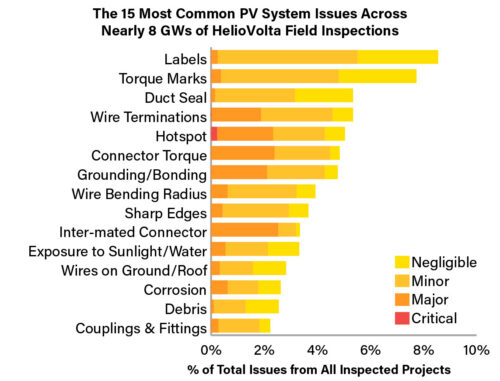
Across all inspected sites, recurring issues typically cluster around a few vulnerable areas:
- DC Wiring and Management: Improper wire support, unsecured Homerun cables, and susceptibility to abrasion against racking components.
- Grounding and Bonding: Failures in equipment grounding conductor (EGC) terminations, which pose severe long-term safety and electrical hazards.
- Module Handling: Undetected micro-cracks resulting from improper clamping pressure or workers walking on modules during installation.
- Inverter and Balance-of-System (BOS) Integration: Suboptimal environmental sealing and torque verification errors on critical electrical terminals.
Official Responses: Industry Leaders Respond to Quality Standards
For the first time, the SolarGrade PV Health Report introduced the HelioVolta Quality Standard Awards, recognizing the two highest-scoring sub-5 MW projects inspected in 2025. The honors went to Onyx Renewables and Greenskies Clean Energy, setting a benchmark for what empirical excellence looks like in commercial and industrial (C&I) solar.
Onyx Renewables
“Not all energy is delivered equal. Our customers need solar that is engineered, inspected, and validated to perform,” said Angie Daoud, COO of Onyx Renewables. “We build accountability into every step of how we develop, build, and care for our projects, and this independent award recognizes and confirms that this approach delivers.”
Greenskies Clean Energy
“This recognition from HelioVolta is meaningful because it independently validates the standards we work to uphold across our portfolio,” noted Vijay Singh, CEO of Greenskies Clean Energy. “As a long-term owner and operator, we know the quality of how a project is built directly supports how it performs over time. That focus on disciplined execution and lasting performance guides every project we deliver.”
David Penalva praised both winners for demonstrating that high-performing assets are achievable under standard commercial market conditions. “The projects from Onyx Renewables and Greenskies Clean Energy show exactly what quality looks like,” Penalva said.
Implications: The Future of Solar Asset Management
The release of the 2026 SolarGrade PV Health Report carries profound implications for developers, EPC contractors, institutional investors, and insurers alike. As the solar market matures, several structural shifts are expected to take root:
1. The End of the Lowest-Bidder EPC Model
For years, competitive bidding has driven developers to award contracts to the lowest-cost EPCs. However, as HelioVolta’s data demonstrates, saving a few percentage points on upfront CapEx through aggressive cost-cutting can trigger a 20% escalation in lifetime LCOE. Institutional investors are increasingly expected to penalize or outright avoid developers who fail to mandate independent third-party quality inspections.
2. Standardized Quality Metrics in M&A Due Diligence
Mergers and acquisitions (M&A) in the renewable energy sector often involve heavy due diligence regarding asset health. The adoption of empirical grading rubrics like HQS allows buyers to rapidly assess portfolio risk. An "F-rated" portfolio will likely see steep valuation discounts, forcing sellers to remediate issues before taking assets to market.
3. Insurance and Warranties
As insurers grapple with rising climate risks and electrical fires in commercial PV systems, verifiable construction quality will become a prerequisite for favorable premiums. Insurers may increasingly tie policy terms to third-party engineering validations, rewarding developers who maintain high HQS grades with lower liability costs.
4. Workforce Training and Accountability
Addressing the root cause of these quality issues requires a massive investment in workforce training. As technological standards evolve, electrical contractors and solar installers must undergo more rigorous credentialing to ensure compliance with modern codes and manufacturer specifications.
Conclusion
The 2026 HelioVolta SolarGrade PV Health Report serves as both a warning siren and a roadmap for the clean energy sector. While the solar industry has triumphed in scaling deployment capacity over the past two decades, the next era of energy transition will be defined entirely by asset resilience and operational longevity.
By shifting quality control from a subjective checklist to an empirical, contract-grade metric, firms like HelioVolta are ensuring that solar energy lives up to its ultimate promise: clean, reliable, and economically optimized power for decades to come.