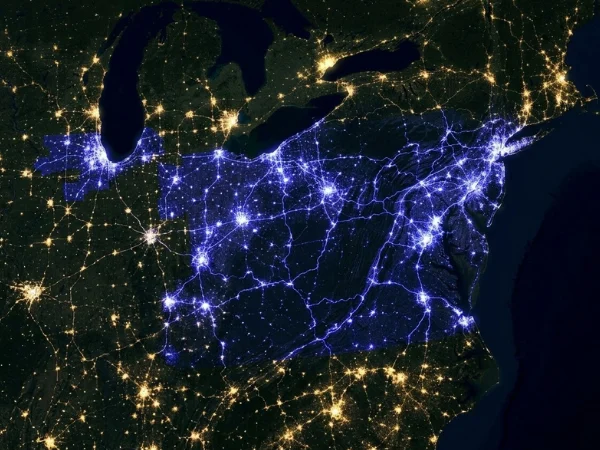
WASHINGTON, D.C. — PJM Interconnection, the largest wholesale electricity market and grid operator in the United States, stands at an unprecedented crossroads. Managing the high-voltage transmission system and wholesale power markets across 13 states and the District of Columbia, PJM is grappling with a confluence of pressures that threaten the reliability of the nation’s most vital power grid.
Driven largely by the explosive, energy-intensive demands of artificial intelligence (AI) data centers, electricity demand across the PJM footprint is surging at a rate unseen in decades. Simultaneously, the grid operator is struggling to bring new generation online quickly enough to replace retiring fossil-fuel plants.
The stakes could not be higher. PJM currently projects a staggering 6.8-gigawatt (GW) capacity shortfall as soon as 2028. For the 67 million Americans living under the PJM umbrella, the crisis is already translating into tangible financial pain. Recent capacity auctions spiraled out of control due to supply scarcity, forcing PJM—with federal regulatory approval—to step in and implement emergency price caps.
As policymakers, utility executives, and clean energy developers scramble for solutions, a recent episode of the Factor This Policycast, produced in partnership with Advanced Energy United, brought together top industry experts to dissect the PJM energy emergency. Hosted by Factor This content director Paul Gerke, the discussion featured Adam Stern of clean energy developer Clearway Energy, Kimaya Abreu of virtual power plant (VPP) operator Voltus, and Jon Gordon, senior director at Advanced Energy United.
Main Facts: The Anatomy of a Grid Emergency
The structural crisis facing PJM is defined by three overlapping phenomena: surging demand, generation retirements, and acute interconnection bottlenecks.
- The Demand Surge: The rapid proliferation of AI data centers, combined with the broader electrification of transportation and building sectors, has reversed years of flat or declining electricity demand. PJM is no longer planning for steady, incremental growth; it is facing exponential load spikes.
- The Capacity Shortfall: PJM models indicate a potential 6.8 GW capacity deficit by 2028. Without swift interventions to procure new resources or curb demand, the grid operator risks failing to meet reserve margins required to maintain continuous service.
- Market and Price Volatility: The mismatch between supply and demand has broken traditional capacity market dynamics. Recent auctions saw clearing prices spike so dramatically that federal intervention was required to shield consumers from catastrophic rate hikes.
- The Interconnection Quagmire: Renewable energy, battery storage, and demand-response resources—which represent the fastest potential routes to adding power—have faced multi-year delays sitting in PJM’s bloated interconnection queues.
Chronology: How PJM Drifted Toward the Precipice
To understand how the nation’s premier grid operator arrived at this juncture, it is necessary to examine the timeline of policy decisions, market shifts, and technological disruptions that shaped the modern grid.
The Post-Deregulation Era and the Capacity Construct
For decades following the restructuring of wholesale electricity markets in the late 1990s and 2000s, PJM’s capacity market (Reliability Pricing Model, or RPM) functioned smoothly. Designed to procure power three years in advance to ensure resource adequacy, the market fostered an environment of over-capacity, leading to low wholesale electricity prices. During this period, cheap natural gas from the shale revolution dominated new builds, while older coal plants began a slow economic decline.
The Clean Energy Transition and Queue Congestion (2018–2022)
As state-level renewable portfolio standards accelerated, clean energy developers flooded PJM with requests to connect wind, solar, and storage projects to the grid. PJM’s traditional, study-by-study interconnection review process was entirely unequipped to handle the sheer volume of applications.
As Jon Gordon of Advanced Energy United noted on the Factor This Policycast, the queue ground to a near-halt.
"They got overwhelmed with all the clean energy that wanted to connect to the grid, and they were stuck in that queue for years. And meanwhile, demand just kept chugging along, kept growing, and we just kept getting further and further behind," Gordon recalled. "And now PJM finds itself at a point where they’re getting worried about keeping the lights on."
The AI Boom and the Retirement Crunch (2023–Present)
Compounding the queue backlog, traditional fossil-fuel generators—particularly coal plants—faced economic pressures and environmental regulations forcing their retirement. While grid operators and reliability organizations (such as the North American Electric Reliability Corporation, or NERC) began issuing warnings about retiring thermal units faster than they could be replaced, the tech sector unleashed an unprecedented wave of data center developments.
By 2024, capacity auctions reflected this tightening supply-demand balance, resulting in historic price spikes and urgent calls for market and operational reform.
Supporting Data and Technical Realities
The challenges facing PJM are heavily underscored by technical and financial metrics that illustrate the severity of the capacity crunch.
- 6.8 GW: The projected capacity shortfall facing the PJM footprint by 2028, signaling an immediate need for new resource additions.
- 67 Million: The number of consumers across 13 states and Washington, D.C., whose reliability and electricity bills are tied to PJM’s market performance.
- 100 Megawatts (MW): The scale of a landmark distributed capacity agreement signed this year between virtual power plant operator Voltus and Google, demonstrating the viability of non-traditional grid resources.
The Cost-Discovery Problem in Interconnection
A major technical barrier identified by utility-scale developers is the lack of transparency in the interconnection process. Adam Stern of Clearway Energy explained that the current system forces developers to use the queue itself as a financial testing ground.
"It starts at the beginning of the process, and this is something that many other RTOs face," Stern said. "And that’s the unfortunate factor that generators who are getting in line into the queue won’t know their full cost until they’re in the queue itself, and so the queue therefore becomes somewhat of a cost discovery tool."
Stern emphasized that PJM must pivot toward providing greater cost certainty upfront so that developers can accurately assess project viability before committing years of capital and resources.
Official Responses and Strategic Solutions
Faced with existential pressures, PJM leadership, regional stakeholders, and clean energy advocates are pursuing multifaceted strategies to avert disaster. These efforts center on three primary pillars: virtual power plants, targeted market rule changes, and the creation of new customer classes.
Tapping into Distributed Capacity
While utility-scale projects navigate the troubled waters of the interconnection queue, distributed energy resources (DERs)—such as rooftop solar, smart thermostats, commercial energy storage, and flexible industrial loads—offer a nimble alternative. Aggregated into Virtual Power Plants (VPPs) by companies like Voltus, these resources bypass traditional interconnection bottlenecks entirely.
Kimaya Abreu of Voltus highlighted how PJM is beginning to embrace these solutions through interim resource adequacy service (IRAS) processes.
"PJM has really run with that idea in the current IRAS processes in terms of developing this ‘bring your own new capacity pathway,’" Abreu pointed out. "The big picture here is that large loads are being incentivized to go to the market and fund solutions, including distributed capacity solutions that allow those loads to carry their own capacity costs while providing the investments the grid needs to meet load growth and hopefully modernize in the process."
Furthermore, Abreu emphasized the long-term macroeconomic benefits of DER aggregation:
"Zooming way out, what are the drivers of cost on the grid? It’s how much infrastructure we’re building out that then needs to be paid for over a long period of time. So if we can use what we already have as efficiently as possible and add less, avoid some of those network upgrades, that has long-term affordability benefits for all ratepayers."
Proposing a New Customer Class for AI Data Centers
Perhaps the most controversial and legally complex debate inside PJM is how to govern large load customers, specifically AI data centers. Because these facilities consume massive quantities of power continuously, they strain local grids in ways traditional commercial and industrial users never have.
This dynamic has forced PJM to contemplate an unprecedented regulatory step: isolating data centers into a distinct customer class subject to different rules regarding reliability and curtailment.
Jon Gordon underscored the historic nature of this policy debate:
"I want to emphasize the unprecedented nature of what PJM is trying to do here. We’ve never isolated a customer class, large load data centers, to be interrupted… Traditionally, all customers are sort of treated the same. If there’s a shortfall in power, there might be rolling blackouts, but it’s not like a customer class is singled out to be interrupted. So this is very new, and that’s what PJM has been struggling with."
However, tech companies and data center operators are pushing back against proposals that would expose them to involuntary load shedding or interruptible service mandates. Because modern computing infrastructure relies on uninterrupted 24/7/365 uptime, the prospect of targeted curtailment introduces severe business risks.
"Being interrupted for a data center is a big, big problem, and so the speed at which we can bring these resources online really matters to the data centers," Gordon noted. "They want to get their resource needs met as soon as possible and not be subject to this involuntary interruption."
Implications: The Future of the American Grid
The outcome of PJM’s current existential trial will reverberate far beyond the Mid-Atlantic and Midwest. As the nation’s largest wholesale electricity market, PJM often serves as a regulatory and operational bellwether for other Regional Transmission Organizations (RTOs) facing identical pressures from the artificial intelligence boom and industrial electrification.
1. Affordability vs. Reliability
The immediate fallout of the capacity shortfall is economic. If PJM fails to streamline new generation and innovative demand-side solutions into the market rapidly, consumers will bear the brunt of skyrocketing capacity prices and emergency procurement costs. Balancing the demands of tech giants with the financial protection of residential ratepayers will require delicate regulatory tightrope walking by the Federal Energy Regulatory Commission (FERC) and state utility commissions.
2. The Acceleration of Hybrid Energy Solutions
To secure firm power without violating corporate decarbonization goals, data center developers are increasingly looking behind the meter—pairing new facilities directly with nuclear, geothermal, or advanced solar-plus-storage installations. This trend could fundamentally alter how large industrial loads interact with the centralized grid.
3. Governance and Structural Reform
Finally, the PJM crisis has exposed deep fractures in stakeholder governance. Critics argue that PJM’s traditional stakeholder process is too slow and vulnerable to incumbent interests to address an emergency of this magnitude. Moving forward, the grid operator will likely be forced to streamline its decision-making authority, balancing stakeholder input with the urgent imperative to keep the lights on.
As 2028 approaches, the decisions made today by PJM, developers, and regulators will determine whether the grid successfully modernizes to meet the technological demands of the 21st century or stumbles into a prolonged era of capacity shortages and economic volatility.