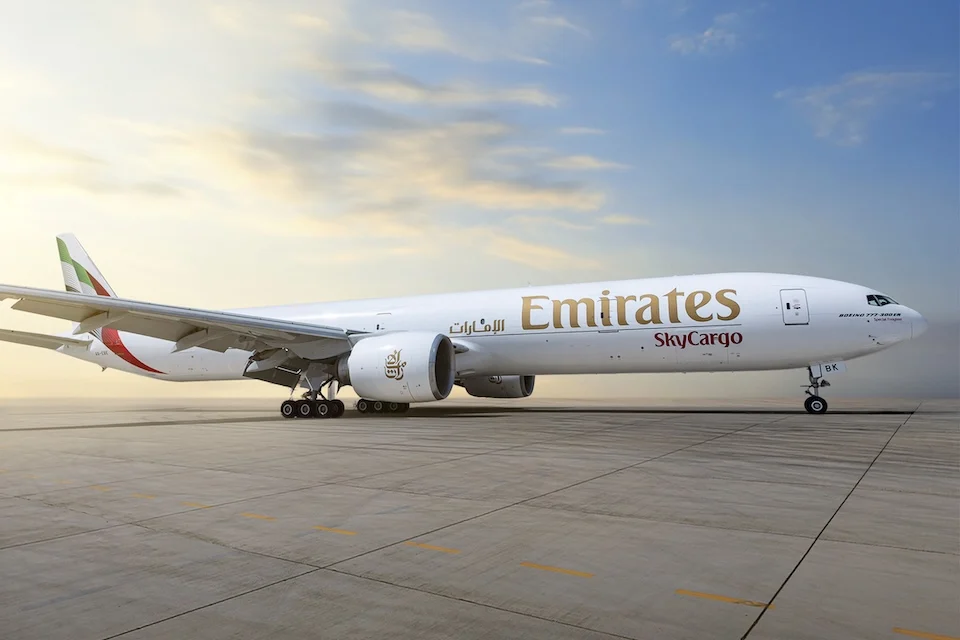
DUBAI / SOUTH AMERICA — Emirates SkyCargo, the freight division of Dubai-based international carrier Emirates, has reported a dramatic surge in cargo volumes across its South American network. The impressive performance directly follows a strategic deployment of additional weekly freighter flights to key markets in the region. Driven by rising global demand for perishables, high-quality food products, and fresh cut flowers, the airline has leveraged its growing fleet capacity to establish a more robust trade bridge connecting South American producers with lucrative consumer markets across Europe, the Middle East, and beyond.
The remarkable turnaround and sustained upward trajectory highlight the growing economic interdependence between South America’s agricultural powerhouse economies and global logistics supply chains. By injecting fresh lift capacity into high-demand corridors, Emirates SkyCargo has positioned itself as a critical enabler of international trade for the region.
Main Facts
The core of Emirates SkyCargo’s recent success in South America rests on a combination of increased flight frequencies, robust tonnage growth, and targeted infrastructure utilization.
During the first half of the 2025/26 financial year, the carrier witnessed significant double-digit percentage volume increases across its primary South American online markets. Overall, the airline transported more than 22,000 tonnes of export cargo from the region since April, marking an impressive 18% year-on-year growth compared to the corresponding period in the previous fiscal cycle.
Country-specific data underscores the depth of this expansion:
- Argentina: Recorded a staggering 57% year-on-year growth in export volumes, fueled heavily by perishables such as fresh fruit, high-grade salmon, and premium meat products. Since April 2024, the airline has facilitated the movement of approximately 5,000 tonnes of exports out of Buenos Aires.
- Brazil: Achieved a 22% increase in export volumes. The airline now operates four weekly freighter flights out of Sao Paulo, moving a diverse portfolio of industrial and agricultural commodities across its international network.
- Colombia: Saw export volumes rise by 18%, supported heavily by the booming floral industry. In the 25/26 financial year alone, the carrier transported more than 3,500 tonnes of Colombian flowers to international destinations.
- Ecuador: Registered a 14% growth in export volumes. With six weekly flights offering approximately 600 tonnes of export capacity, the carrier utilizes Quito as a primary staging ground for the world’s floral trade.
These regional successes were made possible by the introduction of seven additional weekly freighter frequencies earlier in the year. This allocation included three extra flights from Buenos Aires, two additional rotations from Sao Paulo, one from Bogota, and another from Quito.
Chronology of Expansion
The rapid escalation of Emirates SkyCargo’s South American footprint did not happen overnight; it is the result of a carefully orchestrated operational timeline executed throughout 2024, 2025, and into 2026.
Early 2024 to Early 2025: Laying the Groundwork
As post-pandemic global supply chains stabilized, Emirates SkyCargo identified Latin America as a high-potential frontier for perishable logistics. Producers of fresh fruit, proteins, and cut flowers faced persistent capacity constraints on commercial passenger bellies. Recognizing the bottleneck, the carrier began laying plans to optimize its dedicated freighter network to tap directly into the source markets of the Andean and Southern Cone regions.
March 2024: Establishing a Foothold in Argentina
The operational rollout gained momentum in March 2024 when Emirates SkyCargo commenced weekly freighter operations out of Buenos Aires (EZE). Designed to unlock Argentina’s vast agricultural and fisheries potential, the route immediately captured regional market share by offering direct uplift for temperature-sensitive commodities like fresh salmon and premium beef.
May 2025: Bolstering Colombian Floral Lifelines
To address persistent seasonal spikes and year-round structural demand from Colombian flower growers, the carrier introduced an additional weekly freighter flight out of Bogota (BOG) in May. This targeted intervention ensured that local producers could secure reliable space on dedicated freighters, avoiding the vulnerabilities of ad-hoc charter markets.
July 2025: Deepening the Southern Cone Commitment
Building on the early success of its Argentine operations, Emirates SkyCargo intensified its presence in Buenos Aires in July, scaling up its schedule to three weekly freighter flights. This move provided the crucial frequency needed by exporters to plan complex, time-sensitive supply chains into North American and European hubs.
March to July 2026: Fleet Deliveries and Global Scaling
The ultimate catalyst for these regional expansions has been Emirates’ aggressive fleet renewal and growth strategy. Beginning in March 2026, the carrier took delivery of a series of brand-new Boeing 777 production freighter aircraft. This was supplemented in June 2026 by the historic integration of the first Boeing 777-300ERSF—a passenger-to-freighter (P2F) conversion—into the active fleet.
These additions transformed the airline’s operational capacity. By March 2027, the carrier’s dedicated freighter fleet is slated to reach 23 aircraft. Concurrently, this influx of capacity allowed Emirates SkyCargo to scale its global network of freighter destinations from just over 40 in March 2026 to more than 60 by July 2026.
Supporting Data and Market Dynamics
A deeper dive into the logistics mechanisms reveals why these specific routes have experienced such exponential growth. The success of Emirates SkyCargo in South America is deeply tied to niche vertical markets, most notably perishables and horticulture.
The Ecuador-to-Amsterdam Floral Corridor
Ecuador stands out as a prime example of hyper-specialized air cargo logistics. Emirates SkyCargo currently operates six weekly flights out of Quito, offering an export capacity of roughly 600 tonnes.
The logistics chain is finely tuned: flights depart directly from Quito (UIO) and land in Amsterdam (AMS), home to Aalsmeer—the largest flower auction and market in the world. Flowers alone account for more than 90% of all export cargo uplifted by Emirates SkyCargo from Ecuador. During the 2025/26 financial year, the cargo business transported a staggering 24,000 tonnes of flowers from the country. Maintaining the cold chain is paramount; any disruption in transit temperatures can compromise the freshness and market value of the roses, carnations, and other blooms packed tightly within the climate-controlled hulls of the Boeing 777 freighters.
Perishable Logistics in Argentina and Brazil
In Argentina, the focus shifts from flora to fauna and agriculture. The 5,000 tonnes of exports facilitated since April 2024 rely heavily on strict temperature management protocols ("Emirates Fresh"). Patagonia’s salmon, premium Argentine beef cuts, and delicate seasonal fresh fruits require seamless, rapid transit to satisfy high-end culinary markets in the Middle East, Europe, and Asia.
Similarly, Sao Paulo serves as the industrial and agricultural heartbeat of Brazil. The four weekly frequencies out of the Brazilian metropolis act as a vital multi-commodity conduit, whisking away everything from specialized automotive and aerospace components to fresh tropical produce, seamlessly integrating South American suppliers into Emirates’ sprawling global network.
Official Responses
Company executives have been quick to attribute these record-breaking figures to a combination of proactive capacity planning, deep regional partnerships, and the unmatched performance of the airline’s widebody freighter fleet.
Badr Abbas, Divisional Senior Vice President at Emirates SkyCargo, offered detailed insights into the strategic importance of the region:
"South America is a dynamic emerging hub for exports across a range of sectors including high-quality food products and fresh flowers that rely on fast and reliable air cargo connectivity to reach global customers."
Emphasizing the tangible volume metrics achieved during the fiscal year, Abbas added:
"Since April this year, we have transported more than 22,000 tonnes of export cargo from our South American markets, a growth of 18% over the volumes carried during the same period in the previous year."
Industry analysts have noted that executive leadership’s willingness to commit capital expenditure toward dedicated freighters—rather than relying solely on passenger belly-hold capacity—has given Emirates SkyCargo a distinct competitive edge. By controlling the scheduling and routing of dedicated cargo aircraft, the airline can guarantee stability for regional exporters who operate in unforgiving, time-sensitive industries.
Implications for Global Trade and Logistics
The double-digit volume increases recorded by Emirates SkyCargo in South America carry profound implications for regional economies, international trade routes, and the broader air cargo charter industry.
Economic Empowerment for Regional Producers
For developing economies like Ecuador and Colombia, reliable air freight is not merely a logistical convenience; it is an economic lifeline. By securing predictable weekly uplift to major consumption hubs, local farmers, cooperatives, and small-to-medium enterprises (SMEs) are insulated from the volatility of sea freight transit times and port congestions. This reliability stimulates local employment, encourages agricultural investment, and secures long-term foreign exchange revenues for Andean nations.
Similarly, in the Southern Cone, the exponential growth in Argentine and Brazilian exports underscores the value of direct connectivity to emerging consumer markets in the Gulf Cooperation Council (GCC) and Asia. Perishable goods that once faced convoluted, multi-leg journeys can now reach shelves in pristine condition, enhancing the global brand equity of South American agricultural and marine products.
Shifts in Global Freight Capacity Dynamics
From a macroeconomic perspective, Emirates SkyCargo’s expansion reflects a broader structural shift in global air logistics. As major carriers continue to invest in dedicated freighter conversions—such as the Boeing 777-300ERSF program—the capacity constraints that historically plagued secondary and tertiary markets are gradually being alleviated.
By scaling its freighter network destinations from 40 to over 60, Emirates has demonstrated that high-frequency, long-haul freighter routes can unlock latent demand in regions historically underserved by traditional legacy carriers.
Future Outlook
As Emirates SkyCargo marches toward its target of operating a fleet of 23 dedicated freighters by March 2027, the operational framework established in South America will likely serve as a blueprint for expansion in other emerging global markets. For South American exporters of flowers, proteins, and fresh produce, the sky is no longer the limit—it is simply the fastest pathway to the global marketplace.