By ISHN Editorial Staff
Chambersburg, Pennsylvania — In the wake of a preventable workplace fatality, the U.S. Occupational Safety and Health Administration (OSHA) has slammed a Pennsylvania excavation contractor with severe penalties. Jonas David Wagoner, doing business as J.D. Wagoner Excavating based in Chambersburg, has been cited for multiple willful, repeat, and serious safety violations after a young worker lost his life in a catastrophic trench collapse.
Federal regulators have proposed a total of $254,884 in financial penalties following an intensive investigation that revealed systemic safety failures at a municipal utility project. The incident underscores a persistent and deadly hazard in the construction industry: the failure to implement basic, legally mandated trenching protections.
Main Facts of the Incident
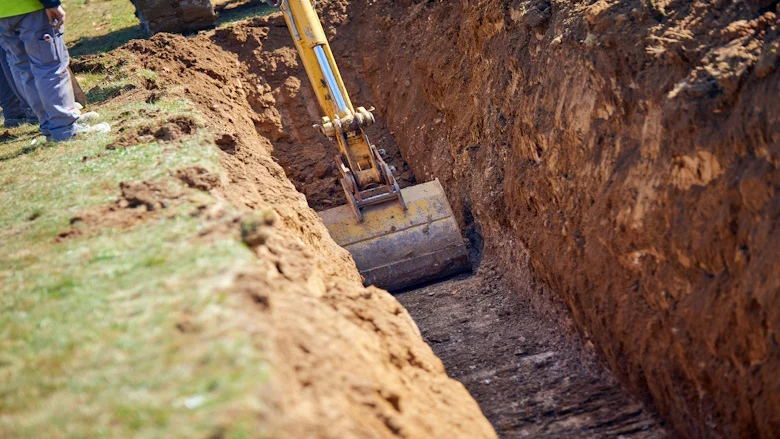
The tragedy unfolded on April 2, 2026, at a job site in Chambersburg, Pennsylvania, where J.D. Wagoner Excavating was contracted to install a new storm sewer system. According to OSHA’s investigative findings, employees were working deep underground—approximately 12 feet below ground level—inside an open excavation trench.
Despite the extreme depth and the unstable nature of the local soil, the trench was completely unprotected. Federal safety standards require any excavation five feet deep or greater to have protective systems in place, such as shoring, sloping, benching, or trench boxes, to prevent soil from collapsing inward.
When a massive portion of the unshielded trench wall suddenly failed, the unrestrained earth cascaded downward with immense force, instantly engulfing one of the young workers. The employee was trapped under thousands of pounds of dirt and soil, sustaining fatal injuries.
OSHA’s subsequent investigation uncovered a harrowing disregard for workplace safety protocols. The agency issued one willful violation—OSHA’s most severe designation, reserved for violations committed with intentional disregard of, or plain indifference to, employee safety and the Occupational Safety and Health Act. Specifically, this citation was issued for the company’s failure to protect workers from cave-ins.
Furthermore, J.D. Wagoner Excavating was hit with two repeat violations. These were handed down because the employer failed to:
- Assign a "competent person" to conduct daily, continuous inspections of the trench and surrounding site conditions for hazards.
- Immediately remove employees from hazardous conditions once danger became apparent.
Compounding these infractions, OSHA issued three serious safety violations. A "serious" violation is designated when there is substantial probability that death or serious physical harm could result, and the employer knew or should have known of the hazard. These violations included:
- Failing to provide fundamental construction hazard prevention training to employees.
- Failing to establish a safe, accessible means of egress (such as ladders or ramps) located within 25 feet of all workers inside the excavation.
- Failing to keep excavated soil and heavy materials at least two feet away from the edge of the excavation site.
- Failing to properly restrain side materials and spoil piles from becoming roll-in hazards that could slide back into the pit.
In total, OSHA assessed $254,884 in proposed civil penalties against J.D. Wagoner Excavating.
Chronology of Events
To understand how a routine utility project devolved into a fatal emergency, safety experts and federal investigators traced the sequence of events leading up to and immediately following the April 2, 2026 catastrophe.
Pre-Project Phase
Prior to breaking ground on the Chambersburg storm sewer installation project, J.D. Wagoner Excavating was legally obligated under federal and state guidelines to evaluate site-specific soil conditions, secure necessary utilities, and establish an OSHA-compliant safety and health program. According to federal investigators, these foundational planning steps were either severely compromised or entirely ignored. No effective protective systems were delivered or staged at the job site, and employees lacked baseline training on recognizing soil destabilization.
April 2, 2026: The Day of the Collapse
- Morning Hours: Crews arrived at the site in Chambersburg. Operations commenced to install the subterranean storm sewer lines. Workers descended into an unshielded excavation trench that quickly reached a depth of 12 feet.
- Mid-Day Operations: Despite clear regulatory requirements, no designated "competent person" inspected the trench walls as conditions evolved. The weight of heavy spoil piles placed too close to the lip of the excavation began to stress the surrounding soil.
- The Collapse: Without warning, the lateral pressure overwhelmed the un-shored earthen wall. A massive section of the trench wall sheared off, burying the young worker beneath tons of heavy earth before he could escape via a safe ladder or ramp.
- Emergency Response: Emergency services were dispatched to the site, but the victim succumbed to his injuries due to the catastrophic weight and asphyxiation risks associated with trench collapses.
Post-Incident Investigation
- April 2, 2026: OSHA compliance safety and health officers opened an immediate inspection into J.D. Wagoner Excavating following notification of the fatality.
- April through June 2026: Investigators conducted interviews with surviving crew members, reviewed site logs, evaluated soil mechanics, and assessed the company’s historical safety record.
- Summer 2026: OSHA concluded its multi-month investigation, officially issuing the citations and slapping the contractor with the $254,884 penalty package.
Supporting Data: The National Crisis of Trench Failures
The tragedy in Chambersburg is not an isolated event; rather, it is part of a persistent, lethal epidemic across the American construction landscape. Trenching and excavation work consistently rank among the most hazardous operations in the construction industry.

The Physics of Danger
Soil is deceptively heavy. A single cubic yard of dirt can weigh as much as 2,700 to 3,000 pounds—roughly the weight of a small automobile. When a trench wall collapses even at a shallow depth of four to six feet, the sudden avalanche of earth acts like liquid concrete. It can instantly pin a worker’s chest, making breathing impossible, and generating massive blunt-force trauma. In a 12-foot-deep trench like the one in Chambersburg, the volume of earth involved in a wall failure is often insurmountable without heavy machinery, leaving trapped workers with mere seconds to react—if a warning exists at all.
OSHA Statistics and Industry Trends
According to historical data from the U.S. Department of Labor:
- A cubic yard of soil weighs roughly 3,000 pounds—equivalent to being crushed by a car.
- The fatal injury rate for trenching and excavation operations is higher than the national average for general construction.
- OSHA notes that trench collapses are entirely preventable. When proper protective systems (sloping, shoring, shielding) are utilized, the risk of a fatality drops exponentially.
- Despite widespread outreach campaigns—such as OSHA’s annual "Trench Safety Stand-Down"—small contractors frequently cut corners to save time and equipment rental costs, treating safety compliance as an optional administrative burden rather than a life-or-death prerequisite.
The issuance of "willful" violations in this case indicates that federal regulators are increasingly losing patience with contractors who knowingly bypass basic protective measures. Repeat violations further highlight that some employers fail to reform their practices even after prior warnings or regulatory interventions.
Official Responses and Regulatory Perspective
OSHA officials have expressed profound frustration over the preventable nature of trenching fatalities. In the construction industry, safety advocates emphasize that trench collapses do not happen by accident; they happen because safety rules are ignored.
While direct public statements from regional OSHA directors often accompany major citations, the regulatory framework speaks for itself through the severity of the penalties. By classifying the primary cave-in protection failure as a "willful" act, OSHA has signaled that J.D. Wagoner Excavating exhibited an intentional disregard for federal law.
Under OSHA guidelines, a willful violation carries the agency’s highest statutory financial penalties, designed to strip away any economic advantage an employer gained by cutting safety corners. The combined total of $254,884 represents a significant financial blow, particularly for a small-to-midsize independent excavation contractor.
Industry safety organizations have echoed federal sentiments. Labor advocates note that young and newly hired construction workers are disproportionately affected by fatal workplace incidents, often because they are placed into high-risk environments without adequate supervision, hazard recognition training, or the institutional voice to halt work when conditions become unsafe. The absence of a "competent person" on-site—a legal mandate under 29 CFR 1926.651—directly strips workers of their primary line of defense against shifting soils.
Broader Implications for the Construction Industry
The Chambersburg fatality and the subsequent penalties levied against J.D. Wagoner Excavating carry far-reaching implications for contractors, project owners, and safety professionals across the United States.
1. Increased Scrutiny on Small Contractors
Large commercial construction firms often maintain robust, dedicated health and safety departments. However, the residential and light commercial utility sectors—dominated by smaller, family-owned or independent contractors like J.D. Wagoner—frequently operate with informal safety cultures. This case serves as a stark warning that OSHA’s enforcement radar is keenly focused on small-scale excavators, and fatal incidents will trigger aggressive, comprehensive federal audits.
2. The High Cost of Cutting Corners
The financial penalty of $254,884 is substantial, but the true cost of non-compliance extends far beyond monetary fines. Contractors facing willful violations suffer severe reputational damage, lose the ability to bond projects, face potential criminal referrals in extreme cases of negligence, and inflict irreversible emotional and psychological trauma on victims’ families and surviving co-workers.
3. Mandatory Cultural Shift: Empowering the "Competent Person"
OSHA’s citations heavily emphasize the failure to assign a competent person to conduct daily inspections. In the construction sector, a "competent person" is not merely someone with seniority; they must be explicitly trained, authorized to identify existing and predictable hazards, and—most importantly—empowered to halt work immediately and order workers out of a trench if wall stability degrades. Industry analysts stress that companies must move past box-checking compliance and instill a proactive culture where stopping unsafe work is universally rewarded, not penalized.
4. Zero Tolerance for Unprotected Trenches
As infrastructure projects expand nationwide under federal funding initiatives, the volume of excavation work is surging. Safety leaders are urging state and federal regulators to maintain zero-tolerance enforcement policies regarding trenching. Every trench five feet or deeper must be protected; there are no exceptions, no matter how short the duration of the work or how stable the soil appears to the naked eye.
Conclusion
The death of the young worker in Chambersburg, Pennsylvania, remains a devastating reminder of the unforgiving nature of excavation work. As J.D. Wagoner Excavating navigates the fallout of OSHA’s $254,884 penalty package, the broader construction community is once again forced to confront an uncomfortable truth: too many lives continue to be lost to hazards that are easily understood, heavily regulated, and entirely preventable.