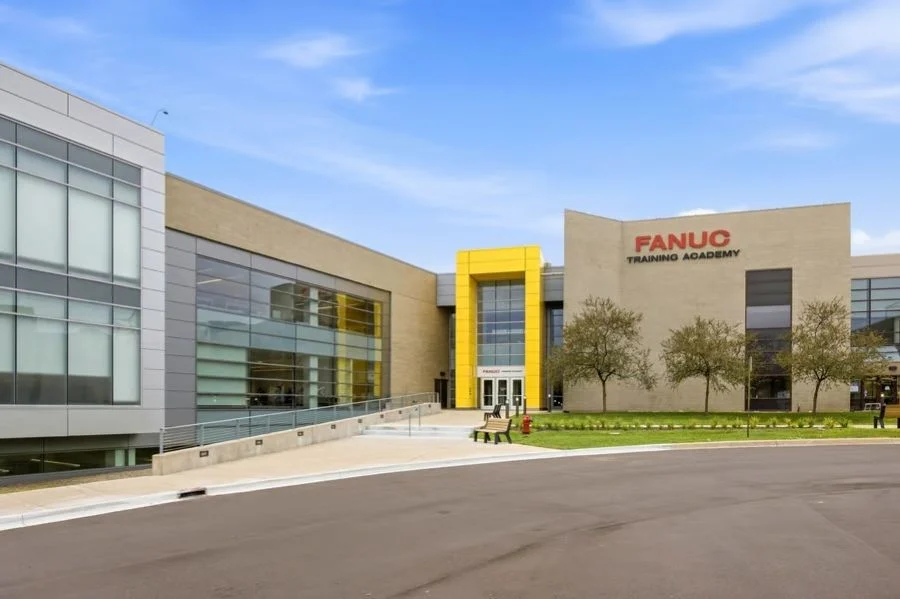
AUBURN HILLS, Mich. — In a landmark development for the United States manufacturing sector, FANUC America Corp. has officially opened its expansive, state-of-the-art training facility in Auburn Hills, Michigan. Costing an estimated $18 million, the massive complex is designed to tackle one of the most persistent bottlenecks in modern industrial engineering: the widening skills gap in robotics, automation, and artificial intelligence-enabled manufacturing technologies.
Spanning three stories and a staggering 132,000 square feet, the new facility houses 56,300 square feet of dedicated, high-tech learning space. According to corporate representatives, the establishment proudly claims the title of the largest corporate robotics and industrial automation training center in the United States.
The launch arrives at a critical juncture for North American manufacturing. As global supply chain pressures, labor shortages, and rapid technological advancements push factories to modernize, the demand for personnel capable of programming, troubleshooting, and maintaining advanced robotic systems has never been higher. By offering an unprecedented volume of hands-on educational experiences for technicians, engineers, educators, students, and manufacturing professionals alike, FANUC America’s new academy aims to serve as the epicenter for the next generation of industrial innovation.
Main Facts
Location & Investment: Situated in Auburn Hills, Michigan, the newly constructed facility represents an $18 million investment by FANUC America Corp.
Physical Scale: The three-story, 132,000-square-foot facility dedicates 56,300 square feet entirely to specialized training infrastructure.
Designation: Officially recognized as the largest corporate robotics and industrial automation training center in the United States.
Capacity Expansion: Replacing the former training setup inside FANUC America’s corporate headquarters, the new academy increases dedicated classrooms from 13 to 28.
Comprehensive Hardware: The facility is equipped with more than 160 operational industrial robots and over 40 Computer Numerical Control (CNC) simulators.
National Network Reach: Combined with its eight regional training facilities across the country, FANUC’s expanded network now possesses the capacity to educate approximately 17,500 participants annually.
Chronology of the Project
The realization of the Auburn Hills Training Academy represents years of strategic planning, structural expansion, and an evolving response to the demands of modern industrial production.
The Foundation and Growing Pains (Pre-2023)
For years, FANUC America managed its educational programs out of a training center housed directly within its primary corporate headquarters. While effective for early waves of automation, the footprint quickly became insufficient. As manufacturers across North America accelerated their adoption of robotic systems to combat labor shortages, the demand for specialized training skyrocketed. The limited number of 13 classrooms at the original site frequently faced scheduling constraints, forcing the company to turn away eager participants or maintain extensive waitlists.
Breaking Ground and Conceptualizing (2023–2024)
Recognizing that temporary fixes would not suffice in a rapidly modernizing industrial landscape, FANUC executives committed to a major capital investment. The vision was clear: build a standalone, world-class institution dedicated solely to automation education. Auburn Hills was selected for its strategic positioning within America’s historic manufacturing heartland. Construction began on the three-story, 132,000-square-foot shell, designed from the ground up to support heavy industrial machinery, high-voltage electrical demands, and large cohorts of students.
Grand Opening and Operational Launch (Late 2024 / Present)
With construction finalized, the new Training Academy officially opened its doors, transitioning operations from the old headquarters site to the expansive new campus. The facility immediately doubled classroom capacity to 28, integrated dozens of advanced CNC simulators, and deployed more than 160 active industrial robots onto the instruction floor. Today, the academy stands fully operational, welcoming its first waves of students, corporate clients, and educational partners.
Supporting Data and Operational Infrastructure
The sheer scale of the Auburn Hills facility sets a new benchmark for corporate-sponsored technical education. To understand the gravity of the investment, one must look closely at the numbers governing the academy’s layout and national footprint.
Inside the Facility
Total Square Footage: 132,000 sq. ft.
Dedicated Training Space: 56,300 sq. ft.
Classroom Count: 28 fully equipped training rooms (up from 13 at the previous location).
Robotics Hardware: 160+ active, industrial-grade robots ready for programming and maintenance exercises.
The Auburn Hills site does not operate in a vacuum; it acts as the flagship anchor for FANUC America’s broader nationwide educational ecosystem:
Regional Hubs: 8 regional training facilities strategically placed across the United States.
Annual Throughput: A combined network training capacity of approximately 17,500 participants per year.
Target Demographics: High school and college students, vocational educators, corporate maintenance technicians, advanced manufacturing engineers, and independent career seekers.
Official Responses and Executive Perspectives
Industry leaders present at the opening emphasized that the facility is more than just a collection of expensive machinery—it is a vital strategic intervention in the American labor market.
Mike Cicco, president and CEO of FANUC America, addressed the core dilemma facing modern factories during the facility’s opening events:
"Manufacturers across North America are investing in robotics, automation, and AI-enabled technologies, but the availability of skilled workers remains one of the industry’s greatest challenges. The new Training Academy is designed to help close that gap by providing hands-on training."
Cicco further elaborated on how the transformation of the industrial sector is reshaping career paths for the modern workforce:
"As manufacturing continues to evolve, the opportunities are changing as well. This investment helps prepare the workforce for higher-skilled, technology-driven careers and strengthens domestic manufacturing."
Highlighting the geographic significance of the launch, Cicco pointed out why metro Detroit remains the ideal home for such an ambitious undertaking:
"The Training Academy reinforces metro Detroit’s position as a global center for manufacturing innovation, robotics, and automation. The region’s concentration of manufacturers, educational institutions, and skilled talent makes it an ideal location for a training operation serving customers and students from across North America."
Echoing these sentiments, Rich Meyer, general manager of FANUC America’s customer service group, underscored the direct link between advanced technology and human capability:
"Advanced automation requires advanced skills. The new FANUC Training Academy gives students, educators, and manufacturing professionals unprecedented access to the technologies shaping today’s factories. By expanding hands-on learning opportunities, we’re helping manufacturers develop the workforce they need, while creating pathways to rewarding careers in modern manufacturing."
Implications for the Future of American Manufacturing
The opening of FANUC America’s Auburn Hills facility carries profound implications for the trajectory of domestic manufacturing, labor economics, and educational policy.
1. Closing the Automation Skills Gap
For decades, the narrative surrounding industrial automation has been fraught with anxiety over job displacement. However, modern economic reality tells a different story: jobs exist, but the workers qualified to fill them do not. By offering a curriculum deeply rooted in hands-on interaction with 160+ robots and 40+ CNC simulators, FANUC is directly addressing the technical competency shortfall. Graduates of the academy leave with practical, muscle-memory experience that textbooks and online courses simply cannot replicate.
2. Strengthening Domestic Supply Chain Resilience
In the wake of global disruptions, re-shoring and near-shoring manufacturing operations have become top priorities for U.S. industrial policy. Yet, companies hesitating to bring production back to North America often cite high labor costs and a lack of specialized talent. By nurturing a robust, highly skilled local workforce, facilities like the Auburn Hills Training Academy remove a critical barrier to domestic production, making U.S.-based factories globally competitive through automation efficiency.
The academy is uniquely positioned to bridge the gap between traditional academia and the private sector. By welcoming educators and students alongside enterprise technicians, FANUC is helping school districts and universities modernize their own curricula. When academic institutions can align their engineering and vocational programs with the actual hardware deployed in modern factories, students experience a seamless transition from the classroom to the factory floor.
4. Cementing Metro Detroit’s Legacy as an Innovation Hub
While Silicon Valley commands the spotlight for software and digital technology, metro Detroit continues to anchor the physical, mechanical, and automated backbone of American industry. By planting an $18 million flagship institution in Auburn Hills, FANUC America has doubled down on the region’s rich heritage, ensuring that Michigan remains the undisputed global capital of robotics and industrial automation integration for decades to come.
As the first cohorts of students fire up the CNC simulators and program their inaugural robotic arms in the newly expanded classrooms, the Auburn Hills Training Academy stands ready to prove that the future of American manufacturing will be built not just by machines, but by the skilled hands and sharp minds trained to master them.