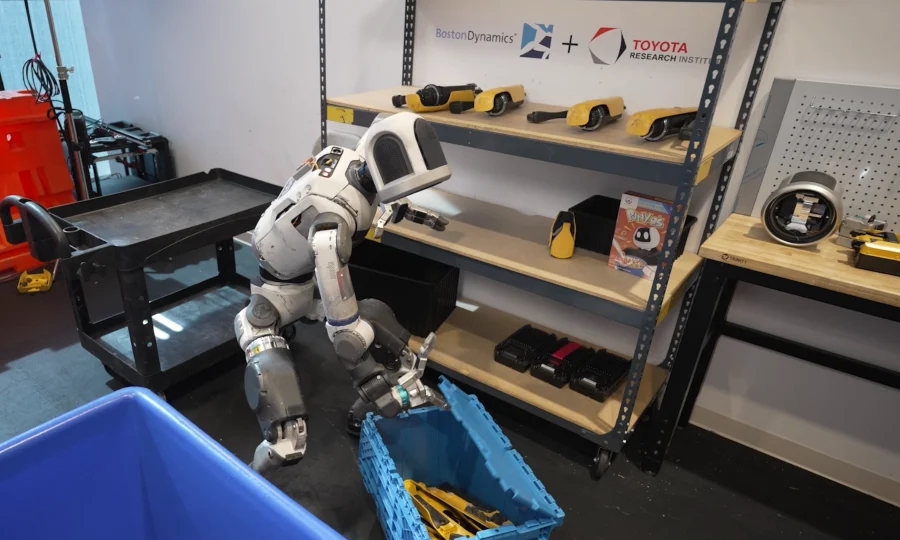
ELLABELL, GA — In a milestone development bridging advanced artificial intelligence and heavy industrial manufacturing, Boston Dynamics has officially transitioned its newly established robotics center at the Hyundai Motor Group Metaplant America (HMGMA) in Ellabell, Georgia, to full operations. Following a successful pilot phase that kicked off in June, the facility now serves as the primary test bed and training ground for integrating next-generation humanoid robots—most notably the electric Atlas—directly into automotive manufacturing workflows.
The launch underscores a massive strategic shift for both Boston Dynamics, which officially became a wholly owned subsidiary of Hyundai Motor Group in July, and the global automotive sector at large. As automakers grapple with labor shortages, ergonomic challenges in heavy lifting, and the demand for unprecedented production precision, the deployment of humanoid robots from laboratory environments onto active factory floors is rapidly accelerating from theoretical concept to hard reality.
Main Facts
The core of this new initiative centers on the deployment, stress-testing, and operational refinement of Boston Dynamics’ newly redesigned humanoid robot, Atlas. Unlike the hydraulic-powered research prototypes of the past, the commercial iteration of Atlas is fully electric, featuring enhanced range of motion, payload capacity, and AI-driven adaptability tailored specifically for industrial environments.
- Strategic Location: The new robotics center is anchored inside Hyundai’s state-of-the-art Metaplant America in Ellabell, Georgia—a facility already designed from the ground up to embrace next-generation sustainable and automated manufacturing.
- Phased Integration Timeline: Having moved past initial pilot operations, Boston Dynamics is currently training Atlas units to handle repetitive parts sequencing and heavy-lifting logistics. The roadmap outlines a progression toward complex component assembly by 2030, with cross-industry commercial trials outside of automotive slated to begin as early as next year.
- Scale of Deployment: Under a sweeping directive outlined by Hyundai, the automaker plans to introduce approximately 25,000 Atlas units across its global manufacturing footprint over the coming years. To support this massive fleet, Hyundai is also spearheading the development of a dedicated U.S. manufacturing facility designed to produce up to 30,000 humanoid robots annually.
- Corporate Synergy: The partnership enters a new era following Hyundai Motor Group’s acquisition of full ownership in Boston Dynamics, cementing robotics as a cornerstone of the automotive giant’s long-term enterprise strategy.
Chronology of Events
The convergence of Boston Dynamics and Hyundai’s manufacturing apparatus is the culmination of years of strategic acquisitions, technological pivots, and localized infrastructure investments.
- December 2020: Hyundai Motor Group announces an agreement to acquire a controlling stake in Boston Dynamics from SoftBank, valuing the robotics pioneer at approximately $1.1 billion. The deal signals Hyundai’s intent to pivot from a traditional automaker into a holistic "Smart Mobility Solution Provider."
- June 2021: The acquisition is officially finalized, setting the stage for deep research-and-development collaborations between Boston Dynamics and Hyundai’s various tech affiliates, including the Toyota Research Institute (in concurrent industry spaces) and internal mobility labs.
- January 2024: Hyundai unveils a comprehensive manufacturing and artificial intelligence investment strategy, committing billions to restructure its global production environments. The core tenet of this strategy focuses on human-robot collaboration (cobotics) to enhance workplace safety.
- April 2024: Boston Dynamics pulls back the curtain on its next-generation, all-electric Atlas robot, retiring the iconic hydraulic model and showcasing a commercial-ready platform designed explicitly for industrial utility.
- June 2025: Boston Dynamics quietly initiates pilot operations at the new dedicated robotics center housed within the Hyundai Metaplant America (HMGMA) in Georgia.
- July 2025: Hyundai Motor Group completes its corporate consolidation by taking 100% total ownership of Boston Dynamics, fully integrating the robotics firm into its industrial supply chain.
- Fall 2025: The Ellabell robotics center successfully transitions from pilot testing to full operational status, establishing permanent training protocols for Atlas units destined for global automotive assembly lines.
Supporting Data and Manufacturing Metrics
The economic and logistical drivers behind Hyundai’s massive commitment to humanoid robotics are rooted in pressing modern manufacturing challenges. According to industry analyses, automotive assembly lines remain one of the most physically demanding work environments, characterized by high rates of repetitive strain injuries, ergonomic fatigue, and labor recruitment bottlenecks.
- 25,000 Units: The target volume of Atlas humanoid robots slated for integration across Hyundai’s worldwide production plants over the next several years.
- 30,000 Units/Year: The projected manufacturing capacity of a forthcoming dedicated U.S. robotics production facility commissioned by Hyundai to meet internal demand and future commercial sales.
- 2030 Milestone: The corporate benchmark year by which Boston Dynamics and Hyundai aim to have humanoid units fully capable of executing delicate, high-precision component assembly—moving beyond simple material handling and box-moving tasks.
- Multi-Sector Expansion: Beyond automotive manufacturing, the Georgia center is compiling operational data to prepare for cross-industry deployment starting next year, targeting logistics, warehousing, construction, and disaster response sectors.
Official Responses and Industry Perspectives
Leadership from both Boston Dynamics and Hyundai Motor Group have emphasized that the integration of humanoid technology is designed to elevate, rather than eliminate, the human workforce.
Zack Jackowski, chief product and technology officer at Boston Dynamics, highlighted the methodical approach the company is taking toward industrial deployment.
"We have established a clear strategy to optimize our supply chain, production, testing and deployment capabilities for Atlas," Jackowski stated. "The robotics center reinforces our ambition to create a future where robots amplify human potential by making work safer and more productive."
Industry analysts note that while previous generations of industrial robots were heavily specialized, caged off from human workers, and bolted to fixed points on the floor, modern humanoids represent a paradigm shift. By leveraging advanced artificial intelligence, computer vision, and large behavior models, Atlas can navigate dynamic, unstructured human environments—adapting in real-time to changes on the factory floor, altering paths around workers, and handling variable payloads without requiring extensive reprogramming.
Implications for the Future of Manufacturing
The full operational rollout at the Hyundai Metaplant America serves as a bellwether for the broader manufacturing sector. If successful, the deployment of 25,000 humanoid units will fundamentally reshape labor economics, factory architectural design, and supply chain logistics.
1. Ergonomics and Workplace Safety
Automotive plants traditionally feature stations where workers must reach overhead, lift heavy vehicle components, or maintain awkward postures for extended periods. Humanoid robots like Atlas are ideally suited to absorb these high-risk ergonomic tasks, dramatically reducing occupational injuries and extending the careers of seasoned human technicians who can shift into supervisory, programming, and quality-assurance roles.
2. Plant Flexibility and Reconfigurability
Traditional automation requires millions of dollars in custom tooling and fixed mechanical arms designed to perform a single, highly specific task. When a vehicle model changes, the assembly line must often be heavily overhauled. Humanoids introduce unprecedented flexibility; because Atlas operates using general-purpose limbs and advanced AI software, re-tooling a factory for a new vehicle variant could become as simple as updating a software model rather than ripping out physical machinery.
3. The Rise of Robot-Ready Infrastructure
The HMGMA facility in Georgia is pioneering the blueprint for "robot-ready" industrial architecture. Future factories will increasingly feature spatial computing networks, advanced 5G sensor arrays, and specialized charging and maintenance hubs designed specifically to support autonomous humanoid fleets working side-by-side with human personnel.
As Boston Dynamics continues to refine Atlas’s manipulation capabilities at the Ellabell center, the global manufacturing landscape stands on the precipice of a new industrial revolution—one where bipedal artificial intelligence transitions from science fiction staples into the reliable, everyday backbone of global production lines.