LEHI, Utah — Unplanned downtime continues to cast a long, expensive shadow over American manufacturing and assembly plants. According to comprehensive new research released by maintenance software provider Limble, nearly half of all maintenance leaders are battling upwards of 10 hours of unexpected equipment shutdowns every single month.
The findings, published in the company’s flagship State of Maintenance Report, draw on insights from nearly 700 U.S. maintenance and operations professionals. They paint a stark picture of an industry frequently caught in a reactive cycle—struggling to execute basic preventive measures, losing critical productivity hours to bureaucratic friction, and exposing technicians to heightened safety risks.
As profit margins tighten and supply chain expectations remain unforgiving, the data underscores an urgent operational reality: modern manufacturing cannot afford to treat maintenance as an afterthought.
Main Facts: The Anatomy of Modern Maintenance Struggles
At the core of Limble’s findings is a troubling baseline of lost productivity. The report quantifies the widespread friction points eroding the bottom line across U.S. industrial facilities:

- Pervasive Downtime: Forty-seven percent of maintenance leaders report experiencing more than 10 hours of unplanned downtime in a typical month. Even more alarming, nearly one in four respondents (25%) indicate their facilities suffer through more than 20 hours of monthly unexpected shutdowns.
- Heavy Financial Penalties: The costs associated with these stoppages add up quickly. Four out of ten maintenance leaders estimate that downtime hits their organization with at least $100,000 in annual losses.
- The Preventive Maintenance Deficit: Many departments are struggling to stay ahead of the curve. Leaders estimate that their teams successfully complete only 54% of scheduled preventive maintenance tasks.
- Productivity Drains: Technicians are losing substantial portions of their shifts before they even touch a tool. Over 60% of leaders and technicians estimate that hands-on maintenance accounts for three hours or less of a typical shift. Furthermore, 48% of technicians report losing at least an hour per shift waiting on administrative approvals or site access.
Chronology of an Industry Shift: Moving From Reactive Firefighting to Predictive Control
To understand how modern manufacturing arrived at this juncture, it is helpful to examine the historical evolution of plant maintenance and how the industry’s operational philosophy has shifted over the decades.
Era 1: Run-to-Failure (Pre-1980s)
Historically, industrial maintenance was predominantly reactive. Machinery was operated until it broke, at which point repair crews rushed in to fix or replace the failed component. While this required minimal planning infrastructure, it resulted in catastrophic, unpredictable downtime and immense capital expenses when parts failed mid-production.
Era 2: The Preventive Maintenance Revolution (1980s–2010s)
As assembly lines grew more complex and automated, the industry shifted toward calendar- or usage-based preventive maintenance (PM). Facilities established rigid schedules—such as servicing a motor every 500 hours or lubricating a conveyor monthly—regardless of whether the equipment actually needed attention. While this reduced catastrophic failures, it often led to over-maintenance, wasted labor, and unnecessary parts replacement.
Era 3: The Predictive and Digital Era (Present Day)
Today, leading-edge manufacturers are transitioning toward predictive maintenance (PdM) powered by IoT sensors, machine learning, and advanced Computerized Maintenance Management Systems (CMMS) like Limble’s platform. Instead of fixing equipment on a rigid calendar or waiting for it to break, PdM uses real-time condition monitoring—such as vibration analysis, thermal imaging, and acoustic monitoring—to address components right before they fail.

However, as Limble’s research illustrates, the broader manufacturing landscape is currently caught in an uncomfortable transition phase. While forward-thinking plants reap the rewards of predictive maintenance, the majority of operations remain tethered to reactive firefighting.
Supporting Data: Risks, Safety, and the Predictive Advantage
The State of Maintenance Report goes beyond surface-level downtime statistics, digging deeply into the secondary impacts of deferred maintenance, safety hazards, and the quantifiable benefits of advanced technological adoption.
Safety and Operational Risk
When maintenance is perpetually reactive, safety is frequently compromised. The survey revealed that 65% of respondents experience situations where reactive maintenance places technicians in higher-risk environments at least once a month.
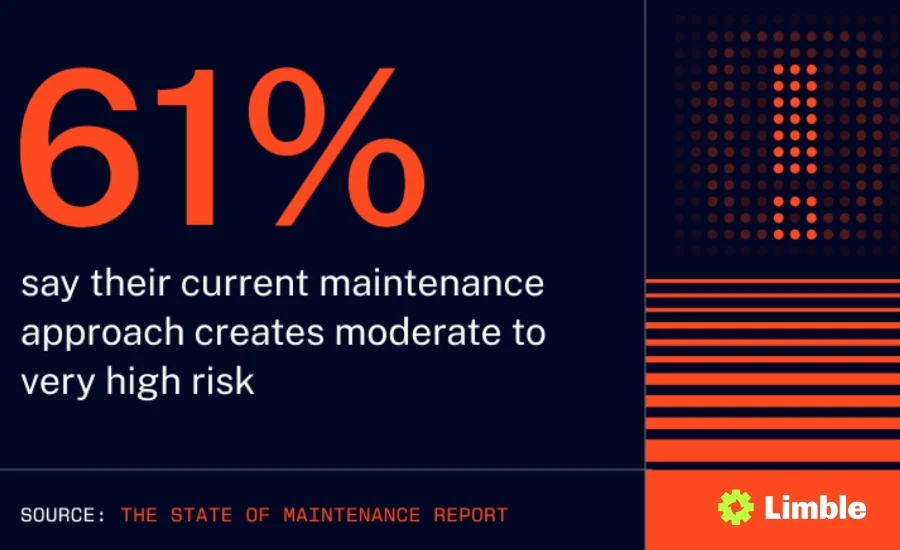
Rushing to fix a critical bottleneck on a live line or improvising repairs under immense production pressure creates fertile ground for workplace injuries and OSHA violations. Unsurprisingly, 61% of maintenance leaders admitted that their current maintenance approach generates a "moderate to very high risk" profile across three critical metrics: unplanned downtime, operational costs, and worker safety.

The Power of Predictive Adoption
Facilities that have successfully migrated away from reactive firefighting toward predictive strategies report dramatically different outcomes. According to the data, maintenance leaders on teams further along in adopting predictive maintenance were 46% more likely than the survey average to report fewer than five hours of unplanned downtime per month.
This statistic provides empirical validation for digital transformation in the plant. Facilities that invest in predictive tools do not just save money on parts; they fundamentally alter their operational stability, nearly eliminating the multi-hour outages that plague their competitors.
The Administrative Bottleneck
Another critical data point centers on labor efficiency. In an era marked by skilled labor shortages, wasting a technician’s time is an expensive luxury.
The report highlights that hands-on wrench time is severely restricted. More than six in ten professionals estimate that technicians spend three hours or less actually performing maintenance during a shift. The primary culprit? Administrative friction. Nearly half (48%) of surveyed technicians noted they lose at least an hour per day simply waiting for work order approvals, tracking down replacement parts, or securing site access.

Official Responses and Industry Insights
Industry analysts and maintenance experts point to these findings as a wake-up call for manufacturing leadership. For years, executive boards have prioritized output volume and throughput metrics while treating maintenance departments as cost centers to be minimized rather than strategic assets to be optimized.
Bryan Christiansen, founder and CEO of Limble, emphasized that the data highlights a systemic disconnect between executive expectations and plant-floor realities.
"When nearly half of your operational leaders are dealing with double-digit hours of unplanned downtime every month, and four out of ten are bleeding at least $100,000 annually because of it, you aren’t just facing a maintenance problem—you’re facing a business continuity crisis," industry experts note regarding the report’s trajectory.
Manufacturing consultants suggest that plant managers must shift their internal culture. Viewing maintenance software and predictive sensor arrays as capital investments rather than discretionary expenses is no longer optional for firms hoping to compete globally. When technicians are empowered with mobile-accessible CMMS platforms that streamline approvals and automate work orders, administrative delays plummet, directly translating into regained hours of productive machine uptime.
Implications: What This Means for the Future of Manufacturing
The implications of Limble’s State of Maintenance Report ripple across several key pillars of the industrial sector:
1. Workforce Retention and Safety
With manufacturing facing a persistent "skills gap" and an aging workforce, employee retention is paramount. Technicians who are constantly subjected to high-stress, dangerous, reactive firefighting environments are more likely to burn out or leave the industry. By adopting predictive maintenance and streamlining administrative approvals, plants can create safer, more orderly, and more satisfying work environments, helping to attract and retain vital talent.
2. Supply Chain Resilience
Unplanned downtime does not happen in a vacuum; it ripples downstream. When an assembly plant suffers a 20-hour unexpected shutdown, delivery windows are missed, tier-one suppliers face inventory gridlock, and end-customers experience frustrating delays. Elevating maintenance maturity is, therefore, a foundational requirement for broader supply chain resilience.
3. The Imperative of Digital Transformation
The stark performance gap between reactive facilities and predictive adopters highlights a widening digital divide. Facilities clinging to legacy paper logs, spreadsheets, and calendar-based checklists will find it increasingly difficult to compete against automated, data-driven competitors who enjoy minimal downtime and maximum asset utilization.
Moving Forward
The full State of Maintenance Report is available for download through Limble’s resource portal, offering manufacturing executives, plant managers, and reliability engineers a detailed roadmap for benchmarking their operations.
For U.S. manufacturers looking to shore up their operations against economic uncertainty, the message from the data is clear: investing in preventive culture, reducing administrative drag, and embracing predictive technologies are no longer just maintenance goals—they are existential business necessities.