




CHICAGO — As industrial automation faces an era of mounting deployment complexity, compressed startup timelines, and acute technical talent shortages, Festo is preparing a comprehensive showcase for Automate 2026. Scheduled for June 22–25 at McCormick Place in Chicago, the company will use Booth #831 to address the core integration hurdles challenging original equipment manufacturers (OEMs) and system integrators today.
By centering its exhibit on decentralized control, multi-protocol connectivity, adaptive gripping, simplified electric motion, and digital engineering tools, Festo aims to demonstrate how manufacturers can simultaneously shrink engineering overhead, enhance machine visibility, and adapt rapidly to shifting production requirements.
Main Facts: Addressing the Modern Automation Bottleneck
Modern machine designs have evolved far beyond simple, isolated mechanical loops. Today’s systems incorporate an unprecedented density of smart devices, dense industrial networks, and modular production configurations designed for high-mix, low-volume manufacturing. However, this functional sophistication comes with a heavy operational penalty.
OEMs and system integrators are increasingly squeezed by:
- Compressed Timelines: Shorter windows from conceptual design to factory-floor commissioning.
- Resource Constraints: A persistent deficit of specialized engineering and technical talent.
- Interoperability Challenges: The friction of harmonizing disparate control architectures, communication protocols, and physical components.
To combat these hurdles, Festo’s exhibition at Automate 2026 will focus heavily on technologies that reduce troubleshooting friction, optimize panel space, and streamline the entire lifecycle of an automation project—from digital design to physical deployment.
Chronology of the Event and Key Educational Sessions
For industry professionals attending Automate 2026, Festo’s presence extends well beyond the exhibition floor. The company has organized a robust schedule of technical presentations, panel discussions, and expert-led forums spanning the four-day event.
Pre-Show and Exhibition Timeline
- June 22–25, 2026: Exhibition halls open at McCormick Place, Chicago. Festo application specialists will be available continuously at Booth #831 to consult on motion control, handling systems, connectivity, and workforce development projects.
Conference Schedule Highlights
Festo technical leadership will take active roles in the Automate educational conference tracks, addressing critical industry vectors including safety, artificial intelligence, component selection, and career pathways:
- Tuesday, June 23, 11:15 AM – 12:00 PM (Room N427abc, North Hall):
- Session: Robotic Safety, Risk Assessment and Responsible AI in Education and Training
- Moderator: Ted Rozier
- Focus: Examining how the integration of artificial intelligence and advanced robotics necessitates a paradigm shift in safety protocols, risk assessment methodologies, and technical training curricula.
- Wednesday, June 24, 1:30 PM (Room S404bc):
- Session: Choosing the Best Fit Motion Control Components and Systems
- Presenter: Frank Langro
- Focus: A deep-dive engineering framework for evaluating pneumatic versus electric actuation, matching torque and speed profiles, and optimizing system architectures for specific industrial applications.
- Wednesday, June 24, 3:00 PM (NextGen Theatre):
- Session: Breaking In, Standing Out, and Shaping the Future of Automation
- Panelist: Carlos Alfaro Flores
- Focus: Addressing the human element of industrial automation, talent retention, mentorship, and strategies for empowering the next generation of engineers.
Supporting Data & Technological Breakdown
Visitors to Booth #831 will experience hands-on demonstrations of several flagship platforms engineered to eliminate traditional integration friction points.
1. The VTUX Valve Terminal and CTED Multi-Protocol Interface
Traditional control architectures often rely on centralized pneumatic cabinets that require extensive tubing runs, complex manual assembly, and separate I/O blocks. Festo’s VTUX platform is designed to shift pneumatic control, vacuum generation, and I/O directly to the machine edge.
- Decentralized Efficiency: Featuring an IP67 rating, the modular VTUX can be mounted in close proximity to the application. This drastically reduces pneumatic tubing length—which directly lowers compressed air consumption and pressure drops—while minimizing control cabinet footprints.
- Advanced Diagnostics: Integrated vacuum monitoring provides real-time operational visibility, facilitating predictive maintenance and rapid troubleshooting. Its lightweight, compact architecture makes it particularly suited for dynamic end-of-arm tooling (EOAT) setups.
- The CTED Multi-Protocol Interface: To solve network fragmentation, Festo is introducing the CTED module for VTUX. This interface provides native, direct connections to major Industrial Ethernet ecosystems, including EtherNet/IP, EtherCAT, Modbus TCP, PROFIBUS, and CC-Link. By supporting multiple protocols natively, the CTED interface reduces machine builders’ dependence on single-network standards and simplifies global machine exportation.
2. HPSX Adaptive Gripper and Advanced Vacuum Technologies
In high-mix automation environments—such as food packaging, cosmetics, and pharmaceutical manufacturing—line changeovers must be swift, and handling delicate, irregular geometries requires finesse.
- HPSX Hygienic Soft Gripper: Festo will showcase the HPSX, a specialized soft gripper equipped with food-safe silicone fingers. Engineered for both traditional industrial robotics and collaborative robot (cobot) deployments, the HPSX can securely manipulate fragile, variable-shape products without requiring time-consuming physical tool changes.
- Ecosystem Integration: The gripping display is rounded out by advanced vacuum generators and high-adhesion suction cups designed to optimize pick-and-place reliability across diverse surface textures and porosities.
3. Simplified Motion Series (SMS) Electric Actuators
While electric automation offers superior precision and programming flexibility, traditional servo and stepper systems often introduce unnecessary software complexity and commissioning overhead.
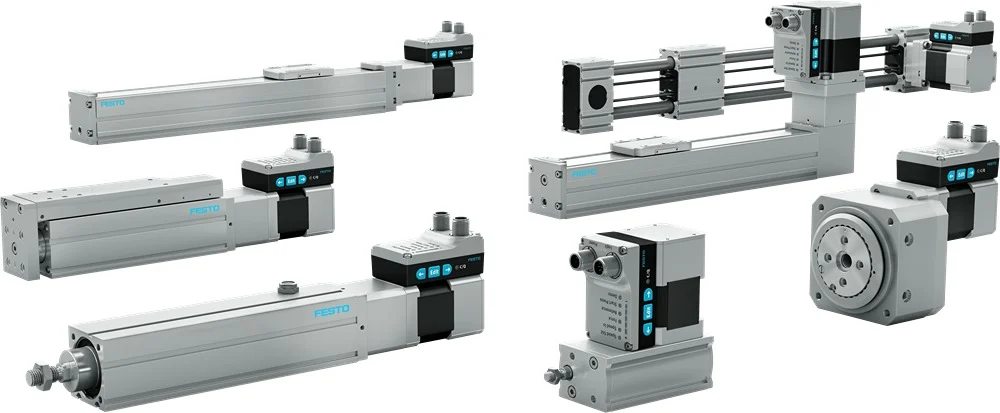
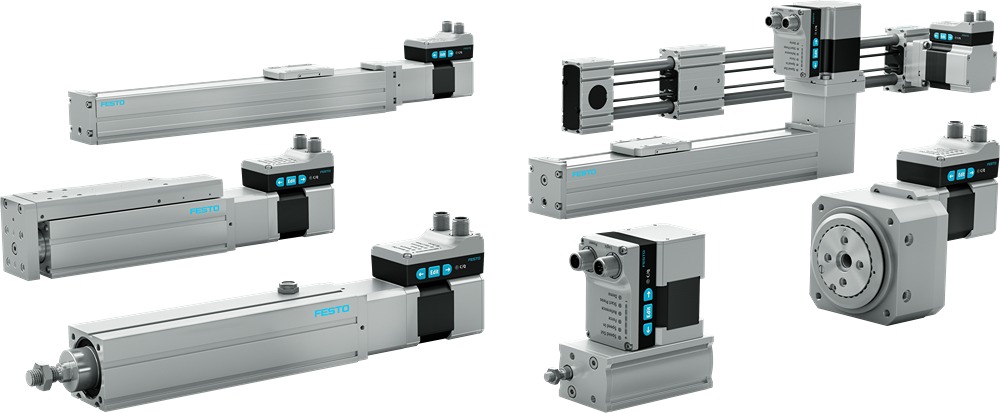
- Pneumatic Simplicity, Electric Performance: Festo’s Simplified Motion Series (SMS) bridges this gap by housing the motor and drive within a unified mechanical package. Commissioning requires zero specialized programming software; parameters are configured directly on the hardware interface.
- Versatile Form Factors: The SMS lineup includes toothed belt axes, spindle axes, mini slides, electric cylinders, and rotary drives.
- Smart Connectivity: Supporting both standard digital I/O and IO-Link, SMS actuators enable remote parameterization, automated backup functions, and continuous process monitoring, vastly accelerating installation while maintaining rigorous industrial data visibility.
4. Connected Engineering Tools
Engineering hours are frequently squandered long before a machine ever hits the factory floor. Designers grapple with tedious sizing calculations, cross-vendor compatibility checks, fragmented documentation, and isolated ordering processes.
- Unified Digital Environment: Festo’s demonstration of its suite of digital engineering tools highlights a streamlined workflow. Engineers can configure multi-axis handling systems, size pneumatic and electric actuators, extract 3D CAD models, verify accessory compatibility, and generate quotes within a single connected ecosystem.
- Risk Mitigation: By validating component interoperability digitally before physical procurement, these tools eliminate costly sizing errors and deployment delays. Furthermore, configurations can be saved, modified, and reordered seamlessly for future machine iterations.
5. Festo Didactic and the MPS 400 Learning System
Advanced hardware is only as effective as the technicians operating and maintaining it. To combat the widening skills gap, Festo Didactic delivers industrial-grade training ecosystems.
- MPS 400 Learning Factory: Festo will feature the Modular Production System (MPS 400), a scalable Industry 4.0 training platform. The MPS 400 immerses students and technicians in real-world mechatronics, intelligent machine networking, IO-Link diagnostic workflows, and decentralized automation paradigms, ensuring workforce readiness for smart manufacturing environments.
Official Responses and Industry Implications
The underlying theme of Festo’s presence at Automate 2026 is a direct response to macroeconomic shifts in manufacturing. As industrial sectors face mounting pressure to localize supply chains, increase production flexibility, and overcome labor scarcity, the role of automation suppliers has expanded beyond component manufacturing into systemic problem-solving.
Industry analysts note that machine builders can no longer afford the friction of siloed components. The market demand has decisively shifted toward interoperable ecosystems that offer visibility from the field bus to the cloud, while remaining intuitive enough to be deployed by leaner engineering teams.
By combining edge-ready hardware like the IP67-rated VTUX and multi-protocol CTED interfaces with no-code-required electric actuators (SMS) and frictionless digital engineering suites, Festo is positioning itself as an enabler of agile manufacturing.
Furthermore, by pairing these hardware and software advancements with the educational framework of Festo Didactic and expert conference panels on AI safety and component selection, the company is tackling the industrial automation crisis holistically: addressing the technology, the engineering workflow, and the human workforce simultaneously.
Join Festo at Automate 2026
Engineers, system integrators, OEMs, educators, and manufacturing leaders attending Automate 2026 are invited to engage directly with Festo application specialists at Booth #831 to explore tailored strategies for optimizing motion control, handling dynamics, network connectivity, and workforce upskilling.
For more information on Festo’s exhibition lineup and technologies, visit www.festo.com.