




BIRMINGHAM, Mich. — In the high-stakes world of automotive manufacturing, time is quite literally currency. Every hour of unplanned downtime at a high-volume assembly facility can ripple through supply chains, disrupt dealer networks, and cost millions of dollars in lost revenue. For one major Midwest automotive manufacturer capable of pumping out 420,000 vehicles annually, keeping the assembly lines moving is an around-the-clock priority.
So when aging infrastructure threatened to compromise plant operations, the stakes could not have been higher.
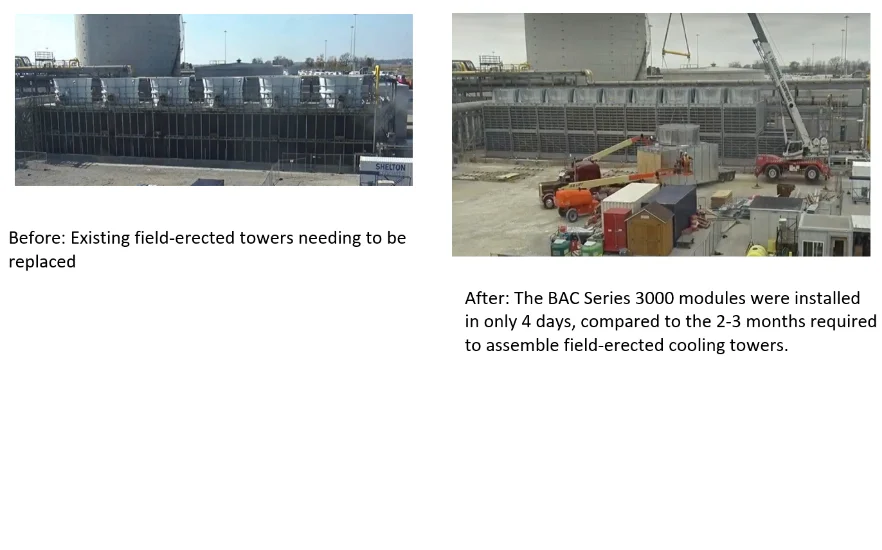
Faced with six decaying, field-erected cooling towers that were nearing the end of their operational lifecycles, plant leadership needed a complete thermal infrastructure overhaul. The challenge was not just upgrading the equipment, but doing so without disrupting the plant’s rigorous production schedule.
Working in close collaboration with manufacturer’s representative ElitAire LLC, the automaker pulled off a logistical coup: replacing the six legacy towers with 12 factory-built modular units in a staggering four days. By pivoting from traditional field-erected systems to off-site manufacturing and advanced direct-drive technology, the plant successfully modernized a critical utility subsystem well within a tight four-month weather and operational window—safeguarding facility output and setting a new benchmark for industrial infrastructure upgrades.
Main Facts: The Anatomy of the Upgrade
At the core of this industrial success story is a major infrastructure pivot executed during a massive, plant-wide modernization effort. The overarching program included extensive retooling, the integration of new machinery, and the deployment of advanced manufacturing technologies designed to keep the high-volume facility at the cutting edge of automotive production.
However, advanced robotics and smart-factory software mean little if the facility itself cannot manage its thermal loads. Cooling towers are the literal lungs of a manufacturing plant, rejecting the immense heat generated by industrial processes, HVAC systems, and heavy equipment. The facility’s existing cooling infrastructure was outdated, inefficient, and increasingly prone to maintenance issues.
To solve this, the manufacturer partnered with ElitAire LLC to evaluate replacement strategies. The choice came down to two distinct paths:
- The Traditional Route: Constructing a new field-erected system from scratch on-site.
- The Modern Modular Route: Deploying factory-built, pre-engineered modular cooling towers manufactured off-site by Baltimore Aircoil Co. (BAC).
After careful analysis, the automaker selected 12 BAC Series 3000 modular cooling towers. Crucially, these units were outfitted with state-of-the-art ENDURADRIVE direct-drive fan systems, eliminating the maintenance-heavy gearboxes of the past. Even better, engineers engineered the deployment so that the 12 new modules could be dropped directly onto the plant’s existing concrete cold-water basin, saving millions in civil engineering costs and weeks of site preparation.
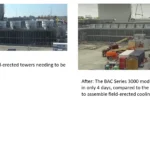
The results shattered industry expectations. While a traditional field-erected system would have required upwards of 60 days of chaotic, on-site construction, the installation of the 12 BAC modules took a mere four days.
Chronology: A Race Against the Calendar
Every major industrial retrofit is a masterclass in project management, but this particular timeline left zero room for error. Because the plant relies on continuous cooling to support its year-round operations, demolition and installation could only take place during a strictly defined window when process cooling demands dropped.
Phase 1: Planning and Procurement (Fall)
Long before a single wrench was turned on the factory floor, extensive engineering evaluations were underway. Collaborating with ElitAire, the automaker’s engineering team weighed the pros and cons of gear-driven versus direct-drive fans and calculated the structural load limits of the existing concrete cold-water basin. Once the BAC Series 3000 units were selected, manufacturing commenced off-site at Baltimore Aircoil Co.’s facilities. This allowed rigorous quality control checks to occur away from the plant.
Phase 2: Demolition (December)
True physical work on the factory grounds could not begin until December, marking the hard start of the project window. Crews moved swiftly to decommission and demolish the six aging, decrepit cooling towers. Demolition in an active industrial environment requires precise coordination to avoid damaging adjacent utilities, electrical feeds, and water piping. Despite winter weather conditions in the Midwest, demolition crews cleared the site efficiently, preparing the legacy concrete cold-water basin to receive its new cargo.
Phase 3: Site Preparation and Staging (January – February)
With the old towers removed, the concrete basin underwent structural inspections, cleaning, and necessary remediation to ensure a sound foundation for the incoming modules. Staging logistics were planned down to the hour; bringing 12 massive modular units onto an active manufacturing campus requires meticulous traffic management to prevent disruption to incoming parts shipments and outgoing vehicle transports.
Phase 4: The Four-Day Installation Surge (March)
The pinnacle of the project occurred in March, when the rubber met the road—or rather, when the cranes met the modules. Over the course of just four consecutive days, all 12 BAC Series 3000 units were hoisted into place and secured to the existing basin.
Phase 5: Commissioning and Startup (April)
Following mechanical and electrical hookups, the system underwent comprehensive commissioning. By April, the entire thermal utility upgrade was fully operational, smoothly integrated into the plant’s broader modernization matrix, and ready to support the facility’s ramp-up for the spring and summer production months.
Supporting Data and Technical Advantages
To truly understand why this project was a watershed moment for the plant, one must look at the underlying engineering data and operational metrics.
The Time Dividend: Off-Site vs. On-Site Construction
Time is the ultimate enemy in plant retrofits. The comparative metrics between field-erected systems and modular alternatives tell a compelling story:
- Estimated time for a field-erected system: 60+ days of active on-site construction (translating to roughly 2 to 3 months of labor-heavy assembly).
- Actual time for modular installation: 4 days total.
- Per-module installation rate: Approximately 3 hours per module from truck bed to final placement on the basin.
“Instead of taking 2-3 months to erect site-built towers, the modules were each installed in about 3 hours, and the entire process from demolition to completion was accomplished well within the four-month window,” noted Hassan Alhashim, lead project engineer at ElitAire.

Quality Control and Factory Acceptance Testing (FAT)
One of the hidden risks of field-erected cooling towers is the variability of on-site labor. Building complex mechanical structures outdoors in winter exposes components to moisture, cold temperatures, and tight working conditions, which can introduce human error or quality defects.
By utilizing factory-built modular towers from Baltimore Aircoil Co., the manufacturer shifted the burden of construction to a controlled manufacturing environment. This allowed for:
- Visual inspections conducted under ideal lighting and ergonomic conditions.
- Factory Acceptance Testing (FAT) to verify mechanical integrity, electrical connections, and thermal performance before the equipment ever set foot on a trailer.
- A dramatic reduction in construction labor performed on the operating automotive campus, minimizing safety risks, contractor footprints, and site congestion.
The Direct-Drive Advantage
The inclusion of BAC’s ENDURADRIVE direct-drive fan systems introduced massive long-term operational efficiencies. Traditional cooling towers often rely on complex gearboxes, drive shafts, and belts to turn massive fans. These mechanical assemblies require frequent lubrication, regular alignment checks, and eventual overhauls due to heavy wear and tear in moist, corrosive environments.
Direct-drive technology couples the fan directly to the motor, drastically reducing the number of moving parts. This results in:
- Higher reliability and uptime: Fewer mechanical failure points mean less risk of unexpected thermal shutdowns.
- Lower maintenance costs: Elimination of gear oil changes, belt tensioning, and gearbox rebuilds.
- Enhanced energy efficiency: Direct-drive systems deliver superior power transmission from motor to fan blade, optimizing energy consumption across varying load profiles.
Official Perspectives and Industry Insights
The success of the Birmingham-area project has drawn significant praise from engineering and manufacturing circles alike, highlighting a broader shift in how heavy industry approaches capital infrastructure projects.
Hassan Alhashim of ElitAire emphasized the sheer logistical relief the modular approach provided. In industrial retrofits, the greatest fear is scope creep and schedule overrun. By selecting pre-engineered, factory-tested modules, the project team effectively insulated themselves from the unpredictable variables of outdoor winter construction in the Midwest.
“Building the modules off-site also allowed visual inspections and factory acceptance testing to be completed before the equipment arrived at the automotive plant,” Alhashim explained. “The approach reduced the amount of construction work that had to be performed at the operating facility.”
From the perspective of the automotive manufacturer, the decision was validated the moment the plant resumed full-scale operations without missing a single shift. In an industry where profit margins are razor-thin and production schedules are locked months in advance, avoiding downtime is priceless.
Furthermore, industrial equipment analysts note that this project serves as a blueprint for aging manufacturing facilities across North America. Thousands of factories built during the mid-to-late 20th century are currently facing a wave of infrastructure obsolescence. Traditional wisdom once dictated that replacing massive utility assets like cooling towers required shutting down operations for months or undertaking perilous, piecemeal repairs. This project proves that modular, off-site manufacturing can solve legacy infrastructure challenges with surgical precision.
Broader Implications for the Manufacturing Sector
The successful four-day overhaul of the Midwest automotive plant’s cooling infrastructure carries profound implications for the broader manufacturing landscape. As industrial facilities face increasing pressure to modernize, reduce carbon footprints, and maximize uptime, the methodologies proven in this project offer a clear roadmap for the future.
1. The Death of the Extended Shutdown
Historically, major utility upgrades were synonymous with "summer shutdowns" or "holiday shutdowns," where plants would go dark for weeks while contractors swarmed the facility. This project demonstrates that off-site pre-fabrication can compress critical path timelines to a fraction of their historical norms. By doing the heavy lifting in a factory environment, plants can preserve their precious operating calendars.
2. Risk Mitigation in Brownfield Retrofits
Working on "brownfield" sites—older facilities with space constraints, legacy foundations, and complex interconnected utilities—is notoriously difficult. The ability of the BAC Series 3000 modules to drop seamlessly onto the existing concrete cold-water basin highlights the value of adaptable engineering. Manufacturers do not always need to tear out underlying civil infrastructure to upgrade mechanical systems; clever modular design can bridge the gap between old foundations and new technology.
3. Sustainability and Energy Efficiency
Modernizing thermal infrastructure is about more than just keeping machines from overheating; it is about energy management. Cooling towers are among the largest electrical loads in an industrial plant. By integrating high-efficiency direct-drive fan systems and modern heat-rejection media, the automaker significantly lowered the parasitic energy load of its utility plant, supporting corporate sustainability and carbon-reduction goals.
4. Labor Optimization
With skilled trades facing a persistent labor shortage across North America, minimizing the hours required for on-site construction is a major competitive advantage. Shifting labor from the field to the factory floor ensures better quality control while keeping contractor headcounts manageable on busy manufacturing campuses.
Conclusion
As the automotive sector accelerates toward a future defined by electrification, advanced automation, and smart manufacturing, the underlying utility infrastructure supporting these high-tech plants must evolve in lockstep.
The story of how a major Midwest automaker replaced six aging cooling towers with 12 state-of-the-art modular units in just four days is a testament to modern engineering ingenuity. Through seamless collaboration between the manufacturer, ElitAire LLC, and Baltimore Aircoil Co., a potential operational crisis was converted into a masterclass in efficiency.
By embracing off-site prefabrication, rigorous factory testing, direct-drive technology, and clever modular design, the facility secured its thermal future without losing a single vehicle of production capacity. For industrial leaders watching aging infrastructure tick closer to obsolescence, this Birmingham project sends a clear, reassuring message: plant modernization no longer requires sacrificing production time. With the right partners and the right technology, the future can be installed in a weekend.