





The convergence of artificial intelligence, high-performance computing, and physical engineering has officially crossed the threshold from experimental research into mainstream industrial application. Recent announcements from global technology leaders—including Dunlop, Fujitsu, Plataine, Siemens, Micron, MetAI, and PhysicsX—illustrate a profound structural shift across the manufacturing and engineering landscapes.
No longer confined to isolated predictive dashboards or static proof-of-concept demos, artificial intelligence is embedding itself directly into the core workflows of product design, structural analysis, factory floor orchestration, and semiconductor fabrication. Driven by GPU acceleration, graph neural networks, OpenUSD-based digital twins, and large-scale physics models, enterprises are radically shrinking iteration cycles, neutralizing production bottlenecks, and rethinking how complex physical systems are designed and optimized.
1. Main Facts: The Core Technological Breakthroughs
Recent industry developments highlight several foundational shifts in how computational engineering and smart manufacturing operate:
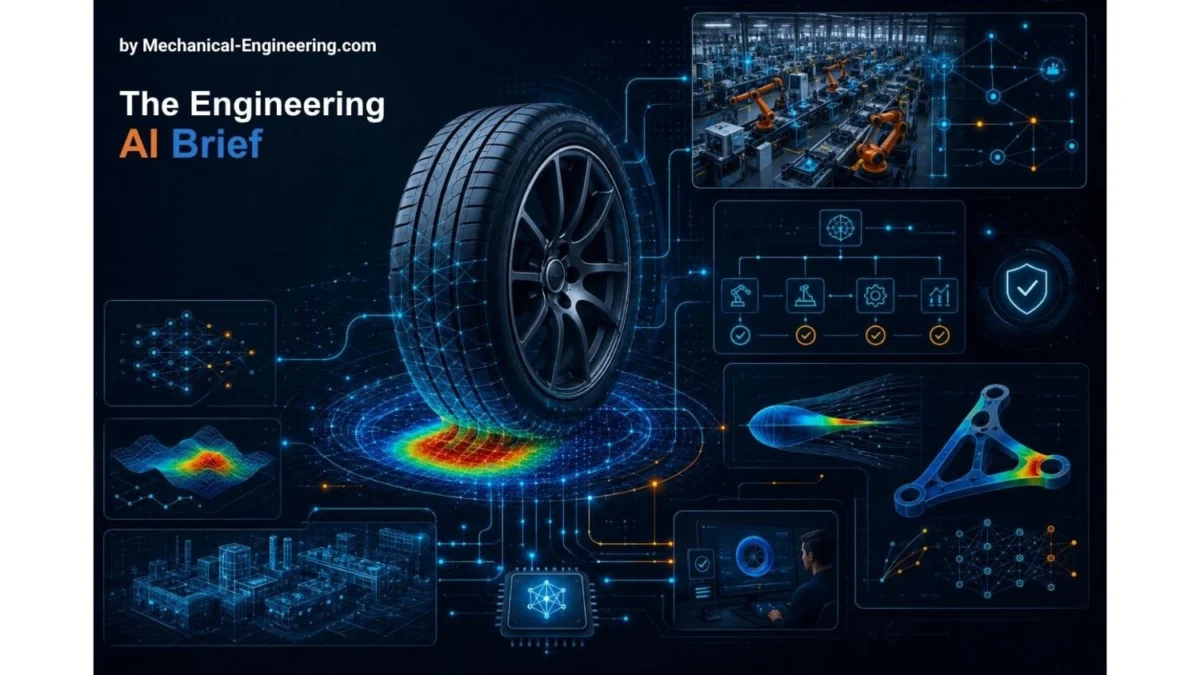
- AI Surrogate Modeling in Tyre Engineering: Dunlop and Fujitsu have successfully engineered an AI surrogate model for tyre structural analysis, leveraging graph neural networks. In initial validation frameworks, the model compressed traditional Finite Element Method (FEM) workflows by roughly 90%, dropping computation times from 45 minutes down to just 5 minutes while maintaining an average 87.7% predictive accuracy for complex contact shapes and pressure distributions across 600,000 mesh elements.
- Conversational Factory Optimization: Plataine has integrated advanced conversational AI agents into its Total Production Optimization suite. These agents monitor real-time manufacturing variables—including materials, asset health, labor availability, and scheduling constraints—allowing operations managers to run natural-language "what-if" simulations and execute automated recovery plans during production disruptions.
- Enterprise-Grade Industrial AI Orchestration: Siemens launched Intelligence Center X, an industrial AI orchestration framework built on Mendix, Graph Studio, and RapidMiner technologies. The platform is designed to govern and scale AI agents across enterprise workflows, yielding documented operational efficiencies such as an 85% reduction in production issue resolution times.
- Simulation-Ready Semiconductor Fab Twins: Micron and MetAI have collaborated on the development of simulation-ready fabrication facility ("fab") twins using the NVIDIA Omniverse ecosystem and MetAI’s MetGen platform. Utilizing OpenUSD, the workflow ingests CAD drawings and facility metadata to construct parametric, modular, SimReady environments for advanced semiconductor planning and robotics simulation.
- Massive Capital Influx into Physics AI: PhysicsX closed a landmark $300 million Series C funding round at a $2.4 billion valuation, led by Temasek with heavy backing from NVIDIA, Siemens, and Applied Materials. The capital will accelerate the deployment of Large Physics Models capable of simulating physical behaviors in seconds rather than days across aerospace, energy, and semiconductor fabrication.
2. Chronology: The Evolution of Industrial AI Integration
The rapid commercialization of industrial AI did not happen overnight. It is the culmination of years of iterative development in computational power, data structuring, and machine learning architectures.
Phase 1: The Era of Siloed Pilots (2020–2023)
For several years, industrial AI was largely experimental. Companies experimented with machine learning to predict machine maintenance or optimize isolated supply chain variables. However, these models suffered from a lack of integration. They operated as "black boxes," disconnected from enterprise resource planning (ERP) systems, computer-aided engineering (CAE) software, and shop floor execution systems. Data silos prevented AI from scaling across broader engineering lifecycles.
Phase 2: The Rise of Generative and Graph Architectures (2024–2025)
As GPU acceleration matured and transformer-based architectures expanded into specialized fields like graph neural networks (GNNs) and OpenUSD frameworks, the industrial sector began adopting domain-specific AI. Companies realized that standard large language models (LLMs) were insufficient for rigorous physical simulations. This era saw the rise of specialized physics-informed machine learning and synthetic data generation, allowing software to understand spatial relationships, material behaviors, and thermodynamic constraints.
Phase 3: Orchestration, Governance, and Industrial Scale (2026–Present)
The current landscape represents an inflection point. Organizations are moving away from unmanaged, isolated AI tools and toward unified orchestration layers. The introduction of frameworks like Siemens Intelligence Center X, Plataine’s real-time conversational agents, and physics-focused capital investments by firms like PhysicsX signal an era where AI is governed, auditable, and embedded directly into the daily operational loops of human engineers and plant managers.
3. Supporting Data & Quantitative Metrics
To understand the tangible impact of these technologies, one must look closely at the performance metrics reported across recent deployments:
| Organization / Initiative | Technology Utilized | Key Performance Metric / Improvement | Baseline Comparison |
|---|---|---|---|
| Dunlop & Fujitsu | Graph Neural Networks (AI Surrogate Model) | ~90% reduction in analysis time (5 minutes vs. 45 minutes) | Traditional Finite Element Method (FEM) workflows |
| Dunlop & Fujitsu | Tyre Deformation Surrogate Model | 87.7% average prediction accuracy for contact shape across ~600,000 mesh elements | Standard FEM structural analysis |
| Vivix (Siemens Integration) | Intelligence Center X (AI Orchestration) | 85% reduction in production issue resolution time | Legacy manual troubleshooting workflows |
| Axiz (Siemens Integration) | RapidMiner & AI Studio Workflows | 95% reduction in manual effort for pricing optimization use cases | Manual data compilation and pricing analysis |
| PhysicsX | Large Physics Models (Series C backed) | Real-time prediction (seconds vs. hours/days) across multi-physics domains | Conventional computational fluid dynamics (CFD) and CAE solvers |
These metrics demonstrate that modern industrial AI is no longer judged solely on theoretical intelligence, but on quantifiable reductions in time, computational overhead, and manual labor.
4. Official Responses and Industry Perspectives
The rapid adoption of AI-driven engineering and manufacturing tools has elicited significant commentary from industry leaders, emphasizing both the immense opportunities and the remaining operational caveats.
The Engineering Perspective: Acceleration Without Compromise
Engineers and simulation specialists have long battled the trade-off between fidelity and speed. High-fidelity CAE simulations provide accurate insights into stress, thermal dynamics, and structural integrity, but they demand immense computational time.
In the collaboration between Dunlop and Fujitsu, the objective was clear: empower engineers to screen structures and materials significantly faster before committing to deep CAE validation. Tsuyoshi [Representative], speaking on behalf of the initiative, noted that while the AI surrogate model drastically compresses the iteration loop—targeting a practical design support tool rollout by April 2027—“engineers still need to validate the results against ground-truth physics.” The AI serves as an upstream filter, not an absolute replacement for rigorous physical testing.
The Manufacturing Perspective: Mitigating Factory "Firefighting"
On the shop floor, unexpected disruptions cost manufacturers billions annually. Plataine’s introduction of conversational AI agents aims to eliminate reactive management—often referred to as manufacturing "firefighting."
Avner Ben-Bassat, President and CEO of Plataine, emphasized the necessity of moving beyond static dashboards: "Manufacturers can no longer afford to rely on historical data presented on reactive screens when supply chains and labor markets fluctuate in real time. Our next-generation agents allow planners to converse with their operations, run what-if scenarios instantly, and apply data-driven recovery actions before minor hiccups escalate into major downtime." However, industry analysts caution that the effectiveness of these agents remains inextricably tied to the hygiene of underlying shop-floor data and strict human oversight.
The Enterprise Orchestration Perspective: Governance and Scale
Addressing the industry-wide challenge of scaling AI beyond isolated experiments, Siemens has positioned its Intelligence Center X as a governed bridge between data silos and automated execution. Cedrik Neike, member of the Managing Board of Siemens AG and CEO of Digital Industries, highlighted the importance of security and auditability: "The true bottleneck in industrial AI is not capability; it is governance. Companies need assurance that AI agents operating within mission-critical manufacturing and engineering workflows adhere to strict policy limits, human-in-the-loop controls, and complete transparency."
5. Strategic Implications for Engineers and Manufacturers
The convergence of these technologies carries profound implications for the future of industrial design, enterprise workflows, and workforce skill sets.
1. The Compression of Design Iteration Loops
In automotive, aerospace, and general manufacturing, the ability to predict structural and physical behavior in seconds rather than hours fundamentally changes product development. By integrating surrogate models and physics-informed AI, design teams can explore a vastly wider design space. Instead of evaluating three or four viable iterations due to time constraints, engineers can computationally screen hundreds of variants, optimizing for weight, durability, and cost much earlier in the product lifecycle.
2. Transition from Visualization to Simulation-Ready Digital Twins
The evolution of digital twins—exemplified by Micron and MetAI’s work on NVIDIA Omniverse—signals a departure from static 3D facility models. By converting CAD drawings and metadata into parametric, OpenUSD-based "SimReady" environments, manufacturers can test robotics, material flows, and layout efficiency in synthetic environments before physical ground is broken. This minimizes costly shop-floor retooling and accelerates time-to-market for high-stakes facilities like semiconductor fabrication plants.
3. The Human-in-the-Loop Imperative
Despite the impressive performance figures—such as PhysicsX’s multi-physics speedups or Siemens’ 85% reduction in issue resolution times—industry consensus remains unified on one point: AI is an accelerator, not an autonomous decision-maker.
The physical world is unforgiving. A miscalculated structural load in aerospace or a flawed thermal simulation in energy production can lead to catastrophic physical failure. Consequently, modern industrial AI frameworks heavily emphasize human-in-the-loop validation. Engineers must act as arbiters of AI-generated outputs, ensuring that surrogate models, conversational recovery plans, and physics predictions align with empirical reality and safety standards.
4. Workforce Evolution and Skill Requirements
As industrial software absorbs AI orchestration tools, the day-to-day role of the engineer and plant manager is shifting. Routine data gathering, manual pricing compilation, and repetitive mesh generation are increasingly automated. In their place, professionals must cultivate advanced skills in data governance, prompt engineering for industrial workflows, model validation, and cross-functional system oversight.
Conclusion
The recent milestones achieved by Dunlop, Fujitsu, Plataine, Siemens, Micron, MetAI, and PhysicsX paint a clear picture of the industrial future. Artificial intelligence in engineering is shedding its novelty status and maturing into an indispensable utility. By marrying the speed of machine learning with the rigorous constraints of physical science, the manufacturing and engineering sectors are poised for an era of unprecedented efficiency, agility, and innovation.
However, as these tools become more deeply embedded in critical infrastructure, the organizations that succeed will be those that balance computational velocity with rigorous data governance, unwavering human oversight, and a deep respect for physical reality.