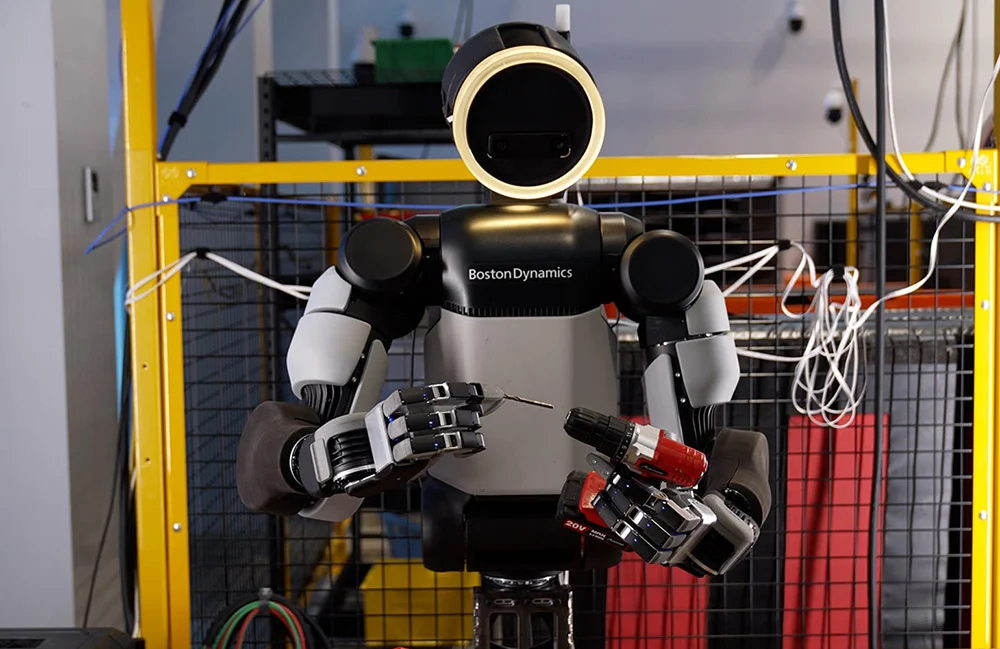
SANTA CLARA, Calif. — In the rapidly evolving landscape of humanoid robotics, few developments capture the industry’s attention quite like a hardware overhaul from Boston Dynamics. Last week, the pioneering robotics institution pulled back the curtain on its heavily redesigned, highly anticipated humanoid hand—a component tailor-made for its flagship bipedal robot, Atlas.
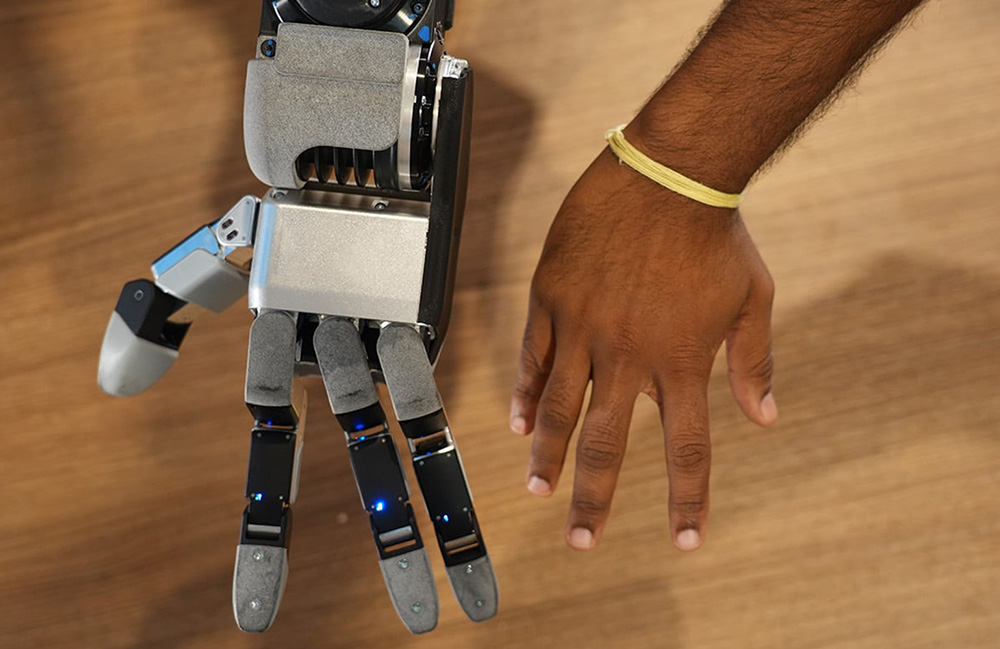
Discarding conventional assumptions about what a robotic end-effector "should" look like, Boston Dynamics has opted for radical functionalism. The new manipulator features a four-fingered, 13-degree-of-freedom (DoF) architecture that is directly actuated and engineered explicitly for high-volume manufacturing. Most notably, the company dropped the pinky finger entirely, trimmed the overall footprint of the gripper, and optimized the design for high-fidelity physics simulation.
To unpack the engineering choices, strategic pivots, and future implications of this new end-effector, The Robot Report spoke directly with Alberto Rodriguez, Director of Robot Behavior for Atlas at Boston Dynamics. The conversation sheds light on how years of trial, error, and practical deployment have shaped one of the most consequential hands in modern robotics.
Main Facts: Deconstructing the Next-Generation Atlas Hand
At first glance, the specifications of Boston Dynamics’ latest gripper reveal a calculated departure from biomimicry in favor of industrial pragmatism.
- Configuration: A four-fingered design featuring 13 degrees of freedom (DoF) with direct actuation.
- Payload Capacity: Despite its reduced size and footprint, the hand retains the robust capability of handling heavy payloads in excess of 100 pounds.
- Structural Innovation: Built using 13 identical, fully encapsulated actuators, eliminating the vulnerable, complex cabling that typically crosses finger joints.
- Manufacturing Focus: Engineered from the ground up for mass production, emphasizing modularity, repeatability, and cost-efficiency.
- AI Integration: Purpose-built to facilitate high-fidelity simulation, specifically paving the way for advanced sim-to-real reinforcement learning (RL) training loops.
Chronology: The Evolution Toward a Production-Ready End-Effector
The journey to the current Atlas hand did not happen in a vacuum. It represents the culmination of a multi-year engineering evolution driven by real-world friction and hard-learned operational lessons.
Phase 1: Heavy Lifting and High Complexity
In earlier iterations of the Atlas humanoid platform, Boston Dynamics prioritized raw strength and maximum physical capability. Early robotic hands were robust enough to lift objects weighing upwards of 100 pounds. However, these prototypes came with significant drawbacks: complex mechanical layouts, fragile joint-crossing cables, and maintenance bottlenecks that hindered rapid experimentation.
Phase 2: Evaluating the Trade-Offs
As the product roadmap for Atlas matured, Boston Dynamics engineers faced critical decisions regarding the intersection of dexterity, strength, ruggedness, cost, and reparability. Recognizing that the previous iterations had already achieved sufficient lifting capacity, the team recognized an opportunity to dial back raw strength slightly to dramatically improve actuation transparency and backdrivability.
Phase 3: The Convergence on Modularity
Applying lessons learned from the structural design of the Atlas robot body, the team pivoted toward extreme modularity and simplicity. By standardizing on 13 identical, fully encapsulated actuators, engineers eliminated vulnerabilities. Prototypes were rapidly deployed to internal systems, controls, and behavior teams to unearth unforeseen field failures—ultimately leading to the streamlined, four-fingered design unveiled last week.
Supporting Data: Engineering Trade-Offs and Design Decisions
Designing a humanoid hand requires navigating a labyrinth of competing engineering constraints. According to Rodriguez, the team evaluated everything from off-the-shelf end-effectors to radical, non-traditional morphologies before committing to an in-house build.
Why In-House?
While commercial, off-the-shelf grippers exist, Boston Dynamics views manipulation as a core value proposition of its humanoid platform. "Hands are a key piece of technology that are so integral to the value proposition of humanoids that it would be very difficult for us to approach it in any other way than in-house," Rodriguez explained. Every hand represents a consequential series of trade-offs that must align tightly with the broader product roadmap.
The Anatomy of the Decision: Finger Count and Morphology
One of the most heavily debated aspects of the design process was determining the optimal number of fingers. The engineering team cycled through various concepts, including an exploratory design featuring "two thumbs"—one on each side.
- The Two-Thumb Concept: This layout offered the logistical advantage of eliminating left- and right-hand variants, allowing both hands to be fabricated on a single, unified assembly line.
- The Final Verdict: Ultimately, the team rejected the dual-thumb approach because it introduced unnecessary actuation complexity, increased the overall degrees of freedom, inflated costs, and added physical volume.
Instead, the team settled on a streamlined four-fingered configuration. By dropping the pinky finger and scaling down the gripper, engineers reduced mechanical redundancy while preserving the dexterity required for complex industrial tasks.
Official Responses: Insights from Alberto Rodriguez
During his discussion with The Robot Report, Rodriguez elaborated on the philosophy governing Boston Dynamics’ hardware-software co-design strategy.
When asked about how the company ensures long-term durability across grueling industrial shifts, Rodriguez credited a deeply integrated corporate culture:
"It all starts from an amazing hardware design team that has done this many times before and has built intuition for what leads to reliable hardware. We also have a strong culture of collaboration between the behavior and hardware teams in those early design phases to lock in key design features… This allows the hardware team to go into the detailed design with more confidence."
Rodriguez also emphasized that rigorous internal testing—though initially tedious—drastically accelerates the broader deployment timeline:
"While this is tedious and might initially slow down the deployment of new hardware, it ends up speeding up the process by allowing [us] to refine issues faster than having to painfully discover them in the field."
Testing regimens have not been limited to basic pick-and-place routines. The team has subjected the hands to a battery of representative industrial tasks—ranging from operating handheld power tools and routing complex cables to "fishing for screws." Beyond standard work routines, the team has experimented with playful, dynamic movements like juggling and speed hand games, drawing inspiration from human physical achievements to push the boundaries of system responsiveness.
Implications: Sim-to-Real Reinforcement Learning and the Future of Dexterity
Perhaps the most consequential aspect of Boston Dynamics’ new hand design lies beneath the mechanical surface: its seamless integration with modern artificial intelligence.
Unlocking Sim-to-Real Reinforcement Learning
Traditional robotics relies heavily on explicit programming or tedious teleoperation to execute complex physical tasks. However, fine manipulative tasks—such as adjusting grip pressure dynamically or managing rapid shifts in contact distribution—are notoriously difficult to program or demonstrate manually.
Boston Dynamics has solved this bottleneck by prioritizing backdrivability and transparency in the hand’s actuation and transmission systems. By engineering actuators that simulate exceptionally well in virtual environments, the control algorithms can accurately account for friction and mechanical non-idealities.
Rodriguez highlighted this breakthrough:
"This enables accurate dynamic simulation, key for the design philosophy of the entire robot. This makes reinforcement learning more effective at training policies that can use proprioception, where the actuators themselves sense that you are pushing back on them and transfer directly to hardware. This is the exact same recipe that has succeeded for agile humanoid behavior in the past few years."
Moving Beyond Pick-and-Place
The ability to leverage reinforcement learning at scale within a high-fidelity simulation environment marks a watershed moment for humanoid robotics. As these AI models absorb vast quantities of synthetic and real-world training data, the next generation of Atlas robots will transition from rudimentary logistics tasks—like moving boxes—to advanced, high-dexterity manipulation required on modern factory floors.
While these new hands have not yet been deployed to the wider fleet at RMAC (Robotics Manufacturing Automation Center) to avoid disrupting active data collection pipelines, their arrival at Boston Dynamics headquarters signals that commercialization is steadily approaching.
As the robotics community looks toward upcoming industry gatherings—such as the upcoming RoboBusiness 2026 conference in Santa Clara, California—it is clear that the race to build the ultimate commercial humanoid is no longer just about walking gracefully. It is about what the robot can do once it reaches out its hands.