The manufacturing sector is currently witnessing a paradigm shift. While advanced composites like carbon fiber have long been the gold standard for performance—offering unparalleled strength-to-weight ratios—their adoption has been perpetually throttled by the realities of production. Historically, these materials have been relegated to "exotic" applications: Formula 1 race cars, fighter jets, and spacecraft. The process of creating them is famously slow, labor-intensive, and agonizingly difficult to automate.
Enter Helicon Industries, a Los Angeles-based startup that has officially emerged from stealth mode with $16 million in seed funding. Led by AlleyCorp, the company is on a mission to drag composite manufacturing into the age of high-volume production, aiming to collapse lead times from a sluggish six months down to a rapid two weeks.
The Bottleneck of Modern Composites
At the heart of the problem is the way carbon fiber is traditionally handled. In current aerospace and defense workflows, technicians lay down sheets of carbon fiber into molds by hand, a process prone to human error and restricted by the physical limitations of manual labor. Whether utilizing "prepreg" (fiber pre-impregnated with resin) or vacuum infusion methods, the process is a masterpiece of precision but a failure in scalability.
"Composite manufacturing is still a very manual process; it’s difficult to automate, especially the manipulation of flexible materials like carbon-fiber textiles," explains Edmundo Sanz-Gadea, co-founder and CTO of Helicon. "That is compounded by the heavy regulation around manned aviation and defense programs."
For industry giants like Lockheed Martin or Boeing, this slow, manual approach is acceptable because their production volumes are low and the per-unit cost is high. However, the market is changing. A new generation of robotics, drone, and logistics companies are emerging with the need to build products at scale—often in the hundreds of thousands—without sacrificing the performance advantages that only carbon fiber can provide.
Sanz-Gadea notes that most companies currently rely on an inefficient workaround: buying flat carbon-fiber sheets from overseas, cutting them to shape, and fastening them together with metal bolts. "It’s a very inefficient way to build a structure," he says. "It creates a massive amount of assembly work, and it makes it much harder to manufacture competitively at scale in the United States."
A Journey from Space to Robotics
The vision behind Helicon is deeply rooted in the multidisciplinary background of its co-founders. Edmundo Sanz-Gadea, whose career has spanned high-level aerospace and cutting-edge robotics, brings a unique perspective to the factory floor.
A Chronology of Innovation
- Early Beginnings: Growing up in Madrid, Sanz-Gadea built rockets and drones. His passion earned him an internship at the European Space Agency in Paris, followed by an aerospace degree from the prestigious TU Delft in the Netherlands.
- Bridging the Gap: During his time at TU Delft, Sanz-Gadea worked with the Formula Student self-driving team—a global initiative where students build autonomous race cars. He served as the bridge between hardware engineers in Delft and software engineers at MIT, managing a team of over 100 people.
- Robotics Integration: After a stint at an autonomous drone startup in the Netherlands, Sanz-Gadea moved to ETH Zurich. There, he developed diffusion policies that enabled ANYbotics quadrupeds to perform complex robot-to-human handovers.
- Founding Helicon: Alongside co-founder and CEO Alex Niehaus, Sanz-Gadea shifted his focus toward "reindustrializing the West." The duo spent time in London developing their foundational tech before moving to San Francisco to engage with investors and finally settling in Los Angeles to build their manufacturing hub.
Sanz-Gadea’s pivot from aerospace to manufacturing was driven by the realization that aerospace design had reached a plateau of efficiency. "Traditional aerospace felt like squeezing out that last 1% of efficiency from already highly optimized systems," he told The Robot Report. "I got very interested in the new wave of robotics and autonomous systems. I realized that the real frontier wasn’t just in the design of the vehicle, but in the capability to manufacture it."

Scaling the Factory of the Future
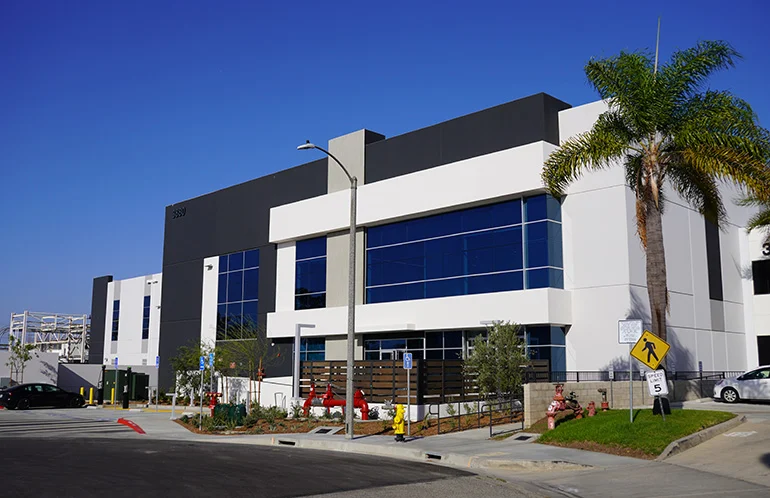
Helicon is currently establishing its footprint in a 36,000-square-foot facility in Torrance, California. This facility is not merely a warehouse; it is a laboratory for automated, high-volume production. The company is re-engineering the entire manufacturing cell to prioritize repeatability and speed.
Key Operational Improvements
- Cycle Time Reduction: By focusing on processes that can be automated, Helicon aims to bring cycle times down to under 15 minutes—a drastic improvement over the hours required by traditional layup and autoclave processes.
- Robot-Centric Design: Rather than forcing robots to adapt to human-centric workflows, Helicon is designing their factory cells so that robots can reliably pick, place, remove, and trim materials.
- Supply Chain Stability: The company is working with domestic material suppliers to bypass the current reliance on overseas flat-sheet imports, focusing on turning raw materials into finished parts within the U.S.
"The goal is to use processes that can be automated much more easily," says Sanz-Gadea. "There’s a lot of demand. The challenge companies face is they can typically do a certain number of prototypes in-house, but when they win a contract for thousands, they can’t hire enough people to keep up."
Implications: Beyond Aerospace
While Helicon is currently pursuing the rigorous certifications required for aerospace and defense, their ambitions extend far further. The startup is eyeing the burgeoning humanoid and mobile robotics markets as a primary customer base.
Performance Comparison: Carbon Fiber vs. Metal
The technical advantage of Helicon’s approach is clear: compared to traditional aluminum, their carbon-fiber structures offer higher stiffness at 40% lower weight. In the world of robotics, this is transformative. A lighter frame allows for smaller actuators, extended battery life, and higher payload capacities.

Sanz-Gadea draws a parallel to the industrial revolution of the 19th century. "Composites today are a bit like metals before modern industrialization," he notes. "The material properties are exceptional, but the manufacturing infrastructure has not caught up. Steel only became transformative once companies like Carnegie and Bethlehem Steel figured out how to produce it reliably and at massive scale. Carbon fiber has already proven itself in elite applications like Formula 1. The challenge now is bringing those same performance advantages into products made in much larger volumes."
Official Perspectives and Future Growth
The $16 million seed round, led by AlleyCorp, underscores the investor community’s confidence in Helicon’s "reindustrialization" thesis. The selection of AlleyCorp was not accidental; the founders were specifically looking for partners with deep-tech manufacturing experience.
Brannon Jones, a principal on AlleyCorp’s deep-tech team, was instrumental in the funding. His background at SpaceX provided a shared language with Helicon’s founders. "He understood what we were trying to build immediately," says Sanz-Gadea. "He flew from New York to San Francisco the next day to meet us."
As Helicon prepares to scale, they are actively hiring across mechanical engineering, robotics, software, and operations. The company’s vision is to become the backbone of a new era of manufacturing where high-performance materials are no longer an expensive luxury, but a standard component of industrial design.

For a sector that has been hampered by the limits of human dexterity for decades, Helicon’s entrance marks a critical turning point. By treating the factory itself as a robotic system, they are not just building carbon fiber parts; they are building the infrastructure that will enable the next generation of American hardware to reach the masses.
"The ambition is much bigger than making one type of carbon-fiber part," concludes Sanz-Gadea. "We want to build the manufacturing capacity to produce advanced composites at a real industrial scale." With a massive facility in Torrance and a clear technological roadmap, Helicon Industries is well-positioned to turn that ambition into a concrete reality.