In the rapidly accelerating landscape of artificial intelligence and robotics, we have entered the era of the "viral demo." Almost weekly, a new video surfaces showing a humanoid robot folding a shirt, navigating a cluttered room, or performing delicate manual labor with human-like dexterity. While these milestones are undeniably impressive, they often obscure a fundamental truth: there is a cavernous gap between a rehearsed demonstration and a general-purpose robotic worker.
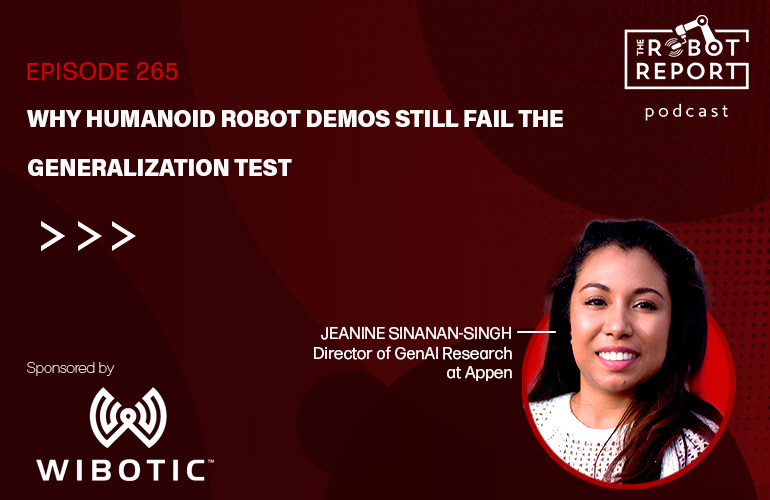
In Episode 265 of The Robot Report Podcast, we sat down with Jeanine Sinanan-Singh, Director of Generative AI Research at Appen, to dissect this gap. As an expert in agentic evaluations, reinforcement learning (RL) environments, and dataset design, Sinanan-Singh offers a sobering perspective on the current state of robotics: our robots are becoming better actors, but they aren’t necessarily becoming smarter workers.
The Illusion of Competence: Understanding Generalization
The core of the issue, according to Sinanan-Singh, lies in the definition of "generalization." In machine learning, generalization refers to a model’s ability to perform tasks in environments it has never seen before, using objects it has never interacted with, under conditions it has never encountered.
"When we see a humanoid robot perform a specific task perfectly in a controlled lab, we are witnessing a high-fidelity execution of a learned trajectory," Sinanan-Singh explains. "However, the leap from that controlled environment to the chaotic, unpredictable reality of a warehouse, a hospital, or a residential home is not a linear progression. It is a fundamental shift in reasoning requirements."
The "generalization test" is the industry’s most difficult hurdle. It asks: Can this robot handle a spill that wasn’t in the training data? Can it navigate around a new, uniquely shaped obstacle? Can it adapt when the lighting changes or the object it is grasping has a different texture than the one it practiced with? Currently, most humanoid systems struggle to translate lab-bench success into real-world utility.
The Human-in-the-Loop Imperative
Sinanan-Singh’s work at Appen focuses heavily on the necessity of "humans in the loop." While there is a prevailing narrative in Silicon Valley that we can simply scale up compute and throw more data at foundation models until they magically exhibit common sense, Sinanan-Singh argues that the quality of human intervention is the actual bottleneck.
"Robots require a nuanced understanding of intent and context that raw sensor data simply cannot provide," she notes. Her research emphasizes the role of expert-led dataset design. By curating the data that informs how a robot "reasons" about a task, developers can bridge the gap between simple motion planning and true agentic behavior.
The implication is clear: we cannot rely solely on self-supervised learning or simulation to achieve the robustness required for commercial deployment. We need humans to provide the guardrails, the edge-case examples, and the semantic context that robots currently lack.
A Professional Journey: From Pharmacy Automation to AI Research
To understand why Sinanan-Singh’s perspective carries such weight, one must look at her unconventional path. A Harvard graduate with deep technical roots at Microsoft and Surge, she first gained industry prominence as the founder of a pharmacy automation startup.
Her startup wasn’t just another software play; it utilized 3D-printing platforms to manufacture personalized medications. This experience gave her a unique vantage point on the intersection of hardware and software. She saw firsthand that automation is rarely about the robot itself; it is about the entire ecosystem—the data, the supply chain, and the ability of the system to handle the "n-th" variable that breaks the process.
This background in physical, mission-critical automation informs her current focus on "agentic evals." She isn’t just looking at whether a robot moved its arm; she is looking at the decision-making chain that led to the movement. In her view, the future of AI is not in the models themselves, but in our ability to evaluate their reasoning in real-world, high-stakes environments.
Chronology of a Tech Trend: The Rise of Embodied AI
To understand the current "demo-first" culture, we must look at the timeline of the last five years in robotics:
- 2020–2021: The Simulation Pivot. Robotics companies began heavily investing in synthetic data and NVIDIA-based simulation environments (like Isaac Gym). This allowed for rapid progress in reinforcement learning, leading to the first wave of robots that could walk on uneven terrain.
- 2022–2023: The LLM Integration. With the explosion of Large Language Models, the industry shifted toward "Embodied AI." Developers began trying to map the linguistic reasoning of LLMs onto the motor control systems of robots.
- 2024–2025: The Generalization Plateau. This is the current phase. We have seen robots that can "talk" and "act," but they frequently suffer from "catastrophic forgetting" or inability to handle out-of-distribution scenarios.
- 2026: The Focus on Evaluation. As we see in the work of researchers like Sinanan-Singh, the industry is pivoting toward rigorous evaluation metrics. The focus is shifting from "Look what it can do!" to "How do we prove it will work 99.99% of the time?"
Supporting Data: Why Demos Fail
The gap between a demo and a deployment is often measured in "nines"—the percentage of reliability. A lab demonstration might have a success rate of 95% on a set of 20 controlled trials. In a commercial warehouse, a 95% success rate is effectively a failure.
If a robot picks up 1,000 items per shift, a 95% success rate means it fails 50 times a day. If each failure requires a human to stop their work to reset the robot, the robot becomes a net negative to productivity. This is why "generalization" is the most important metric in the field. Achieving 99.9% reliability requires data diversity that current web-scraped datasets simply do not provide.
Implications for the Future of Robotics
The conversation with Sinanan-Singh points to a fundamental change in how robotics companies will need to operate over the next decade.
1. Data Quality Over Data Quantity
The era of "more data is better" is evolving into "better data is mandatory." Companies are realizing that training on hours of YouTube videos of people doing chores is not the same as training on curated, high-fidelity datasets that include failure-recovery sequences.

2. The Rise of Specialized Evaluation Firms
Just as the cybersecurity industry relies on third-party auditors to verify systems, the robotics industry will likely see the rise of independent firms focused on "agentic evaluation." These firms will provide the stress tests that manufacturers need to prove their systems are safe for deployment in hospitals, homes, and factories.
3. A Return to Hybrid Control
The dream of a fully end-to-end, "brain-in-a-box" robot that learns everything from scratch is being tempered by the reality of safety. We are seeing a move toward hybrid systems—combining the flexibility of neural networks with the deterministic, hard-coded safety constraints that have governed industrial robotics for decades.
Official Responses and Industry Sentiment
The sentiment expressed by Sinanan-Singh aligns with a broader shift in the robotics community. At industry events like the upcoming RoboBusiness 2026, the focus is no longer on the robots themselves, but on the "Closing the Loop of Autonomy."
As highlighted by sponsors like WiBotic, autonomy is not just about intelligence; it is about infrastructure. Providing reliable, seamless power is a prerequisite for autonomy, just as providing high-quality, human-curated datasets is a prerequisite for intelligence. The industry is beginning to recognize that "robotics" is no longer just a mechanical engineering problem; it is a complex, systems-level challenge that bridges software, hardware, and human-in-the-loop oversight.
Conclusion: The Road Ahead
The "generalization test" is not a hurdle that will be cleared by a single breakthrough or a single model architecture. It is a marathon of incremental progress. As Jeanine Sinanan-Singh aptly puts it, the goal isn’t to build a robot that can perform one trick perfectly; it is to build a system that understands the world well enough to know what to do when its trick fails.
For those watching the humanoid space, the advice is clear: look past the viral videos. Pay attention to the companies investing in data infrastructure, the researchers focusing on edge-case evaluation, and the leaders who acknowledge that the most important component of an autonomous system is often the human guiding its development. The future of robotics is not in the demo—it is in the deployment, and we are only just beginning to learn what that truly entails.