




Main Facts: The Evolution of Industrial Joining
Modern manufacturing is undergoing a profound transformation driven by the relentless pursuit of superior weld quality, compressed setup times, and the seamless integration of complex automation. As global industries face labor shortages, rising material costs, and increasingly stringent quality standards, traditional welding methods are frequently proving inadequate for high-mix, low-volume production environments.
To overcome these hurdles, a new wave of advanced welding technologies is sweeping the industrial sector. From ergonomic resistance spot welders designed to drastically mitigate operator fatigue to artificial intelligence (AI)-powered robotic systems capable of navigating massive, unstructured workpieces, these innovations are expanding production capabilities. Compact laser welding equipment and mobile automation cells are also redefining what is possible on the factory floor, empowering fabricators to increase flexibility, drastically reduce rework, and elevate overall throughput across a diverse spectrum of assembly applications.
This article examines four cutting-edge welding technologies introduced by industry leaders Path Robotics, Koyo Giken Inc., Quantum Machinery Group, and TRUMPF Inc. Each solution addresses specific bottleneck points in contemporary manufacturing—ranging from the physical limitations of manual handling to the tedious programming overhead traditionally associated with robotic deployment.
Chronology and Technological Development of Modern Welding Systems
The timeline of industrial welding has shifted dramatically over the past decade, moving away from rigid, heavily localized automation toward adaptive, intelligent, and flexible systems.

- The Manual Era & Rigid Automation: Historically, manufacturers relied heavily on manual welding for complex geometries and large-scale assemblies, supplemented by rigid, highly specialized robotic cells for automotive and high-volume mass production. These legacy automated systems required extensive programming and precise part fit-up, rendering them impractical for heavy industries like shipbuilding or custom sheet metal fabrication.
- The Rise of Fiber Lasers and Ergonomics: As solid-state and fiber laser technologies matured, equipment became more compact and energy-efficient. Manufacturers began demanding tools that could minimize heat-affected zones and post-weld cleanup. Concurrently, ergonomic concerns pushed equipment designers to rethink manual resistance spot welding, leading to weight-balanced positioning arms that lessened the physical toll on operators.
- The AI and Mobility Integration (Present Day): The current technological frontier is defined by the convergence of physical artificial intelligence, machine vision, and advanced mobility. Systems can now perceive variations in real-time, self-correct paths based on actual component geometry, and travel directly to the workpiece rather than forcing massive assemblies into dedicated robotic enclosures.
Supporting Data and Technical Specifications
A closer examination of the engineering specifications behind these four new technologies highlights the quantitative performance gains they deliver to the modern shop floor.
1. Path Robotics: Rove Mobile Robotic System
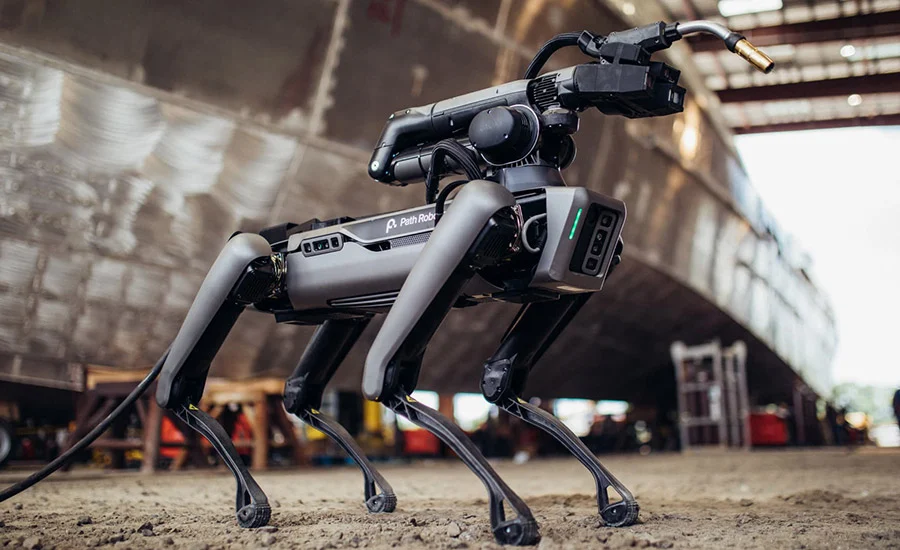
- Core Technology: Combines the Obsidian physical AI model with a quadruped robotic base.
- Target Application: Large assemblies and high-variability environments (e.g., shipbuilding, heavy machinery).
- Key Advantage: Eliminates the logistical bottleneck of moving massive workpieces into traditional fixed robotic cells.
- Early Adoption: Evaluated by Saronic Technologies for autonomous vessel manufacturing in Franklin, Louisiana.
2. Koyo Giken Inc.: NK23 MySpot Resistance Spot Welder
- Ergonomic Impact: Reduces welding arm movement effort by up to 53 percent and horizontal gun insertion effort by up to 91 percent.
- Welding Performance: Utilizes high-speed technology delivering a 0.001-second burst of current to minimize heat input and subsequent material distortion.
- Control Features: Equipped with an EZK touch panel featuring bar code scanning, automated weld sequence optimization, and real-time production tracking.
- Target Sectors: Electrical enclosures, switchboard panels, compressor housings, and automotive components.
3. Quantum Machinery Group: Nargesa MS20 Fiber Laser Welder
- Power Rating: 2,000-watt fiber laser configured for high-quality welds with minimal distortion.
- Wire Feeding System: Features dual wire feeders integrated with eight motorized feed rollers, allowing operators to run two spools simultaneously (matching or mixing materials).
- Control & Connectivity: Utilizes an ESA S820 7-inch touch screen, Industry 4.0 connectivity, Bluetooth resonator monitoring, and comprehensive alarm diagnostics.
- Ergonomics: Includes an ergonomic laser torch with integrated LED lighting, onboard consumable/tool storage, and dedicated bottle holders for shielding gases (argon or nitrogen).
4. TRUMPF Inc.: TruLaser Weld 3000 Robotic Cell
- Footprint: Compact modular cell occupying an area measuring approximately 12 by 12 feet.
- Robotic Reach: Employs a KUKA Iontec robot featuring an 82.68-inch reach.
- Laser Power Options: Available in 3-kilowatt or 4-kilowatt configurations.
- Material Capacities: Capable of welding stainless steel and structural steel up to 0.31 inch thick, and aluminum up to 0.24 inch thick.
- Programming Efficiency: The TeachLine Touch function cuts programming and setup time by up to 50 percent, while optional TeachLine AI automatically compensates for part deviations.
- Optics Design: Welding optics are approximately 40 percent smaller than previous iterations, significantly improving access inside deep housings and confined assemblies.
Official Responses and Industry Perspectives
Industry leaders and early adopters have emphasized that these technologies are not merely incremental upgrades, but strategic assets designed to solve acute labor and productivity challenges.
Autonomous Mobility in Heavy Fabrication
Addressing the deployment of their mobile robotic system, representatives from Path Robotics emphasize that bringing the robot to the part—rather than the part to the robot—fundamentally alters production logistics. In heavy industries where moving multi-ton structural components requires overhead cranes and extensive staging time, a quadruped robot powered by physical AI unlocks unprecedented workflow agility.
Saronic Technologies, an early evaluator of the Rove system at its Franklin, LA facility, noted that integrating autonomous mobility into vessel manufacturing streamlines production lines that traditionally relied heavily on manual dexterity under difficult physical constraints.

Combating Operator Fatigue and Skill Gaps
At Koyo Giken, the focus centers squarely on operator welfare and repeatability. With the manufacturing sector grappling with an ongoing skilled labor shortage, equipment must be intuitive enough to bridge experience gaps while protecting workers from repetitive strain injuries.
Company spokespersons highlight that by slashing horizontal gun insertion effort by over 90 percent and automating parameter selection through bar code scanning, the NK23 MySpot enables operators of varying skill levels to achieve consistent, high-quality welds on complex, deep-boxed assemblies without extensive training periods.
Flexibility and Connectivity in Laser Welding
Quantum Machinery Group positions the Nargesa MS20 as a versatile workhorse for fabricators who require rapid changeovers. By integrating dual wire feed capabilities and Industry 4.0 diagnostics into a 2,000-watt platform, Quantum aims to give job shops the agility to handle diverse material thicknesses and combinations on demand, reducing secondary finishing operations that typically drain shop profitability.
Artificial Intelligence and Compact Footprints
TRUMPF’s introduction of the TruLaser Weld 3000 targets small-batch sheet metal manufacturers who suffer from high setup-to-run ratios. Company executives point out that traditional robotic laser welding cells often demand tedious offline programming and pristine part tolerances.

By integrating AI-driven path correction (TeachLine AI) and intuitive touch-screen re-teaching (TeachLine Touch), TRUMPF removes the programming barrier for small batches. Furthermore, the 40 percent reduction in optic sizing directly answers engineering demands for deeper penetration into enclosed, complex housings.
Broader Implications for the Manufacturing Sector
The commercialization and maturation of these four welding technologies signal a broader, structural shift within global manufacturing. Several key themes underscore their long-term implications for the industry:
1. Mitigation of the Skilled Labor Shortage
As veteran welders retire, manufacturers can no longer rely solely on highly specialized human talent to execute complex or tedious joining operations. Technologies that feature automated parameter selection, AI-assisted path correction, and ergonomic assist arms lower the barrier to entry for new workers. This allows facilities to maintain high output levels even when onboarding novice operators.
2. Elimination of Logistical Bottlenecks
For decades, the physical scale of heavy assemblies dictated factory layouts. Fixed robotic welding cells required heavy-duty cranes, extensive rigging, and precise positioning jigs. The advent of mobile, AI-driven robotic systems like Path Robotics’ Rove points toward a future where automation is inherently mobile—traveling to the workpiece inside shipyards, railcar facilities, and structural steel plants.

3. Compression of Lead Times via AI and Digitalization
Programming overhead has historically priced small-batch fabricators out of advanced automation. Systems incorporating intuitive touch-screen interfaces, such as TRUMPF’s TeachLine Touch and Koyo Giken’s barcode-driven parameter selection, compress setup times from hours to minutes. Combined with Industry 4.0 connectivity and remote diagnostics (seen in Quantum’s MS20), these tools integrate seamlessly into smart factory ecosystems, providing real-time visibility into productivity and quality metrics.
4. Superior Quality and Minimized Post-Processing
In competitive markets, the cost of post-weld grinding, straightening, and finishing can erode profit margins. By deploying high-speed current bursts (in resistance spot welding) and precision fiber lasers with minimal heat input, modern welding equipment drastically reduces thermal distortion and surface marring. The result is a cleaner, higher-integrity final product ready for immediate downstream assembly or painting.
Conclusion
The latest generation of welding technologies demonstrates that innovation in manufacturing extends far beyond raw power. By fusing physical artificial intelligence, advanced mobility, ergonomic engineering, and smart digital connectivity, manufacturers are equipped to tackle complex joining challenges with unprecedented speed and precision. As early adopters validate these systems in real-world production environments, the broader manufacturing sector stands poised to achieve new levels of throughput, quality, and operational resilience.