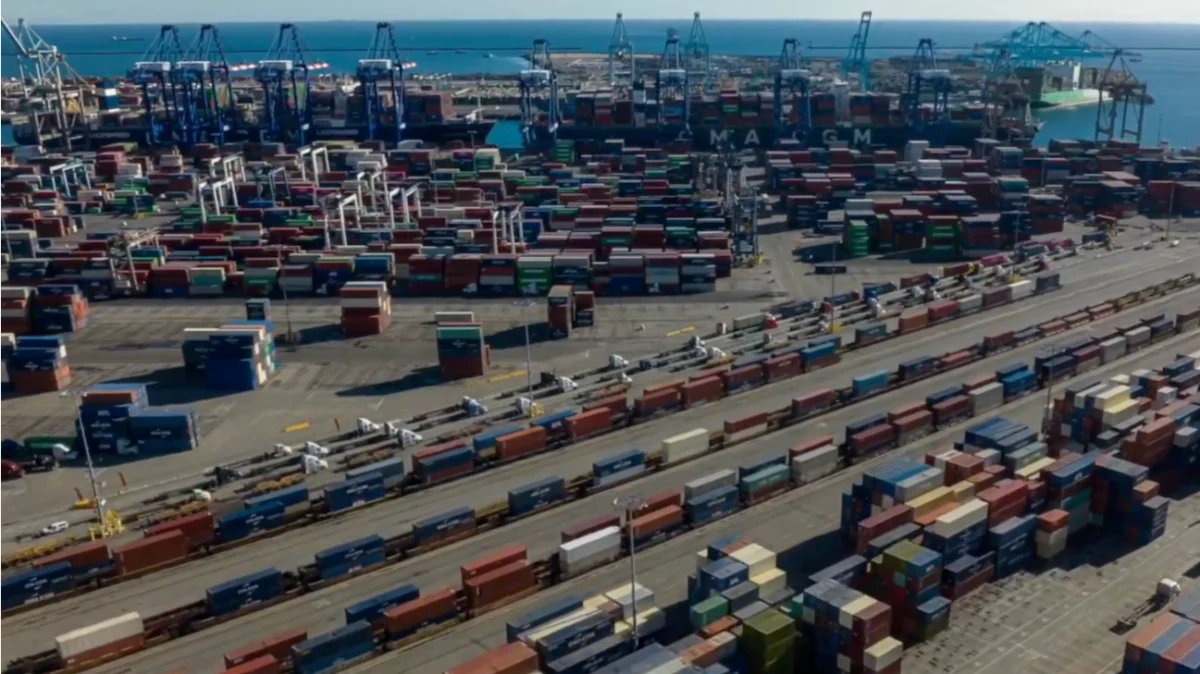
LOS ANGELES — In a monumental milestone for global maritime trade, the Port of Los Angeles handled a staggering 1.42 million Twenty-Foot Equivalent Units (TEUs) in September, marking its best single month ever and setting a historic high for any port in the Western Hemisphere.
Executive Director Gene Seroka announced the unprecedented figures during a media briefing this week, attributing the surge to a confluence of lower tariff levels, highly resilient consumer demand, and a massive tactical shift in global shipping routes away from constrained corridors like the Panama Canal and the Suez route.
The record-shattering month is the crown jewel of an extraordinary operational quarter that underscores the enduring dominance of the nation’s busiest gateway. As retailers rush to secure inventory ahead of the peak holiday season and supply chain leaders navigate persistent geopolitical and environmental bottlenecks, the Port of Los Angeles continues to serve as a critical barometer for the health of the American economy.
Main Facts
The sheer scale of the September volume highlights a dramatic acceleration in international trade passing through the Southern California hub.
- The Headline Figure: The Port of Los Angeles processed 1.42 million TEUs in September, shattering previous throughput records and establishing a new benchmark for Western Hemisphere maritime operations.
- Import and Export Breakdown: September imports reached 546,000 loaded TEUs—representing a dramatic 19% year-over-year increase and coming in 26% higher than the port’s five-year average. Exports experienced a healthy 10% bump, totaling 126,000 loaded TEUs.
- Empty Container Management: The port handled a record 371,000 empty containers as ocean carriers aggressively repositioned equipment back to Asian manufacturing centers to keep pace with relentless export demands.
- Shifting Geographies: Vietnam has cemented its status as the port’s second-largest trading partner, trailing only China, while Thailand has broken into the top five sourcing nations for the first time. Over the past decade, trade volume originating from Vietnam and passing through Los Angeles has quadrupled.
Chronology
To fully understand the velocity of the 2026 shipping season at the Port of Los Angeles, it is necessary to examine the timeline of volume accumulation leading up to and through the historic September surge:
- June 2026: The port begins an extended peak season early, seeing stronger-than-usual summer volumes as cautious importers front-load inventory. The combined June-through-September period ultimately moves nearly 4 million containers.
- July – September 2026 (Q3): The third quarter culminates as the strongest quarter in the port’s history, clearing nearly 3 million TEUs.
- Mid-September 2026: Port leadership navigates a wave of pre-holiday cargo rushes compounded by typhoon-related schedule disruptions at key Asian transshipment hubs. Importers establish cargo "roll pools" ahead of China’s Golden Week national holiday.
- Late September 2026: The port officially logs its historic 1.42 million TEU monthly tally, closing out the first nine months of the year with cumulative volume standing at nearly 8.1 million TEUs—up roughly 3% compared to the same period in 2025.
- October 2026 (Outlook): Executive Director Gene Seroka projects a robust October, anticipating throughput of approximately 900,000 TEUs driven by sustained holiday-season retail replenishment and lingering catch-up volume from Asian ports impacted by severe weather.
Supporting Data
The operational numbers emerging from Southern California reflect both historic achievements and systemic structural shifts in global supply chains:
+-----------------------------------+-------------------+-----------------------------------+
| Metric                            | Volume / Figure   | Context / Comparison              |
+-----------------------------------+-------------------+-----------------------------------+
| September Total Throughput        | 1.42M TEUs        | Best single month in W. Hemisphere|
| September Loaded Imports          | 546,000 TEUs      | Up 19% YoY; +26% vs. 5-yr avg     |
| September Loaded Exports          | 126,000 TEUs      | Up 10% YoY                        |
| Empty Containers Handled          | 371,000 TEUs      | Record repositioning to Asia      |
| Q3 2026 Total Volume              | ~3 million TEUs   | Strongest quarter in port history |
| Year-to-Date Volume (Through Sep) | ~8.1 million TEUs | Up ~3% vs. Jan-Sep 2025           |
| Projected October Volume          | ~900,000 TEUs     | Driven by seasonal replenishment  |
| China's Share of Port Volume      | 40%               | Down from historical 60%          |
+-----------------------------------+-------------------+-----------------------------------+
Beyond raw container counts, efficiency metrics remain a vital part of the data landscape. Seroka noted that vessel turnaround times remain stable, with large container ships being processed in approximately four days, while truck turn times remain healthy. However, rail dwell times have ticked upward—an emerging friction point that port authorities are closely monitoring as boxes are dispatched to inland destinations across the United States.
Official Responses
Speaking during his comprehensive media briefing, Executive Director Gene Seroka provided vital context regarding the operational realities steering the port’s record-breaking performance.
"Lower tariff levels, resilient consumer demand, and cargo shifting away from constrained Panama Canal and Suez routes have driven this unprecedented surge," Seroka stated. He emphasized that ocean carriers and shippers are deliberately recalibrating their routing strategies to prioritize speed and reliability. "Shorter, faster transits have become vastly more valuable," he added, noting that drought-related draft restrictions at the Panama Canal and elevated fuel costs stemming from ongoing Middle East conflicts have made traditional southern water routes increasingly untenable.
Addressing the structural evolution of international trade, Seroka pointed out a profound geographic decentralization. China’s share of throughput at the Port of Los Angeles has slid significantly from 60% down to 40% over recent years. However, he cautioned that true supply chain diversification is proving to be a gradual, deliberate process rather than an overnight pivot.
Joining the briefing as a guest speaker, Harvard Business School Professor Willy Shih offered expert analysis on corporate sourcing behaviors. Shih explained that modern enterprises are increasingly "optimizing for options" rather than relentlessly chasing the absolute lowest cost. Because frequent policy and regulatory changes make long-term capital and operational commitments precarious, flexibility has taken precedence.
Furthermore, Shih poured cold water on the notion that companies are cleanly cutting ties with traditional manufacturing hubs. He observed that apparent shifts in final assembly—such as a rise in goods originating from Vietnam or Mexico—often mask a continued reliance on upstream Chinese components. According to Shih, replicating the deep, multi-tiered supplier networks found in China within alternative manufacturing havens like Mexico could easily take a decade.
Implications
The cascading implications of the Port of Los Angeles’ historic autumn stretch reach far beyond the docks of San Pedro Bay, signaling broader transformations in global logistics, retail inventory strategies, and geopolitical trade dynamics:
1. Supply Chain Resilience Over Just-in-Time Efficiency
The dramatic pivot toward West Coast entry points illustrates a permanent psychological shift among enterprise shippers. Haunted by years of pandemic-era disruptions, canal droughts, and geopolitical choke points, logistics managers are demonstrating a willingness to pay a premium for faster, more predictable transits. By bypassing troubled international waterways and funneling goods directly into the North American consumer market via Southern California, companies are prioritizing risk mitigation.
2. The Complex Reality of China Plus-One Sourcing
While the statistical decline of China’s volume share from 60% to 40% at Los Angeles is eye-catching, the qualitative reality highlighted by Professor Shih suggests that global supply chains remain inextricably linked to Chinese manufacturing foundations. As countries like Vietnam and Thailand capture greater direct trade shares, they act more as assembly waypoints than fully independent industrial ecosystems. For American importers, true supply chain independence remains a long-term horizon project requiring years of infrastructure and supplier development in nearshore and alternative offshore markets.
3. Regulatory and Tariff Volatility
Tariffs continue to act as a primary catalyst for erratic ordering patterns. Importers are forced to make rapid, high-stakes decisions balancing fluctuating cost structures against shifting policy deadlines. While purchase orders moving out of Asia remain fundamentally solid, forecasting the trajectory for November and December remains exceptionally difficult as market participants brace for potential policy pivots.
4. Inland Infrastructure Pressures
While waterfront operations at the Port of Los Angeles continue to flow fluidly—marked by efficient four-day vessel turnarounds and robust drayage truck velocity—the rising tide of cargo places immense pressure on intermodal rail connections. As millions of TEUs transition from maritime vessels to railcars bound for the U.S. interior, monitoring and mitigating rail dwell times will be the defining challenge for maintaining supply chain fluidity into the winter months.
Ultimately, the Port of Los Angeles’ record-shattering September is more than a statistical milestone; it is a masterclass in adaptability. As global trade routes fracture and reform under the weight of climate pressures, geopolitical conflict, and evolving consumer habits, Southern California’s premier gateway has proven its capacity to anchor the North American economy through turbulent times.