






Introduction: The Looming Energy Crisis and the Rise of Behind-the-Meter Storage
As the global energy landscape undergoes a profound transformation, electrical grids worldwide face an unprecedented confluence of demand pressures. The rapid electrification of transportation through the proliferation of electric vehicles (EVs), combined with the exponential rise of power-hungry artificial intelligence (AI) data centers, has pushed power consumption to historic heights. At the same time, the aggressive global transition toward renewable energy sources—such as wind and solar—introduces a new variable: intermittency. Because the sun does not always shine and the wind does not always blow, power generation has become fundamentally non-constant, creating a volatile supply-and-demand mismatch.
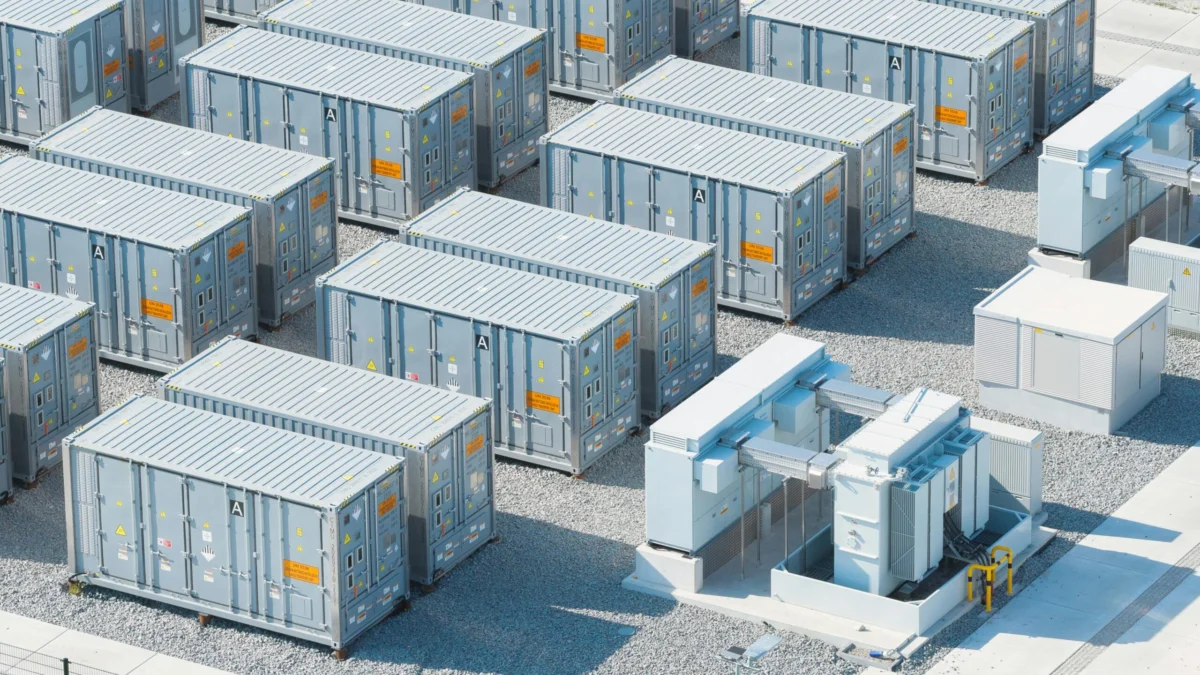
To bridge this widening gap, the energy sector is increasingly turning to Battery Energy Storage Systems (BESS). Positioned strategically both behind the meter and at utility scale, these massive installations capture excess generation during peak production hours and inject power back into the grid when demand surges. Furthermore, they act as critical local buffers for heavy industrial users and hyperscale data centers, absorbing sudden, erratic power spikes driven by intense AI workloads.
However, simply scaling up the physical footprint of lithium-iron-phosphate (LFP) battery banks is only half the battle. As energy storage capacities reach unprecedented gigawatt-hour (GWh) scales, the industry is confronting a harsh physical reality: raw battery capacity means little if the power electronics managing the charge and discharge cycles waste precious electricity as heat. Maximizing power-conversion efficiency has thus become the holy grail of grid modernization.
Addressing this critical bottleneck, semiconductor manufacturer onsemi has joined forces with energy storage titan Sungrow to integrate advanced silicon-carbide (SiC) power-module technology into a new generation of utility-scale energy storage systems. By marrying high-performance wide-bandgap semiconductors with traditional silicon architectures in a hybrid module approach, this partnership is unlocking monumental efficiency gains, slashing operational costs, and redefining the economic viability of modern energy storage.
Main Facts: The Sungrow-onsemi Collaboration and the PowerTitan 3.0 Platform
At the center of this technological leap is Sungrow’s newly unveiled PowerTitan 3.0 platform, a flagship utility-scale energy storage system designed to meet the rigorous demands of modern electrical grids. To extract maximum performance out of the platform’s massive LFP battery arrays, Sungrow has integrated custom Power Integrated Modules (PIMs) engineered specifically by onsemi.
These PIMs are meticulously optimized for three-level inverter topologies, an architecture widely adopted in grid-connected energy storage because of its superior ability to handle high voltages while minimizing harmonic distortion. Yet, what truly sets the PowerTitan 3.0 apart is onsemi’s innovative "hybrid" module design.
Rather than relying entirely on traditional silicon or forcing an expensive, 100% silicon-carbide build, onsemi’s hybrid configuration takes a nuanced, best-of-both-worlds approach:
- Silicon-Carbide (SiC) MOSFETs are deployed in the high-frequency switching stages of the inverter. SiC inherently offers superior thermal conductivity, vastly faster switching speeds, and dramatically lower switching losses compared to legacy silicon. This allows the system to maximize power density and conversion efficiency.
- Traditional Silicon Power Devices are integrated into the remaining, less thermally stressed portions of the module design.
This dual-material strategy bridges the gap between raw technological performance and cost-effectiveness. By strategically deploying expensive SiC materials only where they yield the maximum return on investment, onsemi and Sungrow have successfully balanced system economics without sacrificing high-frequency performance.
The performance metrics of this collaboration are striking. According to validation data from onsemi, the hybrid SiC module architecture improves inverter-level efficiency by 0.4% compared to the previous-generation platform. While a fraction of a percent may sound negligible to the uninitiated, at the multi-megawatt scale of utility operations, this delta translates into millions of kilowatt-hours saved over the operational lifecycle of the asset.
Furthermore, the system supports robust power-conversion units rated up to 450 kW, facilitating massive high-power storage deployments while maintaining a peak conversion efficiency that exceeds 99.3%. This hyper-efficient DC-to-AC conversion minimizes internal thermal stress, reduces the need for aggressive cooling infrastructure, and ensures that more stored energy actually reaches the grid rather than dissipating as waste heat.
Chronology: The Evolution of Grid-Scale Power Electronics and BESS Integration
To understand the significance of the onsemi-Sungrow collaboration, it is helpful to trace the chronological evolution of grid-scale power conversion and energy storage over the past decade.
Phase 1: The Silicon Era and Early Renewables (2010–2018)
In the early days of utility-scale solar and wind integration, power electronics relied almost exclusively on standard silicon Insulated-Gate Bipolar Transistors (IGBTs) and diodes. While these components were reliable and cheap to manufacture, they suffered from intrinsic physical limitations. Silicon devices exhibited high switching losses at elevated frequencies, forcing engineers to design bulky, heavy transformers and extensive cooling systems to manage thermal output. Efficiency hovered around 98% to 98.5%, which was deemed acceptable when grid capacities were smaller and energy margins were wider.
Phase 2: The Lithium-Iron-Phosphate Boom and Grid Strain (2018–2022)
As electric vehicle adoption accelerated and the cost of lithium-iron-phosphate (LFP) chemistry plummeted, BESS deployment exploded. Grid operators began realizing that batteries were necessary not just for smoothing out solar and wind generation, but for frequency regulation and peak shaving. However, as installations scaled from tens of megawatts to hundreds of megawatts, thermal management became a nightmare. Inverters were running hotter, conversion losses were compounding at scale, and the physical footprint of energy storage stations was expanding rapidly. The industry desperately needed higher power densities and lower losses.
Phase 3: The Wide-Bandgap Revolution and the Birth of Hybrid Modules (2022–Present)
Entering the 2020s, wide-bandgap semiconductors—specifically silicon carbide and gallium nitride (GaN)—matured from niche aerospace and automotive applications into heavy-duty industrial power. Early adoption of 100% SiC modules proved that efficiency could cross the elusive 99% threshold. However, pure SiC solutions remained cost-prohibitive for massive multi-megawatt utility deployments.
Recognizing this economic barrier, semiconductor innovators like onsemi pioneered hybrid module architectures. By combining SiC MOSFETs with silicon devices, manufacturers could offer near-SiC performance at near-silicon price points. The culmination of this trajectory is the integration of onsemi’s hybrid PIMs into Sungrow’s PowerTitan 3.0 platform, marking a maturation point where advanced materials, sophisticated topology design, and utility-scale economics finally align.
Supporting Data: Quantifying the Impact of a 0.4% Efficiency Boost
In the utility sector, financial and operational models are dictated by margins, Total Cost of Ownership (TCO), and lifecycle energy yields. A common misconception among laypeople is that fractional efficiency improvements are economically irrelevant. Detailed engineering analyses tell a drastically different story.
According to technical data published by onsemi, let us examine the real-world mathematical impact of their hybrid SiC module architecture within a standard 100-megawatt (MW) battery energy storage installation:
- The Efficiency Delta: The new hybrid SiC module achieves a 0.4% efficiency improvement over previous-generation silicon modules at the inverter level.
- Annual Energy Savings: In a continuous-cycling 100-MW BESS deployment, that seemingly minor 0.4% boost compounds over millions of kilowatt-hours processed annually, resulting in more than 475 megawatt-hours (MWh) of energy saved per year.
- Capacity Preservation: To put 475 MWh into perspective, it represents enough electrical energy to power dozens of American homes for an entire year—energy that otherwise would have been bled off as unusable waste heat into the surrounding enclosure.
- Thermal Performance and Overload Capacity: Because the SiC MOSFETs switch faster and generate significantly less thermal resistance, the inverter units exhibit superior overload capabilities. This is vital when the BESS is subjected to sudden, brutal power draws, such as when an AI data center experiences an instantaneous compute load spike.
- Peak Efficiency: With peak efficiency ratings surpassing 99.3%, the PowerTitan 3.0 sets a new benchmark for power-conversion units rated up to 450 kW. Lower internal heat generation translates directly into extended component lifespans, reduced degradation of surrounding hardware, and lower parasitic loads from auxiliary cooling fans and HVAC systems.
When aggregated over a projected 15- to 20-year operational lifecycle of a utility asset, these cumulative energy savings translate into millions of dollars in reduced operational expenditures (OPEX), higher revenue capture from energy arbitrage, and a dramatically lower Total Cost of Ownership for utility operators and independent power producers (IPPs).
Official Responses: Industry Leaders Speak on the Strategic Partnership
The collaboration between onsemi and Sungrow represents a symbiotic alignment between semiconductor manufacturing expertise and utility-scale energy deployment. Industry executives have openly emphasized the profound implications of this technological integration for the global energy transition.
Weighing in on the microelectronic side of the equation, Sergio Fissore, Vice President and General Manager of the IPD Power Division at onsemi, underscored the economic reality of utility-scale power conversion:
"At utility scale, even small improvements in power-conversion efficiency can have a meaningful impact on battery energy storage system performance and total cost of ownership."
Fissore further elaborated on the broader implications of their data-driven findings, noting that the analytical proof of over 475 MWh in annual energy savings for a 100-MW installation demonstrates that material science innovations are no longer just academic exercises—they are immediate financial drivers for energy asset owners.
Echoing these sentiments from the systems integration and deployment perspective, Chen Peng, General Manager of Energy Storage Conversion Products for Sungrow’s Energy Storage Business, emphasized how strategic technological partnerships accelerate market readiness:
"By integrating advanced technologies and collaborating with strategic partners such as onsemi, Sungrow is accelerating the deployment of higher-performance storage solutions that deliver greater value throughout the lifecycle of energy assets."
Peng noted that the architecture embedded within the PowerTitan 3.0 platform is specifically engineered to help grid operators, developers, and commercial off-takers navigate an increasingly complex energy market. By ensuring that assets deliver higher performance, superior reliability, and lower lifecycle degradation, Sungrow and onsemi are providing the foundational infrastructure necessary for the next era of electrification.
Implications: Building the Resilient Grid of Tomorrow
The successful deployment of hybrid SiC-powered energy storage systems like Sungrow’s PowerTitan 3.0 carries profound implications for the future of global power grids, industrial operations, and the clean energy transition.
1. Hardening the Grid Against Intermittency
As coal-fired and nuclear baseload power plants continue to be decommissioned in favor of decentralized wind and solar farms, electrical grids face unprecedented stability challenges. Battery energy storage systems equipped with ultra-efficient power conversion modules serve as the primary shock absorbers for the grid. By minimizing conversion losses, these systems ensure that the maximum possible amount of harvested renewable energy is preserved and dispatched precisely when consumers need it most.
2. Powering the AI and Data Center Boom
The meteoric rise of generative artificial intelligence has created an insatiable appetite for data center computational power. Modern hyperscale data centers require constant, uninterrupted power supplies capable of handling massive, unpredictable load surges without flinching. When an AI training cluster ramps up compute cycles, the local power demand spikes instantaneously.
In these high-stress scenarios, a BESS acts as an immediate local shock absorber, stepping in to supply supplemental power faster than traditional peaker plants can spin up. The superior thermal performance and high overload capabilities enabled by onsemi’s SiC modules ensure that the storage system can repeatedly absorb and discharge these violent electrical shocks without thermal throttling or premature component degradation.
3. Economic Viability and the Acceleration of Capital Investment
Ultimately, energy transition projects are bound by economic fundamentals. If energy storage is too expensive to operate or suffers from high parasitic losses, utility companies and investors will hesitate to deploy capital. By engineering hybrid modules that balance the high cost of pure silicon carbide with the high efficiency required at scale, semiconductor manufacturers are lowering the economic barrier to entry. This reduction in Total Cost of Ownership paves the way for accelerated private-sector investment in grid modernization, driving us closer to a fully decarbonized, highly resilient electrical infrastructure.
Conclusion: A Milestone in Power Electronics
The partnership between onsemi and Sungrow, anchored by the launch of the PowerTitan 3.0 platform and advanced hybrid silicon-carbide power modules, represents a watershed moment for modern energy storage. By squeezing every fraction of a percent out of power-conversion efficiency, these companies are proving that hardware-level microelectronic innovation is just as critical to the clean energy transition as chemical advancements in battery cell manufacturing.
As electric vehicles saturate our roadways and artificial intelligence redefines our digital infrastructure, the demand for reliable, ultra-efficient, and cost-effective power will only intensify. Through the strategic marriage of silicon carbide and smart inverter topology design, the energy storage sector is proving well-equipped to meet these formidable challenges—delivering a cleaner, more resilient, and economically viable electrical grid for generations to come.