NORTH READING, Mass. & BURLINGAME, Calif. — In a landmark convergence of industrial automation, semiconductor testing, and artificial intelligence, automated test equipment and robotics pioneer Teradyne Inc. has announced a strategic investment in Bright Machines Inc.
The partnership pairs Teradyne’s industry-leading robotics and precision test systems with Bright Machines’ software-defined manufacturing platform. The alliance is explicitly engineered to tackle one of the most pressing engineering bottlenecks of the modern tech economy: the rapid, high-precision production of next-generation artificial intelligence data center infrastructure.
As hyperscalers, silicon designers, original equipment manufacturers (OEMs), and AI laboratories race to deploy unprecedented volumes of compute power, traditional electronics manufacturing lines are straining under the weight of rapid design iterations, extreme component complexity, and zero tolerance for defect rates. This collaboration aims to modernize how AI hardware is built, tested, and scaled.
Main Facts: Uniting Testing, Robotics, and Software-Defined Manufacturing
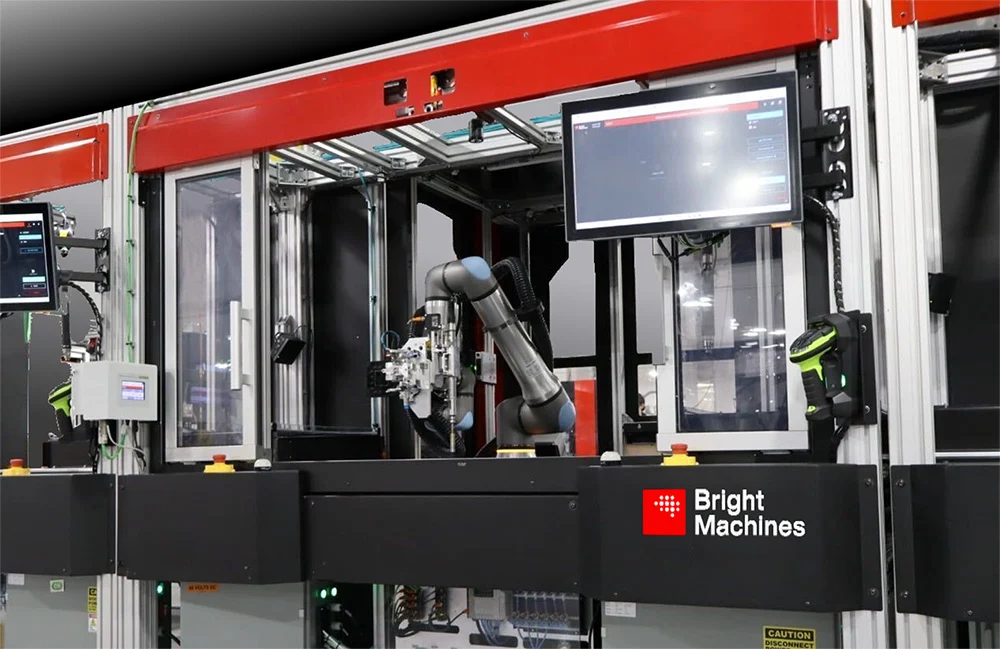
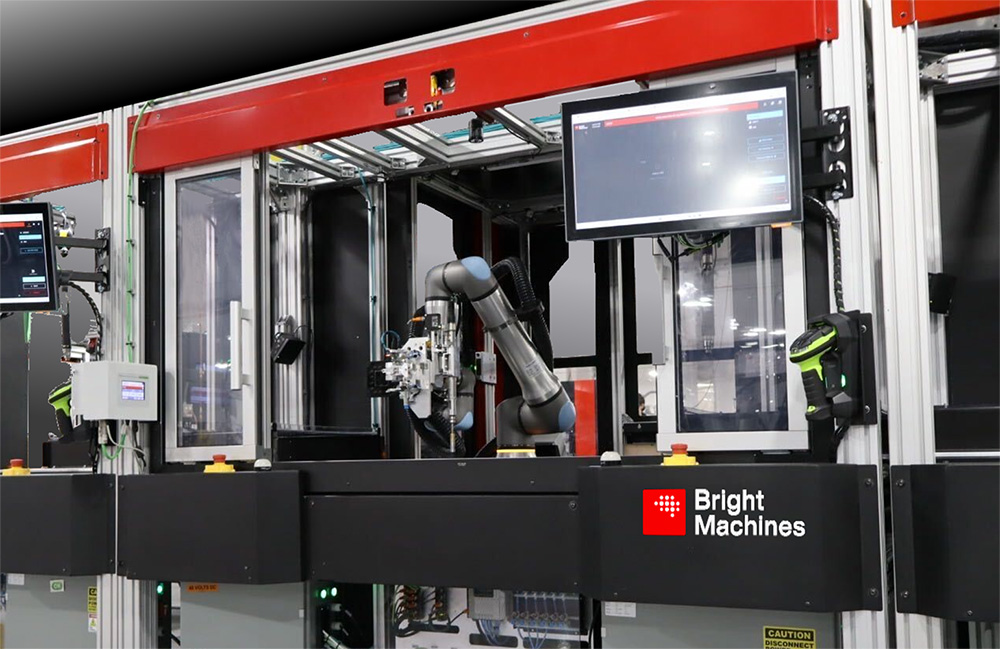
The partnership centers on an ambitious technological integration. Teradyne and Bright Machines are combining their respective ecosystems—including Teradyne’s advanced board test systems and its Universal Robots (UR) collaborative robot (cobot) subsidiary—with Bright Machines’ intelligent automation platform, known as "Bright Factory."
Key pillars of the partnership include:
- Strategic Investment: Teradyne has acquired an equity stake in Bright Machines, providing capital to accelerate the scaling of its AI infrastructure manufacturing platform.
- Unified Technology Stack: The collaboration integrates robotic assembly, automated test equipment (ATE) loading and unloading, autonomous mobile robot (AMR) material handling, and electrical verification into a single, cohesive workflow.
- Closed-Loop Data Integration: By linking design data, assembly inspection records, and electrical testing outcomes into a single product-genealogy thread, the platform uses real-time analytics to continuously optimize production lines.
- Market Catalyst: The initiative is custom-built for the high-mix, short-lifecycle manufacturing demands typical of AI infrastructure buildouts, where product refreshes happen in months rather than years.
Chronology: How the Deal and Collaboration Took Shape
While the formal investment and strategic partnership were publicly unveiled today, the groundwork for this collaboration has been developing against a backdrop of sweeping industry shifts.
Q2 2024 – 2025: Teradyne’s AI-Driven Growth Wave
Over preceding quarters, North Reading-based Teradyne experienced substantial financial momentum, marked by consecutive quarters of revenue growth heavily fueled by global demand for AI-enabling hardware. Concurrently, Teradyne’s subsidiary, Universal Robots, doubled down on AI integration, culminating in the launch of its seventh-generation cobot arm designed explicitly to leverage machine learning and advanced perception models.
Late 2025: Identifying the Manufacturing Bottleneck
As hyperscalers and AI infrastructure providers accelerated data center buildouts, engineering teams at both Teradyne and Bright Machines identified a widening gap between software capability and physical manufacturing constraints. Modern AI accelerators, networking switches, and server blades require unprecedented assembly precision and rigorous testing. Traditional assembly lines, which often rely on manual labor or rigid, siloed automation, were struggling to adapt to frequent design changes without massive engineering overhauls.
Early 2026: Technical Integration Initiated
Prior to the public announcement, engineering teams from Teradyne and Bright Machines quietly initiated technical integration phases. Universal Robots units began being deployed directly onto Bright Machines’ production lines. Teams began mapping out the software protocols necessary to bridge the gap between electrical test data and robotic assembly instructions.
Present Day: Formalizing the Alliance
Today’s joint announcement formalizes Teradyne’s capital investment and establishes the official roadmap for commercializing the joint architecture across both companies’ internal facilities and mutual customer sites.
Supporting Data: The Scale of AI Infrastructure and Automation
To understand the weight of this investment, one must examine the macroeconomics of current data center buildouts.
- Explosive Hardware Demand: The global race for artificial intelligence has triggered one of the largest electronics manufacturing expansions in history. Silicon providers and OEMs are cycling through product generations at an accelerated pace.
- Proven Microfactory Footprint: Bright Machines brings substantial operational scale to the table, having deployed more than 130 microfactories across over 10 countries, alongside active AI infrastructure production lines within the United States.
- Continuous Financial Momentum: Teradyne reported a 33% year-over-year revenue increase in its robotics division during recent fiscal periods, with management explicitly pointing to AI-related semiconductor testing and automation as primary growth vectors.
- The High-Mix Challenge: According to industry analysts, modern data center hardware is characterized by "high-mix, short-lifecycle" production. Unlike consumer electronics manufactured in static runs of millions, AI servers and networking gear undergo frequent engineering revisions to optimize for thermal performance, power efficiency, and compute density.
Official Responses: Leadership Perspectives
Executives from both companies emphasize that the partnership is rooted in solving concrete operational friction points rather than speculative R&D.
Shantnu Sharma, Chief Development Officer at Teradyne, explained the strategic thesis behind the investment to The Robot Report:
"Teradyne chose to invest in Bright Machines because of what AI data center buildouts are asking of manufacturing. Designs change quickly and every unit has to be verified. What drew us in is the loop Bright Machines’ solutions close — a design goes into a manufacturing cell, robots assemble it, test verifies it, and the data coming back tells you how to optimize the next one. Solutions like this, where a collaboration can measurably accelerate not only a founder’s path, but also time to market for our customers, are core to our investment strategy."
Fiaz Mohamed, Chief Growth Officer at Bright Machines, highlighted the operational benefits for shared customers:
"The investment will support Bright Machines’ continued growth and the expansion of its AI infrastructure manufacturing platform, including the engineering and deployment work behind the collaboration, integrating Teradyne’s robotics and test technologies with our platform, and bringing that combined architecture to customer sites… Integrating those systems with our platform will connect robotics and test data with assembly, inspection and product-genealogy data, giving customers confidence in a pre-tested manufacturing platform that can improve with every system built at the scale they need."
James Davidson, Chief AI Officer at Teradyne, addressed the core software and robotics challenge:
"What limits automation today is not what a robot can physically do but how much engineering it takes to tell it what to do. When a robot can pick up a new task in hours instead of being re-engineered over weeks, high-mix, short lifecycle production becomes the default. Once build data and test data sit in the same loop, the line can correct itself quickly."
Sviat Dulianinov, CEO of Bright Machines, noted the validation provided by the partnership:
"The next generation of AI infrastructure calls for a manufacturing approach that is more automated, software-defined, data-driven, and responsive to change. Teradyne’s expertise, and the investment that comes with it, helps us validate that approach. Their robotics and test technologies are complementary to our platform, and together we can help customers simplify integration, accelerate deployment, and maintain a complete production data thread."
Implications: Reshaping the Electronics Manufacturing Ecosystem
The integration of Teradyne’s test and robotics portfolio with Bright Machines’ software ecosystem carries profound implications for Original Design Manufacturers (ODMs), Electronics Manufacturing Services (EMS) providers, and hyperscale cloud operators.
1. Breaking Down Data Silos
Historically, electronics manufacturing has suffered from severe data fragmentation. Assembly data lived on one server, optical inspection data on another, and electrical testing results in a completely separate database. By weaving these inputs into a single continuous data thread, the Teradyne-Bright Machines architecture allows manufacturers to trace a defect back to its root cause instantaneously—whether it stems from a component variance, a robotic placement error, or an upstream design flaw.
2. Transitioning to Software-Defined Production
As James Davidson noted, the historical barrier to flexible automation is the engineering overhead required to reprogram industrial robots for new tasks. By combining Universal Robots’ force- and power-limited cobots with Bright Machines’ software platform, the partnership aims to make line reconfigurations swift and software-driven. When an AI server design changes mid-quarter, the manufacturing cell can adapt via software rather than undergoing weeks of physical retooling.
3. Mitigating the Risk of Rework in AI Hardware
AI infrastructure components are extraordinarily expensive and complex. Graphics processing units (GPUs), custom application-specific integrated circuits (ASICs), and high-bandwidth memory (HBM) modules leave very little margin for error. Reworking a faulty AI server blade is costly and delays critical data center deployments. By baking automated testing, inspection, and verification directly into the automated assembly loop, the joint platform ensures that quality control is proactive rather than reactive.
Looking Ahead
Neither Teradyne nor Bright Machines has published a rigid commercial timeline for the complete, out-of-the-box deployment of the fully integrated system. Instead, the rollout will be phased, tailored to specific manufacturing applications and customer-driven requirements.
However, the message to the industrial automation market is clear: the physical backbone of the artificial intelligence boom is undergoing a profound automation overhaul. By closing the loop between design, precision robotics, and exhaustive testing, Teradyne and Bright Machines are positioning themselves to build the assembly lines that will build the future of AI.