By Global Business Insights Desk
Published: September 2026
Main Facts
As artificial intelligence systems march forward with unprecedented velocity, enterprise leaders across the global economy are increasingly forced to reconcile the technology’s staggering productivity gains with its profound human costs. In late August 2026, Microsoft co-founder Bill Gates published a widely discussed essay addressing the societal implications of unbridled AI development. While acknowledging the technology’s transformative potential, Gates painted a sobering picture of a turbulent transitional era defined by large-scale job displacement, elevated risks of misuse, and disruptions to human development.
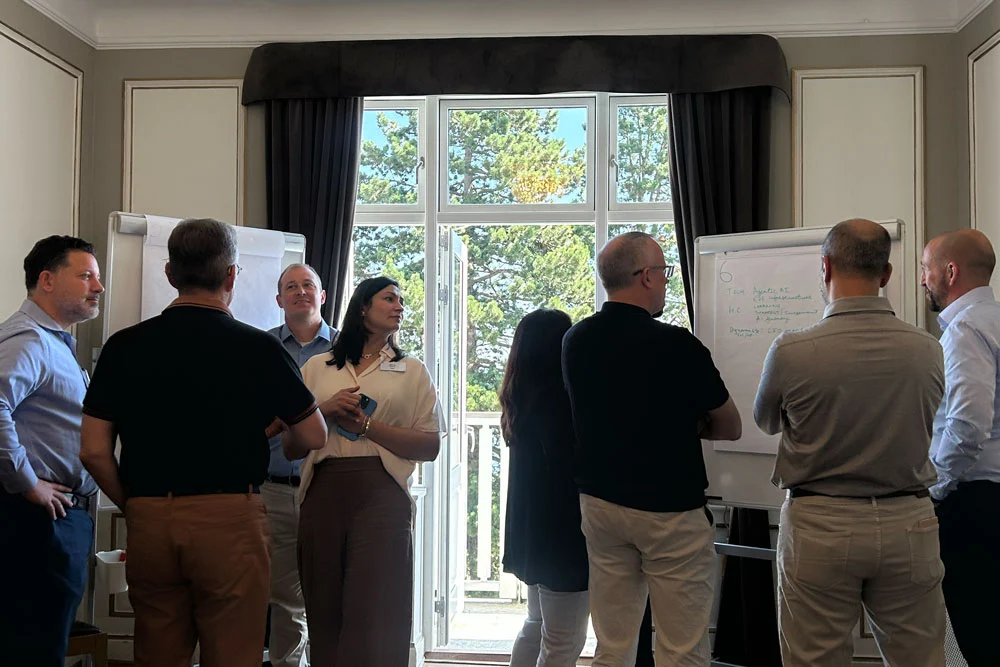
This tension between technological acceleration and human capital preservation took center stage at the July Ovation Chief Procurement Officer (CPO) retreat. During intensive scenario-planning sessions, procurement leaders were challenged to break their current operating models and confront the raw reality of AI integration. The results were stark: workshops yielded estimates suggesting potential workforce reductions ranging from 30% to 80% driven by automation.
These findings expose a fundamental contradiction currently plaguing executive boardrooms. On one hand, corporate leaders routinely claim that automation will merely free employees to focus on high-value, strategic tasks. On the other hand, aggressive headcount reductions driven by AI implementation—often mandated directly by CFOs and CEOs—tell a drastically different story.
Compounding this operational crisis are macroeconomic and philosophical warnings from academic leaders. Speaking at the Ovation retreat, London School of Economics (LSE) President and Vice Dean Larry Kramer argued that successfully navigating the AI transition requires a fundamental shift in how modern capitalism views humanity: moving away from prioritizing people purely as consumers toward valuing them first and foremost as workers.
Chronology
To understand how enterprise procurement and the broader corporate landscape arrived at this critical juncture, it is necessary to examine the timeline of escalating AI integration and executive awakening:
- Early-to-Mid 2020s: Generative AI tools transition from experimental novelties to core enterprise infrastructure. Procurement functions begin adopting automated sourcing, contract analysis, and predictive supply chain modeling software.
- July 2026: The Ovation CPO retreat convenes global procurement leaders. A provocative breakout session tasks attendees with modeling the extreme impacts of AI on team structures, sparking intense debate over whether automation leads to workforce upskilling or mass layoffs. LSE President Larry Kramer delivers a keynote address warning against treating humans solely as consumers in an automated economy.
- Late-August 2026: Microsoft co-founder Bill Gates publishes a landmark essay detailing the societal risks of rapid AI adoption. He warns that the transition will be "one of the most turbulent times in human history," citing risks of widespread job loss, reduced human agency, and societal instability.
- Present Day (September 2026 and Beyond): Enterprise executives, particularly CPOs, face mounting pressure to balance aggressive cost-reduction mandates from financial stakeholders with the long-term ethical and operational responsibility of managing human capital through an automated future.
Supporting Data and Insights
The friction between corporate efficiency and workforce preservation is supported by the stark projections emerging from leadership forums and industry analyses.
The 30% to 80% Headcount Dilemma
During the Ovation retreat, facilitators deliberately pushed procurement executives to think beyond incremental adjustments. By forcing leaders to design future operating models from scratch—assuming near-total automation of transactional procurement, routine negotiations, and supplier data ingestion—participants estimated that team sizes could shrink by 30% to 80%.
While these numbers were generated in a stress-test workshop designed to explore extreme outcomes, they reflect an underlying anxiety across the corporate sector. According to internal enterprise surveys, supply chain and procurement functions are prime targets for AI automation due to their heavy reliance on data processing, repetitive documentation, and standardized workflows.
The Two Narratives of Automation
Enterprise leadership currently finds itself trapped between two mutually exclusive narratives:
- The Augmentation Myth: The comforting narrative that AI will act as a co-pilot, absorbing mundane administrative burdens while leaving human workers free to engage in creative, strategic, and relationship-driven work.
- The Replacement Reality: The aggressive financial imperative pushed by Chief Financial Officers and Chief Executive Officers, wherein AI is deployed explicitly to optimize operational expenditure by shrinking full-time equivalent (FTE) headcounts.
When these two perspectives collide, organizations frequently discover that the promise of "higher-value work" for all displaced employees is mathematically impossible without profound organizational restructuring.
Official Responses and Perspectives
The debate surrounding AI’s impact on labor has drawn sharp commentary from technological pioneers, academic institutions, and enterprise strategists.
Bill Gates on the Turbulent Transition
In his late-August 2026 essay, Bill Gates pulled no punches regarding the societal friction ahead. While maintaining optimism about AI’s capacity to revolutionize medicine, education, and scientific research, Gates emphasized that the transition period must not be ignored.
"Even under the best circumstances, the transition to this new AI era will be one of the most turbulent times in human history," Gates wrote.
His warnings extend beyond economics. Gates highlighted how unmanaged AI deployment could enable bad actors to scale malicious activities easily, stunt the cognitive development of children through over-reliance on synthetic systems, and devastate traditional labor markets before new economic paradigms can be established. He insists that society must proactively address these risks rather than waiting to celebrate the ultimate benefits.
Larry Kramer and the "Worker vs. Consumer" Paradigm
Offering a macro-economic and philosophical counterweight at the Ovation retreat, LSE President and Vice Dean Larry Kramer challenged the foundational tenets of modern commercial strategy.
For decades, global capitalism—heavily supported by supply chain and procurement optimization—has focused on driving down costs and maximizing efficiency to benefit the end consumer. Kramer argued that this hyper-fixation has systematically eroded the security and stability of the worker.
In an AI-driven economy, Kramer asserts, this model becomes unsustainable. If automation eliminates millions of jobs in the pursuit of cheap consumer goods, the consumer base itself collapses because people no longer possess earning power. Protecting human dignity and economic equality in the age of artificial intelligence, Kramer argued, will require a complete ideological inversion: recognizing individuals as workers first, supported by robust government intervention and international multilateralism.
Implications for Chief Procurement Officers (CPOs)
For CPOs and other enterprise leaders, these high-level philosophical and economic debates are no longer distant theoretical concerns. They sit directly at the intersection of operational execution, ethical leadership, and corporate governance.
1. Redefining the Value of Procurement Talent
As automated agents take over supplier discovery, RFP generation, spend analytics, and contract lifecycle management, the traditional career path within procurement is vanishing. Junior procurement roles—traditionally the breeding ground for analytical talent—are precisely the tasks AI performs fastest and cheapest. CPOs must actively design career pathways that cultivate strategic relationship management, geopolitical risk assessment, and ethical supply chain oversight, ensuring that human workers develop skills that algorithms cannot replicate.
2. Navigating the C-Suite Pressure Cooker
CPOs are caught in a crossfire between CEOs and CFOs demanding rapid ROI on heavy AI investments through immediate cost-cutting, and human resources leaders warning of morale collapse, institutional brain drain, and societal backlash. Navigating this successfully requires procurement leaders to champion responsible automation—using efficiency gains not merely to slash payrolls, but to redeploy human capital into areas where empathy, negotiation nuance, and complex judgment are paramount.
3. Ethical Supply Chain Stewardship
Procurement professionals are uniquely positioned as the guardians of the extended enterprise. If suppliers adopt aggressive, unregulated AI automation that exploits labor or destabilizes regional economies, the brand damage eventually hits the buying enterprise. CPOs must begin integrating ethical AI usage and workforce stability metrics into their supplier code of conduct, mirroring how environmental, social, and governance (ESG) standards have been integrated over the past decade.
Conclusion
The convergence of Bill Gates’ sobering warnings, the LSE’s structural critiques, and the stark workforce reductions modeled at the Ovation retreat point to an inescapable reality: the future of work cannot be left to automated market forces alone. For CPOs, the challenge of the next decade is not merely implementing the most advanced technology, but preserving the human element within an increasingly mechanized enterprise ecosystem.
To receive weekly insights, executive briefings, and deep-dive analysis from the Procurement Leaders community, sign up to the CPO Crunch newsletter.