The robotics industry stands at a critical inflection point. While hardware costs have plummeted—with capable industrial arms now priced similarly to high-end laptops—the "software gap" remains a formidable barrier to mass adoption. San Francisco-based startup Dream Labs aims to bridge this divide, announcing this week a significant $90 million seed funding round and the public launch of its flagship Dream API. By decoupling intelligence from hardware, Dream Labs is positioning itself to become the "brain" of the next generation of industrial and consumer robotics.
Main Facts: A Universal Operating System for Robots
Dream Labs’ primary innovation is Dream-1, a foundational model trained on massive datasets of human video demonstrations. Unlike traditional robotics programming, which requires specialized engineers to spend months hard-coding specific tasks for individual machines, Dream-1 utilizes "zero-shot learning." This means the model can observe a task, understand the physical constraints of the environment, and execute commands on a robot it has never interacted with before.
The newly launched Dream API serves as the bridge between human intent and mechanical execution. By translating plain-English instructions and visual inputs from a robot’s onboard camera into precise motor commands, the API allows developers to deploy complex behaviors—such as pick-and-place operations or laundry folding—in minutes rather than months. The company currently supports a diverse range of hardware, ranging from $2,000 hobbyist arms to sophisticated $10,000 industrial systems, currently boasting partnerships with over 20 hardware manufacturers.
The Chronology: From NVIDIA Labs to a $90M Seed
The genesis of Dream Labs lies in the deep technical expertise of its founding team, many of whom cut their teeth at NVIDIA, the global leader in accelerated computing and AI-driven robotics. Recognizing that the bottleneck in the field was not the mechanics of the robots but the "cognitive" layer, the team spent the last two years developing a model that could generalize across different form factors.
The startup’s trajectory moved rapidly from internal research to proof-of-concept testing with hardware partners. Following successful validation, the company secured its $90 million seed round, led by venture capital heavyweights B Capital and Kindred Ventures. The round also saw participation from a broad coalition of strategic investors, including A.Capital, Unusual Ventures, SV Angel, Wing VC, Scribble VC, and notable angel investor Adrian Aoun.
Following the funding announcement, Dream Labs moved quickly to democratize access, opening its "Robot Playground" to the public. This web-based interface allows users to remotely control robots located in the company’s San Francisco headquarters via browser-based commands, providing a real-time, unedited demonstration of the model’s capabilities.
Supporting Data: The Case for Intelligence
The urgency for a universal robotic brain is rooted in the current state of industrial automation. According to recent industry data, there are over 5 million industrial robots currently operating in factories worldwide. However, the vast majority of these machines are "siloed"—they are rigid, single-task entities that cannot transfer knowledge from one unit to another.
The economic inefficiency is clear:
- High Setup Costs: Traditional integration requires highly paid specialized labor for months of programming.
- Hardware Fragmentation: Because models are usually tuned for specific hardware, a factory upgrading its robots must often start the software development process from scratch.
- The Cost-to-Intelligence Ratio: While hardware prices have reached consumer-friendly levels, the intelligence to operate that hardware remains locked behind proprietary, expensive software suites.
Dream Labs addresses this by providing a model that learns from video, not code. By observing how humans interact with the world, the model develops an intuitive understanding of physics and causality. When this model is deployed via the Dream API, it treats the robot as a tool to be operated, much like a person getting into a rental car: the driver (the model) doesn’t need to learn how to drive again; they simply need to familiarize themselves with the controls.
Official Responses: A Paradigm Shift in Engineering
The reaction from both investors and early adopters highlights a sense of relief within the robotics sector. Daisy Cai, a general partner at B Capital, emphasized the timing of this development, noting, "A capable robot arm has gone from the price of a luxury car to the price of a high-end laptop. What it needs now is intelligence. This team did some of the defining work in robot learning at NVIDIA. Now, anyone with an API key can build on it."
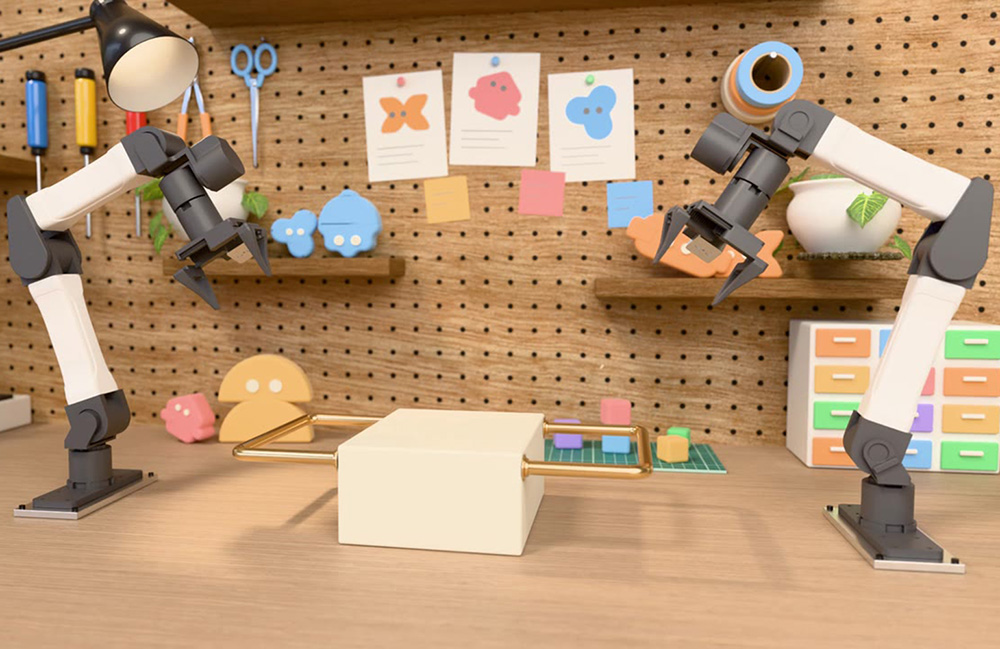
Joel Jang, the co-founder and CEO of Dream Labs, frames the innovation as a fundamental shift in user experience. "When you get into a rental car, you don’t relearn how to drive. You find the controls, and your past driving experience does the rest," Jang said. "Dream-1 approaches a new robot the same way, so a new robot can do useful work in minutes, not months."
Hardware manufacturers are also echoing this sentiment. Ryan Chan, CEO of MakerMods, which produces bimanual robot arms, noted that integrating the Dream API transformed his company’s value proposition. "Our customers buy our robots to build things, and the hardest part has always been getting them to do actual work," Chan stated. "With Dream-1, our robot was up and running in a few minutes and attempting tasks we never programmed. We can focus on building better hardware, and our customers get intelligence that keeps improving."
Implications: The Future of Autonomous Labor
The long-term implications of Dream Labs’ approach are profound. If the "brain" of the robot is modular and independent of the hardware, the market for robotics will likely shift toward a "software-first" model.
1. Scaling Through Compute
The $90 million in fresh capital is earmarked primarily for the massive compute resources required to run these models at scale. As the company expands the library of tasks—moving from basic pick-and-place to more complex, dexterous manipulation—the demand for cloud-based inference will grow. By centralizing the intelligence in data centers, Dream Labs ensures that even low-power robots can perform high-level cognitive tasks.
2. Fine-Tuning as a Service
While Dream-1 is designed to be "out-of-the-box" ready, Dream Labs recognizes that specific industrial applications require specialized nuance. Their offering of "fine-tuning as a service" allows companies to upload small batches of demonstration data for their specific hardware, receiving a customized model within hours. This creates a hybrid model of generalized intelligence with specialized precision.
3. Democratization of Innovation
Perhaps the most significant impact is the lowering of the barrier to entry for small and medium-sized enterprises (SMEs). Previously, only large corporations could afford the R&D costs to implement advanced robotics. With Dream Labs, a startup or even an individual hobbyist can now command a machine to fold laundry or sort items using nothing more than a standard API key and a reasonably priced robotic arm.
4. A New Frontier for Human-Robot Interaction
By providing a live, browser-based "playground," Dream Labs is demystifying AI-driven robotics. This transparency serves a dual purpose: it proves the company’s claims in real-time while fostering a community of developers who can stress-test the model in varied environments. As these users provide feedback and edge-case data, the model will inherently become more robust.
Conclusion: The Horizon
As Dream Labs scales, the industry will watch closely to see if the "Dream-1" model can maintain its performance across increasingly complex environments. The vision of a universal robot brain—a system that can look at a piece of hardware and immediately understand how to manipulate it—is the "holy grail" of robotics.
With $90 million in funding and a growing ecosystem of over 20 hardware partners, Dream Labs has transitioned from a theoretical research entity into a tangible infrastructure provider. Whether in the factory, the warehouse, or eventually the home, the arrival of a scalable, "plug-and-play" intelligence layer suggests that the robotic revolution is moving from the realm of science fiction into the everyday reality of global industry. The era of the "trained" robot is ending; the era of the "intelligent" robot has begun.