The landscape of electric vehicle (EV) charging in the United States is undergoing a profound transformation. Long gone are the days when public charging stations were an afterthought—lonely, exposed pillars tucked away at the dark edges of remote parking lots, vulnerable to the elements and lacking basic conveniences. Today, major automotive coalitions, independent networks, and innovative startups are rewriting the rules of infrastructure. Leading this charge is IONNA, an ambitious automaker-backed joint venture scaling up its public charging network to meet anticipated long-term EV adoption growth, even in the face of shifting federal energy policies.
Main Facts
The US public EV charging ecosystem is experiencing a major renaissance driven by several simultaneous developments:
- IONNA’s Rapid Expansion: Launched in 2023 by a coalition of major automakers—including BMW, General Motors, Honda, Hyundai, Kia, Mercedes-Benz, Stellantis, and later Toyota—IONNA is aggressively expanding its "Rechargery" network.
- Top Industry Recognition: In its first year of award eligibility, IONNA claimed the top spot in J.D. Power’s 2026 U.S. Electric Vehicle Experience (EVX) Public Charging Study, proving that the OEM-backed model is successfully addressing historical reliability concerns.
- Massive Footprint Growth: IONNA reported nearly 1,000 operational charging bays distributed across more than 100 sites, with an additional 4,700 bays under contract—nearly 1,500 of which are already under construction or awaiting final regulatory sign-offs. The network aims to reach 30,000 ultra-fast charging points by 2030.
- Diversified Partnerships: Beyond its standalone lounge-style locations, IONNA has partnered with convenience store giant Circle K to bring branded ultra-fast chargers to over 350 US stores.
- App Fatigue Mitigation: To streamline user experience, IONNA integrates seamlessly with a broad array of existing native vehicle apps (such as those from Ford, Rivian, BMW, and GM), bypassing the need for drivers to download a bespoke network application.
- Broader Industry Innovation: Competitors are also pushing boundaries. EVgo recently unveiled a dynamic power-sharing system capable of delivering up to 750 kW, while urban-focused startups like Voltpost and It’s Electric are pioneering lamppost and curbside modular charging solutions.
Chronology of Infrastructure Evolution
The "Wild West" Era of Early Charging
In the early commercial days of modern electric vehicles, charging infrastructure was treated as a compliance checkbox rather than a vital consumer service. Stations were frequently placed on the periphery of commercial properties. Reliability was spotty, maintenance schedules were erratic, and amenities consisted of little more than asphalt and gravel. Drivers faced widespread "range anxiety" compounded by "charger anxiety"—the fear that arriving at a public stall would reveal a broken or occupied plug.
The Automaker Awakening (2020–2023)
As the COVID-19 pandemic recovery period gave way to surging EV sales, automakers realized they could no longer rely on fragmented third-party networks or inconsistent public utility deployments to support their fleets. Recognizing that the consumer refueling experience directly impacted vehicle sales, major global original equipment manufacturers (OEMs) decided to take matters into their own hands. This realization culminated in the formation of the IONNA consortium in 2023, uniting fierce automotive competitors under a shared banner to build a reliable, high-powered national network.
Groundbreaking and Scaling (2024–2026)
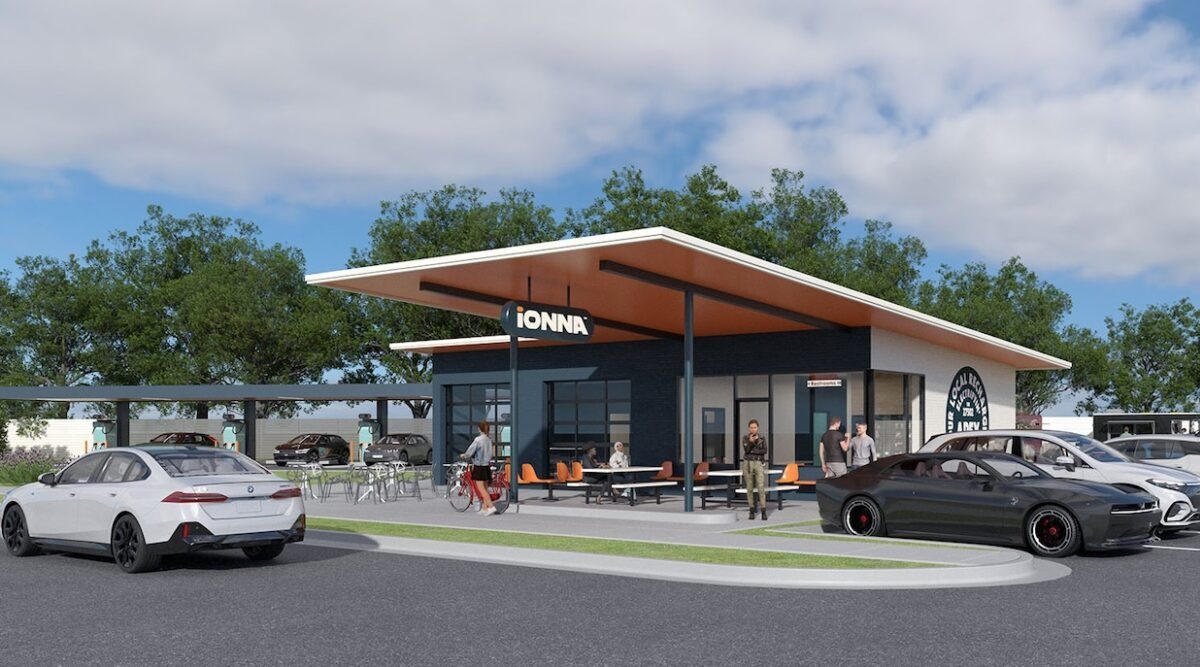
- Late 2024: IONNA broke ground on its very first flagship "Rechargery" in North Carolina, introducing a retro-chic, lounge-like environment equipped with high-speed chargers, Wi-Fi, restrooms, and refreshments.
- March 2026: IONNA reported nearly 1,000 operational bays and thousands more contracted. Concurrently, Tesla introduced its accordion-folding V4 prefabricated charging units to slash installation times and costs. Meanwhile, high-profile projects like the West Hollywood Tesla Diner opened, though they faced mixed long-term consumer retention.
- April 2026: IONNA announced its strategic "Rechargeries @ Circle K" partnership, supercharging its expansion timeline by embedding branded fast chargers into hundreds of established convenience retail locations across the nation.
- August 2026: J.D. Power released its 2026 EVX Public Charging Study, cementing IONNA’s market leadership by ranking the joint venture highest among DC fast-charger stations in its inaugural year of eligibility.
- September 2026: EVgo introduced its next-generation 750 kW power-sharing architecture, and startups like Voltpost accelerated the rollout of lamppost-integrated urban chargers.
Supporting Data and Market Metrics
The empirical data tracking the maturation of the US charging network highlights a decisive pivot toward higher reliability, faster speeds, and denser urban deployment:
- IONNA’s Infrastructure Pipeline:
- Operational Bays: ~1,000 across 100+ sites.
- Contracted Bays: 4,700 total.
- Active Construction/Pending Sign-offs: ~1,500 bays.
- Long-Term Goal: 30,000 ultra-fast charging points by 2030.
- J.D. Power 2026 EVX Study Findings: The study noted that newer, higher-speed chargers, larger site footprints, destination-style amenities, and frictionless payment options have collectively driven down failed charging attempts. This rebound in consumer confidence has directly bolstered broader EV adoption rates despite macroeconomic and political crosswinds.
- Hardware Efficiency Advances: Newer modular station designs—such as Tesla’s foldable V4 units—have increased logistics efficiency by allowing 33% more units per delivery truck, cutting overall installation costs by 20%, and doubling deployment speeds.
- High-Power Benchmarks: The introduction of EVgo’s 750 kW power-sharing systems illustrates how rapidly charging speeds are escalating to accommodate heavy-duty commercial fleets and ultra-fast-charging consumer passenger vehicles.
Official Responses and Industry Perspectives
Industry leaders and consumer analytics firms have expressed immense optimism regarding the structural shift toward amenity-rich, highly reliable charging hubs.
In its official August 2026 announcement, J.D. Power highlighted the profound impact of automotive industry intervention:
"New OEM-backed charging networks elevate the public charging experience. Newer, higher-speed chargers, larger charging sites, destination-style locations with more amenities and more seamless payment options are reducing failed charging attempts and delivering a more reliable charging experience, helping to support continued EV adoption."
IONNA executives have consistently emphasized that their model is designed around the human element of travel. By viewing charging locations as "destinations" rather than mere parking spaces, the consortium aims to eliminate the friction of long-distance EV travel.
Competitors have echoed the necessity of user-centric design. Regarding its dynamic power-sharing architecture, EVgo stressed the elimination of stall anxiety:

"Drivers won’t have to worry about finding a certain power-level stall because every stall is the right one for their vehicle." This philosophy addresses a historical pain point where drivers were forced to hunt for specific kilowatt ratings compatible with their car’s architecture.
Implications for the Future of US Mobility
The rapid maturation of public charging networks carries profound implications for the American automotive market, urban planning, and energy grids.
Overcoming the Multi-Unit Housing Bottleneck
While the vast majority of EV owners prefer the convenience and cost-effectiveness of overnight home charging, millions of Americans reside in multi-unit apartment complexes, condominiums, or historic urban row houses where dedicated home chargers are impractical or entirely absent. The aggressive build-out of public plazas, convenience store hubs (such as Circle K locations), and urban street furniture chargers (such as Voltpost’s lamppost units and It’s Electric’s curbside bays) is essential to unlocking the next wave of mainstream EV adoption. Without robust, ubiquitous public charging, these urban demographics would remain locked out of the electric transition.
The Death of App Fatigue
A subtle yet critical win for consumers is the conscious dismantling of closed-loop software ecosystems. By opening their networks to native manufacturer applications—allowing drivers to use apps from BMW, Ford, Rivian, GM, Hyundai, and others without forcing them to download a proprietary IONNA app—charging providers are removing administrative friction. This interoperability mirrors the seamless experience of traditional gas station credit card readers.
Navigating Policy Shifts and Market Realities
Despite sharp reversals in federal energy incentives and shifting regulatory landscapes, private consortia and independent operators are proving that market demand and long-term electrification trends are robust enough to sustain independent infrastructure investments. As high-power architectures, drive-through convenience hubs, and reliable multi-brand compatibility become the baseline standard, the US electric vehicle charging network is finally evolving to match the demands of a modern, low-carbon transportation future.