





In anticipation of the November 3, 2026, Future of Engineering (FoE) Summit, industry leaders are shifting the narrative from AI experimentation to operational transformation. The core thesis: The greatest ROI for artificial intelligence isn’t just speed—it’s the reclamation of human ingenuity.
For the modern engineer, the job description has drifted dangerously far from the act of engineering. A typical week is no longer defined by design iterations, structural analysis, or innovative breakthroughs, but rather by a suffocating deluge of administrative friction. Meetings, email chains, complex approval queues, and the repetitive, soul-crushing manual labor of navigating CAD files now dominate the professional landscape.
This phenomenon, dubbed the "hidden factory," is the central theme of the third annual Future of Engineering (FoE) Summit. As the industry moves past the "hype" phase of AI, the focus for 2026 has sharpened: How do we move from pilot programs to scalable, trust-based deployment?
The Summit: Bridging the Gap Between Pilot and Production
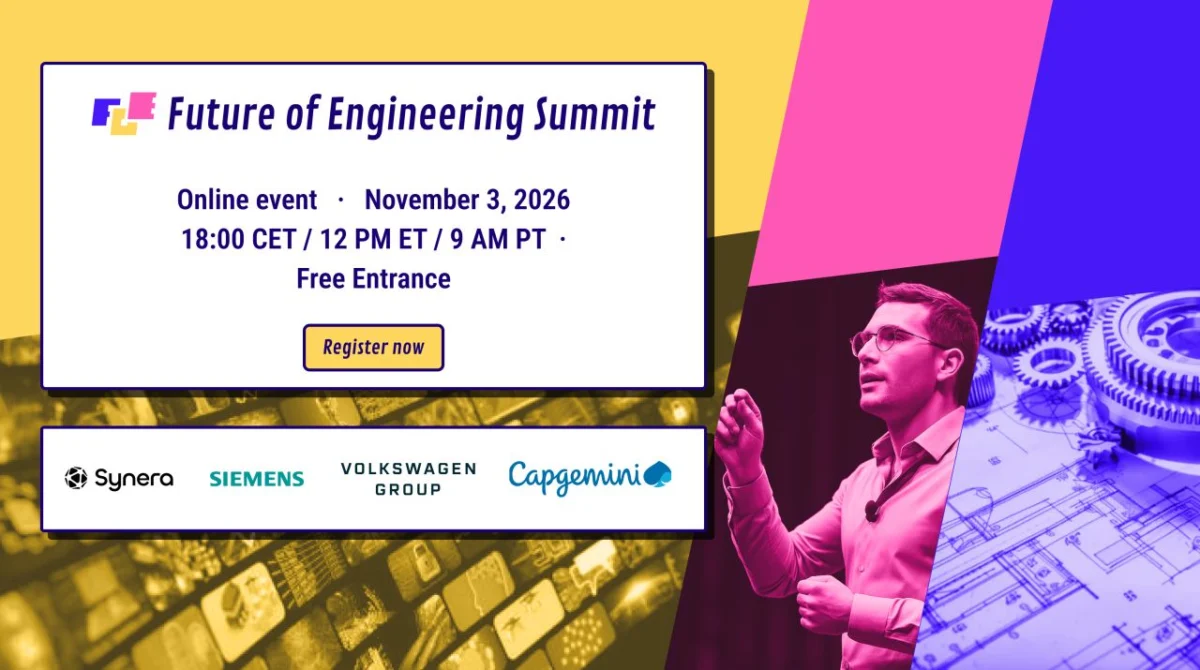
The virtual event, scheduled for November 3, 2026, at 12:00 p.m. ET (18:00 CET), promises to be a critical junction for engineering leaders. Moderated by Design World Editor-in-Chief Rachael Pasini, the two-and-a-half-hour broadcast will feature a blend of keynote presentations, a high-stakes startup pitch, and an executive panel discussion.
The event arrives at a moment of reckoning. While the initial euphoria surrounding AI agents has settled, organizations are now grappling with the harsh realities of implementation. Analysts, including those at Gartner, have sounded a note of caution, predicting that 40% of agentic AI projects could face cancellation by the end of 2027 due to spiraling costs, nebulous business cases, and a lack of robust risk management. The FoE Summit is designed to help organizations navigate these choppy waters, providing a blueprint for successful, sustainable integration.
Defining the ‘Hidden Factory’
Praveen Cherian, Executive Vice President at Capgemini, has spent his career in the trenches of automotive OEMs, observing a startling trend: the systematic erosion of engineering time. His upcoming session, "Free Your Engineers: Finding the Hidden Factory in Engineering," argues that the modern engineering organization is suffering from a structural identity crisis.
"About 70% of your time at work is spent in non-engineering activities," Cherian asserts. "When you think of engineers, you think of someone sitting and tinkering with something. But that’s not what you see. They’re largely in meetings, sending emails, talking to people, and coordinating. It becomes a function that an engineer does, and they really have lost their engineering skills because of this."
Cherian categorizes the organizational resource drain as follows:

- 20%: Maintaining baseline operations.
- 70%: "Context" work—the necessary but undifferentiated administrative burden.
- 5% each: Differentiating work and true, breakthrough innovation.
"No wonder all the cars look the same," Cherian notes dryly. The hidden factory is a product of legacy processes, bureaucratic approval chains, and a lack of integrated digital tools. In some instances, a simple engineering change order can languish in an approval queue for up to 20 days. Agentic AI, Cherian argues, is the surgical tool required to excise this inefficiency, with the potential to reduce that 70% "context" burden to 40%, thereby freeing up massive tranches of capacity for high-value innovation.
The Data Perspective: Rewiring Product Development
Data from the Capgemini Research Institute’s October 2026 report, Rewiring automotive product development, confirms that industry sentiment is shifting toward this agent-led future. Surveying 800 senior automotive executives, the report found that 83% believe agentic AI is the key to reclaiming core engineering time. Furthermore, 68% of respondents confirmed their organizations have already moved past the theoretical stage and are actively piloting agentic AI in their product development workflows.
However, Cherian warns against a common trap: the "faster-horse" fallacy. "Do you see an agentified organization when you look at the car, or do you see the same old car just done faster using AI?" he asks. "I think it’s a big failure mode if you see doing more of the same using AI." The goal of AI, in his view, is not to accelerate the mundane; it is to eliminate it so that human intelligence can focus on the novel.
Mechanical Engineering in the Age of Copilots
While Cherian addresses the structural and organizational side of the hidden factory, Owein Dourneau, CEO and cofounder of MecAgent, tackles the issue from within the CAD software itself. MecAgent provides an AI copilot that functions as a force multiplier for mechanical engineers.
By turning natural language prompts, technical spec sheets, or raw STEP files into native, editable features and macros, the platform targets the granular, time-consuming tasks that plague day-to-day design. The impact is quantifiable. Dourneau cites a case study where an engineer was tasked with updating 25,000 legacy drawings due to a corporate rebrand—a project estimated to take three months of manual labor. Using MecAgent, the team automated the process in five minutes.
"Changing the value of five chamfers is not mechanical engineering; it’s just execution," Dourneau says. "All of that will be offloaded." This shift mirrors the evolution of software development, where the role of the coder has moved from writing raw syntax to managing complex, high-level system architecture.
Building Trust in Phases
The question of accountability remains the most significant barrier to mass adoption. If an AI agent makes a decision, who is to blame when the design fails?
Both Cherian and Dourneau emphasize a "human-in-the-loop" philosophy. They argue that trust is not a binary switch but a graduated process. Cherian compares this to the maturity of financial fraud detection systems. Initially, agents might be granted autonomy only over low-risk, high-frequency tasks—such as approving a cost variance under a specific monetary threshold. As the agent proves its reliability and its guardrails are refined, its authority can be expanded.

Dourneau approaches trust-building through the lens of quality assurance. For MecAgent, the goal is not "perfect" output, but "80% there" output—work that is sufficiently accurate to save the engineer from starting from scratch, yet requiring the final, critical review of a human expert.
"I would not yet trust an AI to build a car or a plane I want to fly in," Dourneau admits. The strategy is to maintain the human as the final gatekeeper, shifting the job description from "creator of every line" to "editor and architect of machine-generated designs."
Summit Highlights: A Comprehensive Roadmap
The FoE Summit will serve as a venue for dissecting these challenges in real-time. The agenda is packed with expert perspectives:
- The Golden Age of Engineering: Andrew Sartorelli (Synera) will kick off the event by discussing the requirements for scaling AI, from team culture to leadership buy-in.
- The Four Gates of Production: Clemens Frenzel (Volkswagen) will detail the rigorous framework necessary to move a pilot program into a production vehicle, emphasizing the need for real data and clear ownership.
- Scaling AI in PLM: Alexandre Poisson (Siemens Digital Industries Software) will present on the practicalities of embedding AI into Product Lifecycle Management systems.
- Text-to-CAD: Daniel Kane (Onshape) will explore the cutting edge of prompt-driven design, illustrating how the barrier between concept and CAD model is thinning.
The event will conclude with a panel discussion featuring Cherian, Sartorelli, Kane, and Michael Finocchiaro (ThreadMoat), where attendees can engage directly with the speakers on the practicalities of business impact and risk mitigation.
Implications for the Future
The promise of the 2026 FoE Summit is a departure from the "AI will replace you" narrative. Instead, it positions AI as a long-awaited liberation movement. The hidden factory is not an inevitable byproduct of engineering; it is a legacy construct that can be dismantled.
As Cherian notes, the leap is one of mindset. Organizations must stop asking how to use AI to do the same amount of work with fewer people, and start asking how to use AI to enable their current people to reach levels of innovation that were previously inaccessible.
For engineers who have spent years navigating bureaucratic labyrinths and repetitive CAD adjustments, the message of the summit is clear: The tools are finally arriving to return you to your core purpose. The future of engineering is not about the automation of the engineer, but the restoration of the art of engineering itself.
Registration for the virtual summit is currently open at future-of-engineering-summit.com. As the industry converges on November 3, the conversation will likely serve as the definitive marker for the next era of industrial design and product development.