In an era where industrial facilities are increasingly defined by the sheer volume of data generated by thousands of sensors, the challenge for operational teams is no longer access to information—it is the ability to filter that information effectively. TwinThread, a leader in industrial digital transformation, has officially announced the launch of its Anomaly Action Center, an AI-powered solution designed to cut through the "alarm fatigue" that plagues modern manufacturing and processing plants. By intelligently prioritizing equipment anomalies and streamlining response workflows, TwinThread aims to move industrial teams from reactive troubleshooting to proactive, knowledge-based maintenance.
The Industrial Data Dilemma: Why Prioritization Matters
Modern industrial environments are drowning in data. With the proliferation of Industrial Internet of Things (IIoT) sensors, a single production line can generate millions of data points every hour. While this granularity is essential for predictive maintenance, it creates a significant bottleneck for human operators.
Plant managers and maintenance technicians are frequently overwhelmed by a deluge of notifications. When a facility experiences hundreds of minor alarms daily, the "noise" often masks critical issues that could lead to catastrophic equipment failure or significant quality degradation. Furthermore, much of the institutional knowledge required to fix these issues remains locked in the minds of veteran technicians. When these employees move to new roles or retire, that expertise leaves the floor, forcing the next generation to "reinvent the wheel" during every troubleshooting session.
TwinThread’s Anomaly Action Center is engineered specifically to address these systemic inefficiencies. By integrating with existing operational technology (OT) and information technology (IT) ecosystems, the platform provides a centralized, intelligent dashboard that turns raw data into actionable intelligence.
How Anomaly Action Center Functions: The Mechanics of Insight
At its core, the Anomaly Action Center functions as an intelligent layer that sits atop TwinThread’s existing prebuilt industrial solutions. The system employs sophisticated algorithms to evaluate anomalies based on two primary variables: persistence and severity.
1. Intelligent Ranking and Summarization
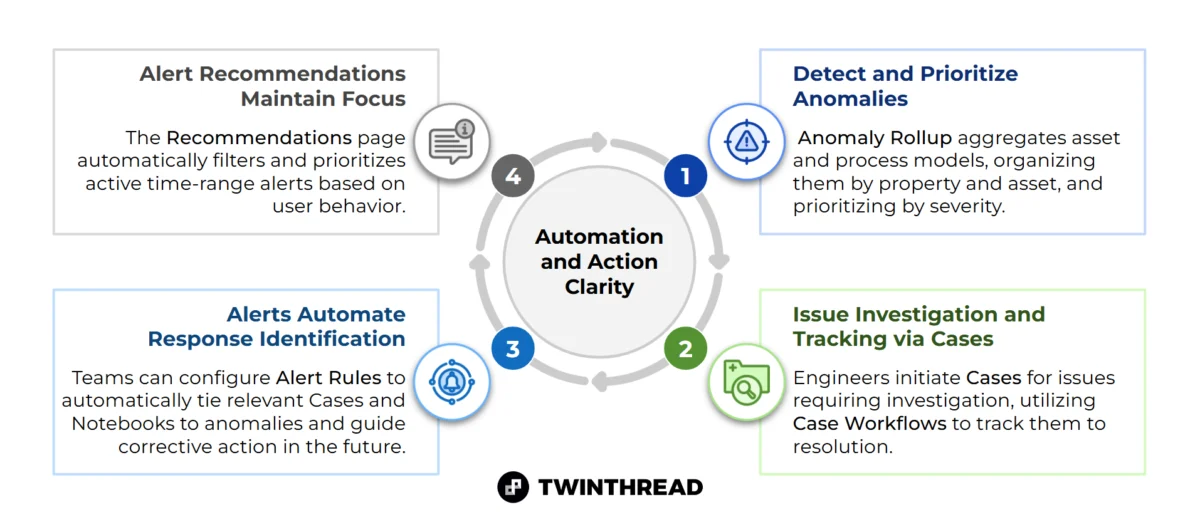
Rather than presenting a flat list of alarms, the platform ranks anomalies by their impact on operations. It evaluates how long an anomaly has persisted and how significantly the equipment’s performance deviates from predefined operating limits. This ranking ensures that maintenance personnel address the most critical threats to uptime first.
To further reduce the cognitive load on operators, the platform provides a concise, one-sentence summary for every identified issue. This "executive summary" approach allows maintenance technicians and engineers to immediately grasp the nature of the problem, the equipment affected, and the potential severity, facilitating faster decision-making.
2. Capturing Institutional Knowledge
Perhaps the most transformative aspect of the Anomaly Action Center is its ability to digitize the resolution process. When a team responds to an anomaly, the software records their actions. These recorded responses are then converted into formal procedures. Over time, this creates a living library of institutional knowledge. Future occurrences of the same issue can then be automatically paired with these documented, proven resolutions, effectively training the workforce while the work is being performed.
Chronology of Development: From Predictive Modeling to Actionable Response
The release of the Anomaly Action Center represents the latest milestone in TwinThread’s broader roadmap to automate the industrial enterprise.
- Foundation Phase: TwinThread established its reputation by deploying advanced predictive modeling, allowing plants to monitor equipment health across thousands of sensors simultaneously.
- Integration Phase: As the platform matured, the focus shifted toward integrating these predictive models with enterprise-level software, including CMMS (Computerized Maintenance Management Systems) and QMS (Quality Management Systems).
- Actionable Intelligence Phase: Recognizing that identifying a problem is only half the battle, TwinThread developed the Anomaly Action Center to bridge the gap between "detecting a failure" and "executing a repair." This current phase prioritizes the human element of industrial operations, ensuring that software serves the operator rather than overwhelming them.
Supporting Data and Technical Efficacy
The scalability of the TwinThread platform is evidenced by its real-world performance metrics. In one recent large-scale deployment, the Anomaly Action Center was tasked with managing 80 active models across multiple distinct departments.
Each of these models was responsible for monitoring up to 1,500 individual sensors, creating a complex web of inputs that would be impossible for a human team to monitor manually. By consolidating this massive stream of data, the system was able to reduce the time-to-resolution by filtering out low-priority "nuisance" alarms and highlighting the issues that required immediate human intervention. This ability to handle high-density sensor inputs while maintaining a simplified user interface is a cornerstone of the platform’s value proposition.

Seamless Integration: The Connected Plant Ecosystem
TwinThread’s approach is predicated on the belief that software should integrate into the existing environment, not replace it. The Anomaly Action Center is designed to communicate bi-directionally with:
- CMMS (Computerized Maintenance Management Systems): Automatically generating work orders when a high-priority anomaly is detected.
- QMS (Quality Management Systems): Ensuring that deviations in equipment performance are cross-referenced with production quality standards.
- Existing SCADA/MES Environments: Allowing teams to investigate the root cause of an anomaly without leaving their primary operating consoles.
This interoperability is crucial for adoption. By working within the existing software environment, TwinThread lowers the barrier to entry for maintenance teams who are already accustomed to specific operational workflows.
Implications for the Future of Industrial Work
The implications of this technology extend far beyond simple maintenance efficiency.
Bridging the Skills Gap
As the manufacturing sector faces a significant labor shortage, the ability to "upskill" junior employees is paramount. By providing step-by-step guidance derived from documented historical resolutions, the Anomaly Action Center acts as a force multiplier. A technician with less experience can effectively handle complex machinery issues by following the documented workflows suggested by the system.
Transitioning to "Zero-Unplanned-Downtime"
The ultimate goal of such technology is the minimization—and eventual elimination—of unplanned downtime. By identifying and ranking anomalies early, organizations can perform maintenance during scheduled windows, significantly reducing the cost of repairs and the loss of production revenue.
Data-Driven Culture
By documenting every resolution, companies move away from a culture of "tribal knowledge" and toward a culture of "data-driven excellence." Every repair becomes a data point that refines the AI’s understanding of the machine, creating a virtuous cycle of improvement. Each anomaly resolved today makes the facility smarter and more resilient for tomorrow.
Conclusion: A New Standard for Operational Excellence
The launch of the Anomaly Action Center by TwinThread marks a significant shift in the industrial software landscape. By moving the focus from merely "monitoring" to "prioritizing and documenting," TwinThread is addressing the human constraints of modern industry.
As plants continue to become more automated and sensor-dense, tools that can distill complexity into actionable, ranked, and documented tasks will become non-negotiable assets. For operations managers, maintenance leads, and engineers, the Anomaly Action Center offers a way to regain control over their equipment, reduce operational risk, and empower their workforce.
For more information on how this solution is reshaping industrial maintenance, visit the official TwinThread website.
Reported by the Editorial Staff, focusing on developments in AI, Machine Learning, and Industrial Digital Transformation.