





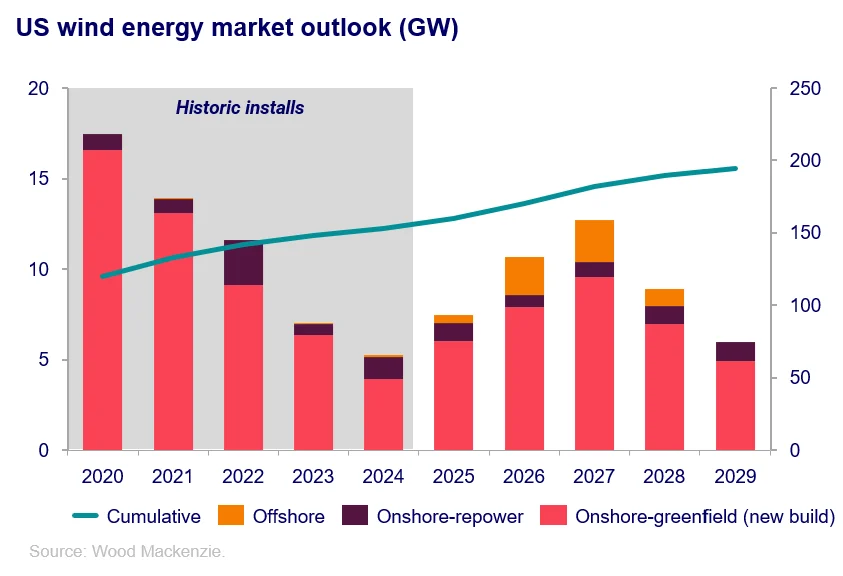
The United States wind energy sector is bracing for a pivotal year in 2025, with industry forecasts signaling a robust rebound in deployment. According to the latest U.S. Wind Energy Monitor—a collaborative report released by Wood Mackenzie and the American Clean Power Association (ACP)—the nation is projected to install more than 7 gigawatts (GW) of new wind capacity in 2025. This represents a significant 36% increase over the previous year’s performance, underscoring a critical shift in the deployment trajectory as developers navigate a landscape defined by both unprecedented demand and stubborn inflationary pressures.
While the five-year cumulative outlook remains steady at 46 GW of new capacity between 2025 and 2029, the internal mechanics of the industry are shifting. The sector is moving toward a more accelerated commissioning cycle in the middle of the decade, even as developers grapple with the persistent, dual-sided challenges of tariff-induced cost spikes and the urgent need for grid-scale infrastructure to meet the nation’s skyrocketing power demand.
The Chronology of Deployment: A Back-Loaded Decade
The road to the 2025-2029 targets is not a linear climb. Industry analysts have observed a marked "back-loaded" pattern in recent installation data, which is standard for large-scale energy projects.
The 2025 Ramp-Up
Despite a sluggish third quarter in 2025, which saw installations fall 23% below original forecasts to 932 megawatts (MW), the industry remains confident in its year-end goals. Roughly 3.8 GW of capacity is queued for the fourth quarter of 2025, accounting for over half of the year’s total expected additions. This concentration of commissioning activity is typical for the industry, where projects often finalize interconnection and grid-testing protocols in the final months of the fiscal year.
The Mid-Decade Surge (2026–2027)
The report highlights 2026 and 2027 as the high-water marks for the industry’s current development pipeline. With 10.7 GW and 12.7 GW projected for these respective years, the industry is effectively moving a backlog of assets through the permitting and construction phases. This surge is buoyed by the fact that the 2025–2027 pipeline is now fully committed, with turbine supply agreements already locked in place for every project.
The Late-Decade Horizon (2028–2029)
Looking further ahead, the outlook for 2029 shows a noticeable cooling trend. Several projects initially slated for the end of the decade have either been cancelled or moved into "inactive" status. Analysts attribute this drop-off to systemic issues, including lingering permitting bottlenecks and the broader complexities of site development that tend to surface as project timelines stretch into the long term.
Supporting Data: Economic Fundamentals and Market Dynamics
The resilience of the U.S. wind market is being tested by a volatile intersection of record-breaking demand and rising capital expenditure (capex).
The Demand Imperative
The U.S. power grid is undergoing a transformation not seen in decades. After a ten-year period of largely flat demand, the nation is witnessing a surge driven by massive industrial and technological growth. Estimates suggest that power demand will grow at an average of 3% annually through 2029, compared to just 0.7% over the previous decade.
Central to this shift is the data center industry, which accounts for approximately 59 GW of the projected 90 GW total peak demand growth. As utilities scramble to secure reliable baseload power, wind energy has emerged as a high-value candidate, favored for its competitive Levelized Cost of Energy (LCOE).
Turbine Order Recovery
There is clear evidence of renewed confidence among developers. U.S. turbine order intake has rebounded to levels seen before the implementation of recent policy shifts (specifically the "One Big Beautiful Bill Act" or OBBBA). Q3 saw more than 2 GW of firm commitments—a 79% increase quarter-over-quarter—marking the most significant surge in order activity in nine months. However, transparency remains a hurdle; Original Equipment Manufacturers (OEMs) are increasingly keeping project details confidential, and much of the early-stage construction activity is now occurring "off-site" through component manufacturing, making it harder to track real-time project progress.

Official Perspectives: Navigating Policy and Price
Leila Garcia da Fonseca, Director of Research at Wood Mackenzie, notes that while the economic case for wind remains stronger than ever, the industry is currently held captive by regulatory and cost-related uncertainties.
"The U.S. power market is facing mounting strain," says Garcia da Fonseca. "Utilities are committing to 160 GW of large-load additions, which provides a massive opportunity for wind energy. However, while the business case is compelling, turbine costs remain elevated due to tariffs, and our growth trajectory will ultimately depend on how effectively the nation resolves policy uncertainty and permitting delays."
The Tariff Dilemma
The report paints a complex picture regarding costs. While domestic manufacturing overcapacity would typically drive prices down, the reality is the opposite: onshore wind capex is projected to rise by 5% through 2029. This is largely due to tariff exposure on raw materials and subcomponents. According to the report, 2026 will be a particularly difficult year for costs before the market begins to see some moderation in subsequent years.
Implications: A Geographic and Sectoral Divide
The U.S. wind landscape is evolving both geographically and in terms of its technological split between onshore and offshore projects.
Onshore Expansion
The onshore sector remains the primary engine of growth, with 39.8 GW of the five-year outlook dedicated to land-based projects. Western states, including Wyoming and New Mexico, are leading the charge, projected to account for 34% of all activity.
- Key Projects: Pattern Energy’s 3.5-GW SunZia project in New Mexico stands as a landmark endeavor, set to make the developer the top installer in 2026. Similarly, the 998-MW Towner Energy Center in Colorado, scheduled for 2027, highlights the scale of contemporary onshore builds.
- Market Entry: The industry is expanding into new territories, with Arkansas set to bring its first utility-scale onshore wind project—Cordelio’s Crossover Wind—online, signaling a broader geographic footprint for the industry.
- Repowering: The repowering of existing wind farms continues to be a strategic pillar, with 18 projects expected to add 2.5 GW of capacity over the next three years.
Offshore Challenges
Offshore wind presents a more fragmented story. While projects like Vineyard Wind have demonstrated operational success—connecting 15 turbines and delivering 200 GWh of power in the first nine months—the sector faces significant hurdles.
Harsh winter weather is expected to slow installation in late 2025, pushing capacity into 2026. Looking further, the sector is struggling with a shortage of wind turbine installation vessels. This constraint, combined with financial pressures, has led to increased contract terminations and delays for projects slated for post-2027 completion. As Garcia da Fonseca notes, the offshore sector is showing "diverging momentum," where projects already in the water are succeeding, but future developments are mired in systemic logistical and financial risk.
Conclusion: The Path Forward
The U.S. wind industry stands at a critical juncture. The next five years will be defined by the race to meet an unprecedented surge in power demand—a task for which wind energy is perfectly positioned. However, the path to that 46 GW goal is obstructed by a "tariff trap" that keeps costs high and a permitting environment that remains slow to adapt.
For the wind sector to capitalize on the 36% growth projected for 2025, policymakers and developers must find a middle ground. Reducing the volatility of turbine pricing through clearer trade policies and streamlining the permitting process for late-decade projects will be essential. If the industry can navigate these headwinds, wind will remain the cornerstone of the U.S. transition to a high-demand, low-carbon future. The data confirms the intent and the necessity; the coming years will reveal whether the regulatory and economic environment can rise to meet the challenge.