NEW YORK — In an era marked by persistent supply chain volatility, labor constraints, and margin pressures, manufacturing executives face a relentless mandate: make smarter, faster decisions that directly correlate to bottom-line performance. But are leadership teams truly making operational choices that translate into measurable financial success? And more importantly, how do emerging technologies like Artificial Intelligence (AI) and advanced manufacturing operations software shift the needle?
To answer these critical questions, the prominent research firm Tech-Clarity has released the findings of a comprehensive, large-scale survey of over 400 manufacturing professionals. The results offer a compelling narrative for industrial leaders hesitant to invest in digital transformation: operations software and AI solutions do not just promise theoretical long-term gains—they deliver concrete, quantifiable benefits, typically within a year, and in some cases, in as little as three months.
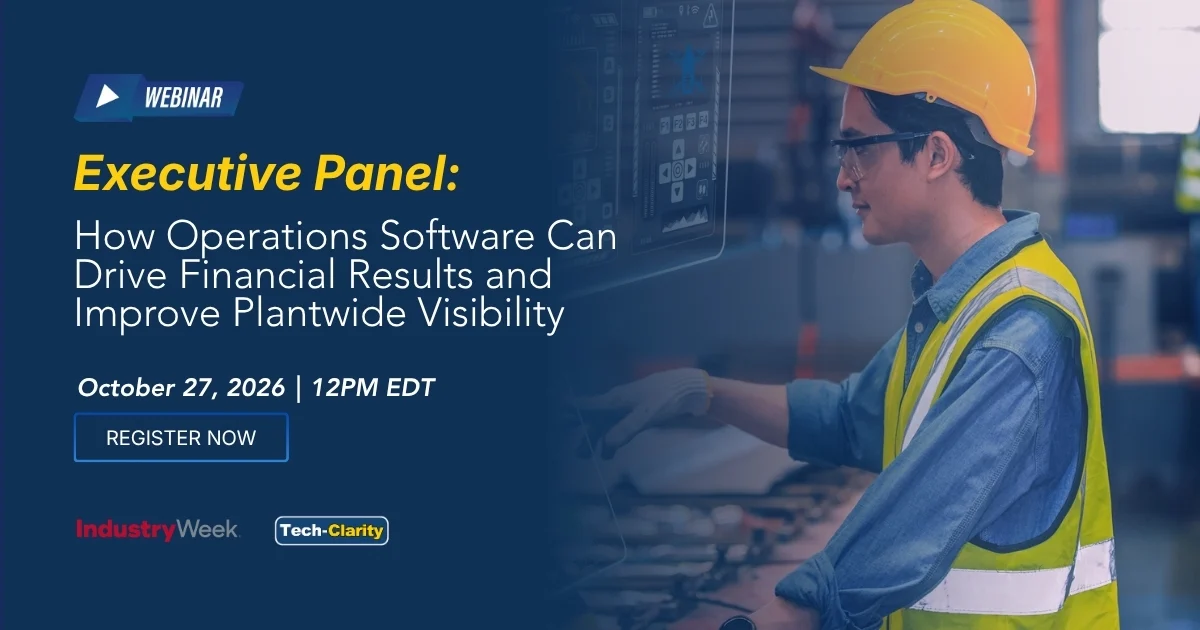
To dissect these findings and provide actionable takeaways, IndustryWeek is hosting an exclusive, panel-style executive webinar titled “How Operations Software Can Drive Financial Results and Improve Plantwide Visibility,” scheduled for October 27, 2026, at Noon Eastern Time.
This comprehensive report explores the foundational facts of the upcoming event, the chronological backdrop of manufacturing digital maturity, the robust data underpinning the Tech-Clarity study, insights from industry leaders, and the profound long-term implications for the industrial sector.
1. Main Facts: The Intersection of Software, AI, and Financial Results
The forthcoming webinar is designed to bridge the gap between high-level corporate strategy and day-to-day plant floor execution. As modern manufacturing environments grow increasingly complex, visibility across silos remains one of the most stubborn bottlenecks for organizations of all sizes.
Key Highlights of the Initiative:
- The Core Question: How do operational decisions connect to financial outcomes, and can AI and manufacturing software accelerate success?
- The Data Source: Fresh empirical research from Tech-Clarity surveying more than 400 industry professionals.
- The Time-to-Value Horizon: Survey data proves that software and AI implementations frequently yield tangible returns on investment (ROI) within 12 months, with aggressive deployments seeing value in as little as 90 days.
- The Event Details: Hosted on IndustryWeek, the webinar goes live on October 27, 2026, at 12:00 PM Eastern Time.
- The Panelists: Experienced manufacturing executives from small, mid-sized, and enterprise-level organizations who have successfully deployed plantwide and operations-wide software across production execution, maintenance, quality, and inventory management.
The session will move beyond vendor hype, offering a candid look at whether real-world software investments are genuinely living up to their lofty expectations and what best practices separate successful implementers from struggling laggards.
2. Chronology: The Evolution of Plant Floor Digitalization
To understand why the findings from Tech-Clarity’s 2026 survey represent a watershed moment, it is necessary to examine how manufacturing software and enterprise architectures have evolved over the past two decades.
Phase 1: Siloed Systems and Paper Trails (Late 1990s – Early 2010s)
For decades, manufacturing operations were governed by isolated islands of automation. Enterprise Resource Planning (ERP) systems handled top-floor financial transactions and high-level scheduling, while shop-floor systems—such as legacy Manufacturing Execution Systems (MES) or Computerized Maintenance Management Systems (CMMS)—operated independently. Data entry was frequently manual, relying on clipboards, spreadsheets, and tribal knowledge. Plantwide visibility was a myth; plant managers often waited days or weeks to compile lagging key performance indicators (KPIs).
Phase 2: The Industry 4.0 Awakening (Mid-2010s – 2020)
The advent of "Industry 4.0" and the Industrial Internet of Things (IIoT) promised a connected future. Sensors multiplied on machines, generating unprecedented volumes of data. However, many early adopters fell into the trap of "data hoarding." Organizations collected terabytes of telemetry data without the overarching software layer required to contextualize, analyze, and act upon it. The focus was heavily weighted toward hardware connectivity rather than software-driven decision-making.
Phase 3: The Post-Pandemic Push for Resilience (2020 – 2025)
Global supply chain shocks, severe labor shortages, and inflationary pressures forced a dramatic pivot. Manufacturers could no longer afford operational blind spots. Companies began demanding software that could provide real-time agility. During this period, integration between production execution, quality control, maintenance, and inventory management became a baseline survival strategy rather than a luxury.
Phase 4: The AI Integration and Rapid ROI Era (2025 – Present)
Today, we have entered an era where cloud-native operations software is infused with Artificial Intelligence and Machine Learning (ML). Rather than merely displaying dashboards of historical performance, modern systems predict maintenance failures before they happen, dynamically reroute production lines around bottlenecks, and automatically optimize inventory levels. As Tech-Clarity’s latest research indicates, the time-to-value has compressed drastically, allowing modern manufacturers to realize measurable financial returns within months rather than years.
3. Supporting Data: What the Tech-Clarity Survey Reveals
The backbone of the upcoming IndustryWeek webinar is Tech-Clarity’s rigorous study examining the habits, deployments, and outcomes of over 400 manufacturing professionals. While technology vendors have long touted the benefits of digital transformation, empirical data mapping software usage directly to financial and operational metrics provides much-needed clarity for cautious CFOs and COOs.
Speed to Value: Busting the Myth of Lengthy Deployments
One of the most persistent hesitations among small and mid-sized manufacturers (SMMs) regarding software adoption is the fear of protracted implementation cycles and delayed ROI. The Tech-Clarity survey shatters this misconception.
- The 12-Month Benchmark: The vast majority of respondents reported realizing concrete, measurable benefits from their operations software within the first year of deployment.
- The 90-Day Sprint: A notable segment of agile manufacturers achieved positive financial and operational impact within just 3 months. This acceleration is largely attributed to modern, cloud-based software architectures, out-of-the-box integrations, and pre-configured AI analytics modules that bypass the grueling custom-coding cycles of the past.
Core Functional Pillars Evaluated
The research evaluates deployments across four vital operational pillars:
- Production Execution: Tracking work orders, reducing cycle times, and maximizing Overall Equipment Effectiveness (OEE).
- Maintenance: Shifting from reactive firefighting to predictive and proactive asset management.
- Quality Management: Capturing defects at the source, automating compliance reporting, and minimizing scrap and rework.
- Inventory Management: Optimizing raw material and finished goods buffers to free up working capital without risking stockouts.
When software provides a unified, plantwide view across these four pillars, the compounding effect on financial results becomes impossible to ignore. Organizations eliminate the hidden costs of downtime, reduce excess inventory holding costs, and dramatically improve labor productivity.
4. Official Responses and Industry Perspectives: Lessons from the Front Lines
What separates organizations that thrive with software from those that struggle with failed implementations? To answer this, the October 27 webinar features a curated panel of manufacturing executives who have been in the trenches.
While the formal panelist discussion will unfold live, pre-event insights from leading industrial practitioners highlight several recurring themes regarding best practices, cultural change, and expectation management.
Moving Beyond the "Shelf-Ware" Syndrome
A central theme of the upcoming discussion addresses whether software investments are genuinely living up to their expectations. Industry veterans emphasize that software success is rarely about the technology alone; it is about alignment with business processes.
"Investing in operations software is not an IT project; it is a business transformation initiative," notes a seasoned manufacturing operations director. "When you roll out production execution or quality tools plantwide, you are changing how people work every single day. If leadership does not actively bridge the gap between the shop floor and top-floor financial goals, the software becomes expensive shelf-ware."
The Role of AI: From Hype to Pragmatic Execution
Artificial Intelligence is frequently discussed in abstract, futuristic terms, but manufacturing executives are finding immense value in highly pragmatic, targeted AI applications.

- Predictive Maintenance: Using machine learning algorithms to analyze vibration and temperature data from legacy motors, preventing catastrophic line shutdowns.
- Demand and Scheduling Optimization: Leveraging AI to automatically adjust production schedules in real-time based on material availability, labor shift changes, and rush orders.
Panelists on the upcoming webinar will share unfiltered accounts of where AI delivered immediate value, as well as the pitfalls they encountered along the way, offering attendees an invaluable roadmap for their own digital journeys.
5. Implications for the Future of Manufacturing
The findings from Tech-Clarity’s survey and the discussions fostered by IndustryWeek carry profound implications for the global manufacturing sector. As competitive pressures intensify, the digital divide between technologically mature enterprises and laggards is widening into an unbridgeable chasm.
The Financial Imperative of Visibility
In modern manufacturing, visibility is synonymous with profitability. When plant managers operate in silos—where production data is separated from maintenance logs, and quality metrics are divorced from inventory levels—financial waste is inevitable.
- Reduced Scrap and Rework: Real-time visibility allows operators to catch quality drift before hundreds of defective parts are produced.
- Optimized Working Capital: Accurate, real-time inventory tracking prevents capital from being unnecessarily tied up in excess raw materials while ensuring customer delivery deadlines are consistently met.
Democratization of Advanced Tech for Smaller Manufacturers
Historically, robust manufacturing operations software and AI tools were the exclusive domain of Fortune 500 multinationals with massive IT budgets. However, the rise of modular, scalable, and cloud-delivered software solutions has leveled the playing field. As the Tech-Clarity survey demonstrates, companies of all sizes—including small and mid-sized businesses—are now reaping the financial rewards of digital tools within months.
Strategic Action for Leadership Teams
For executives questioning whether to embark on a plantwide software or AI initiative, the message from the upcoming webinar is clear: the risk of inaction far outweighs the risk of implementation. With time-to-value compressed to months rather than years, organizations that embrace modern operational software will outmaneuver competitors bogged down by legacy systems and manual processes.
Conclusion and How to Attend
Navigating the complexities of modern manufacturing requires more than intuition—it demands real-time data, plantwide visibility, and the strategic deployment of operations software and AI. The upcoming IndustryWeek webinar, rooted in fresh data from Tech-Clarity’s survey of over 400 professionals, provides a rare opportunity to learn directly from executive peers who have successfully turned technology investments into measurable financial results.
Event Details at a Glance:
- Event Executive Panel: How Operations Software Can Drive Financial Results and Improve Plantwide Visibility
- Host: IndustryWeek in partnership with Tech-Clarity
- Date: October 27, 2026
- Time: 12:00 PM Eastern Time
- Target Audience: Manufacturing executives, plant managers, operations directors, IT leaders, and engineering professionals of all company sizes.
Manufacturing leaders interested in accelerating their time-to-value, improving plantwide visibility, and aligning operational decisions with bottom-line financial results are encouraged to register for the live event on the IndustryWeek webinar platform.