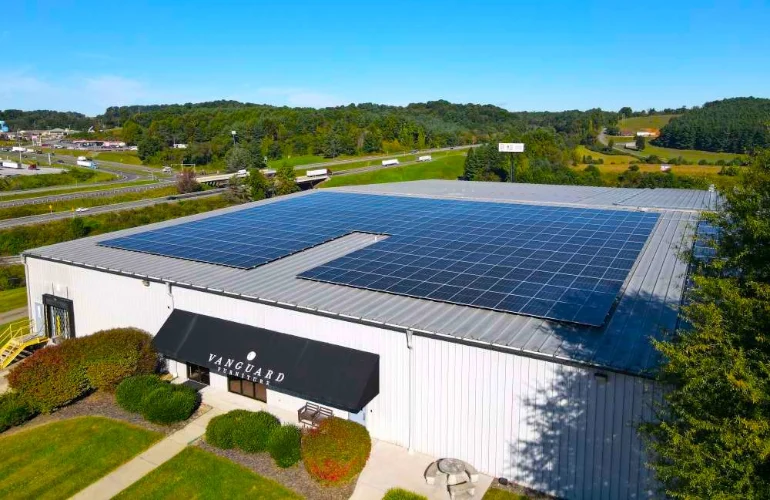
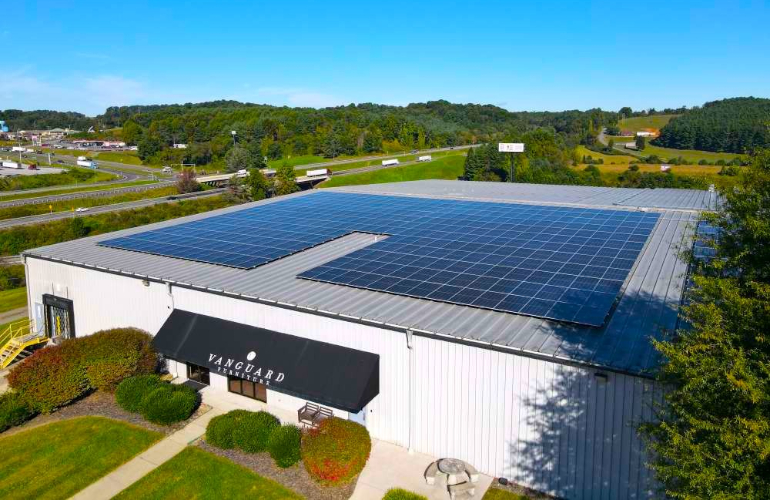
HILLSVILLE, Va. — In a milestone achievement for sustainable heavy manufacturing, North Carolina-based renewable energy developer Pisgah Energy has successfully completed a massive 848-kilowatt (kW) rooftop solar installation for renowned craft furniture maker Vanguard Furniture. Located at Vanguard’s manufacturing and production facility in Hillsville, Virginia, the newly operational solar array represents the third successful collaboration between the two regional enterprises.
This latest deployment is not merely an isolated green energy upgrade; it marks the continuation of a strategic, multi-year environmental partnership aimed at decarbonizing traditional furniture manufacturing. Building upon two previous solar investments completed in Conover, North Carolina, this newest installation pushes the envelope of what is achievable in industrial energy efficiency. According to project metrics, the Hillsville rooftop system is engineered to offset a staggering 95% of the manufacturing facility’s total electricity usage—a rare feat for an energy-intensive heavy manufacturing plant.
Main Facts: The Hillsville Installation
The newly commissioned solar array in Hillsville integrates cutting-edge photovoltaic technology to maximize energy harvest and reliability. Pisgah Energy spearheaded the initiative, acting as the lead designer, developer, and primary general contractor throughout the construction phase.
To achieve optimal performance and long-term durability, the system features high-efficiency SEG Solar panels paired with advanced SolarEdge inverters. These components were carefully selected to withstand industrial operating environments while optimizing energy conversion, even during periods of intermittent cloud cover or seasonal shifts in Virginia’s climate.
- Project Location: Hillsville, Virginia
- System Capacity: 848 kW rooftop solar array
- Energy Offset: Approximately 95% of the facility’s total electricity consumption
- Key Hardware: SEG Solar panels and SolarEdge inverters
- Primary Contractor & Developer: Pisgah Energy
- Client: Vanguard Furniture
The achievement of offsetting 95% of an industrial manufacturing plant’s energy demand places Vanguard Furniture in an elite tier of eco-conscious industrial producers. Heavy manufacturing facilities typically require vast amounts of continuous baseload power to operate heavy machinery, climate-control systems, and finishing rooms, making complete reliance on onsite solar historically difficult. The Hillsville project shatters these conventional limitations through intelligent engineering and system sizing.
Chronology: A Multi-Year Evolution Toward Sustainability
The completion of the Hillsville project represents the latest chapter in a long-term commitment to environmental stewardship by both Vanguard Furniture and Pisgah Energy. The timeline of their collaboration highlights a deliberate, phased approach to corporate sustainability:
Phase 1: The Conover Foundations (2021–2024)
Vanguard Furniture’s journey into commercial solar power began in earnest with initial investments in Conover, North Carolina, where the company operates significant manufacturing infrastructure. In late 2021, industry observers took note when the high-end upholstery and furniture maker embarked on a series of five distinct solar projects designed to shrink its carbon footprint. These early installations laid the operational and cultural groundwork within the company, proving that renewable energy could be seamlessly integrated into high-end furniture crafting without disrupting production schedules or product quality.
In June 2024, the partnership deepened when Pisgah Energy delivered a subsequent solar deployment for Vanguard in Conover. These initial projects allowed Vanguard’s executive leadership and facility managers to assess the return on investment, reliability, and maintenance requirements of commercial rooftop solar systems. Satisfied with the performance metrics and financial returns of their North Carolina assets, Vanguard leadership began looking outward to their regional footprint, setting their sights on the Hillsville, Virginia plant.
Phase 2: Scaling Up in Virginia (2025–2026)
With a proven blueprint established in North Carolina, planning for the Hillsville facility began in earnest. Pisgah Energy’s engineering teams conducted exhaustive feasibility studies, roof-load analyses, and energy-load profiling of the Virginia plant. Construction commenced following rigorous design approvals, culminating in the late-2026 commissioning of the 848-kW system. By scaling up the system capacity to meet nearly the entire load of the Hillsville plant, Vanguard transformed the facility into a flagship model of industrial sustainability.
Supporting Data: Operational Impact and Circular Economy Integration
The transition to solar power at the Hillsville facility does not exist in a vacuum; it is part of a holistic corporate ethos that redefines how luxury furniture is produced in the 21st century. Vanguard Furniture has long recognized that true environmental responsibility extends far beyond the factory roof.
Comprehensive Waste Reduction and Circular Manufacturing
Alongside its massive carbon reduction metrics, Vanguard maintains an aggressive industrial waste diversion program. The company successfully recycles 95% of its post-manufacturing waste stream. This intricate recycling and upcycling infrastructure covers a wide variety of materials generated during the furniture-making process:
- Wood Scraps: Raw lumber offcuts are captured and diverted for biomass energy, local agricultural uses, or secondary wood products.
- Fabric Scraps: Textile leftovers from upholstery operations are systematically collected and routed to industrial recycling facilities.
- Metal, Paper, and Packaging: Cardboard boxes, shipping crates, office paper, and metal fasteners are sorted and bailed for commercial recycling, drastically cutting landfill contributions.
Durability as an Environmental Strategy
Vanguard’s philosophy heavily emphasizes the concept of "furniture built to last for generations." In the modern consumer landscape defined by fast furniture and disposable goods, Vanguard deliberately swims against the current. By producing heirloom-quality craft furniture that withstands decades of daily use, the company inherently reduces the demand for replacement goods, conserving raw materials, water, and energy on a macro scale. Pairing this timeless manufacturing ethos with 95% solar-powered assembly facilities closes the loop, creating a product lifecycle that respects planetary boundaries.
Official Responses: Leadership Perspectives
The successful commissioning of the Hillsville solar array drew enthusiastic praise from the executive suites of both partnering companies, underscoring the mutual respect and shared vision driving the alliance.
Andy Bray, President and CEO of Vanguard Furniture, emphasized the alignment between environmental stewardship and sound business strategy:
"Pisgah Energy has been an outstanding partner as we’ve expanded solar across our facilities. This project reflects our commitment to responsible stewardship and investing in solutions that strengthen our business for the long term."
For Vanguard, renewable energy investments are viewed not merely as charitable environmental expenditures, but as strategic hedges against volatile utility markets. By generating the vast majority of its own electricity onsite, the company shields its operational margins from future electricity price spikes, ensuring long-term financial stability and competitiveness in the luxury furniture market.
Evan Becka, President of Pisgah Energy, highlighted the rarity and significance of the achievement from an engineering and contracting perspective:
"It’s almost unheard of for a manufacturing facility to offset most of its electricity usage with solar, and we’re proud to be a part of this milestone achievement for Vanguard Furniture. I’ve said it before, and I’ll say it again, it’s an honor to partner with a company so deeply committed to using renewable energy to produce its wares."
Becka noted that achieving a 95% offset required precise calibration between the physical roof space available in Hillsville and the facility’s specific hourly load profile, a testament to the collaborative planning between Pisgah’s technical team and Vanguard’s plant managers.
Implications: Setting a New Standard for American Manufacturing
The completion of Vanguard Furniture’s third solar installation by Pisgah Energy carries profound implications for the broader American manufacturing sector, particularly within the Southeast.
1. Proof of Concept for Energy-Intensive Industries
Historically, heavy manufacturing sectors—such as furniture assembly, textiles, automotive components, and metalworking—have viewed commercial solar as a supplementary power source capable of shaving peak loads, but rarely as a primary energy provider. Vanguard and Pisgah Energy have collectively upended this assumption. By demonstrating that a sprawling manufacturing plant can run almost entirely on clean, local sunlight, this project serves as a practical template for other industrial players hesitant to make deep investments in renewables.
2. Regional Economic and Environmental Co-Benefits
As states like North Carolina and Virginia continue to evolve their regional energy policies and grid infrastructures, corporate investments in distributed generation provide critical relief to local power grids. By generating clean power at the point of consumption, the Hillsville facility reduces strain on regional transmission lines, minimizes line losses, and lowers the local carbon intensity of the grid. Furthermore, projects of this scale support high-paying local jobs in engineering, electrical contracting, project management, and solar maintenance.
3. Meeting Consumer Demands for Supply Chain Transparency
Modern consumers, interior designers, and commercial buyers are increasingly demanding transparency regarding the environmental footprint of the goods they purchase. High-end furniture buyers expect premium craftsmanship, but increasingly, they also demand ethical and ecological integrity. By eliminating the vast majority of the carbon emissions associated with the production of its furniture, Vanguard Furniture secures a distinct competitive advantage in a marketplace that increasingly rewards sustainability.
Looking Ahead
As the partnership between Pisgah Energy and Vanguard Furniture enters its next phase, industry analysts are watching closely to see whether the furniture maker will expand its solar footprint to remaining administrative or storage facilities. What is already certain, however, is that the collaboration has established a new benchmark for industrial decarbonization—proving that traditional craft manufacturing and cutting-edge clean technology can not only coexist, but thrive together.