OMAHA, Neb. — Major transportation and logistics provider Werner Enterprises (NASDAQ: WERN) has laid out a strategic roadmap aimed at achieving double-digit truckload operating margins, even as near-term cost pressures threaten to cap earnings momentum over the next two quarters.
The company’s executive leadership detailed the balancing act between aggressive, long-term fleet positioning and immediate financial friction during its recent third-quarter earnings call. While management remains optimistic about navigating the nascent stages of an industry freight upcycle, rising operational expenses continue to complicate the near-term financial picture for one of the nation’s premier carriers.
Main Facts: Q3 Earnings and Revenue Performance
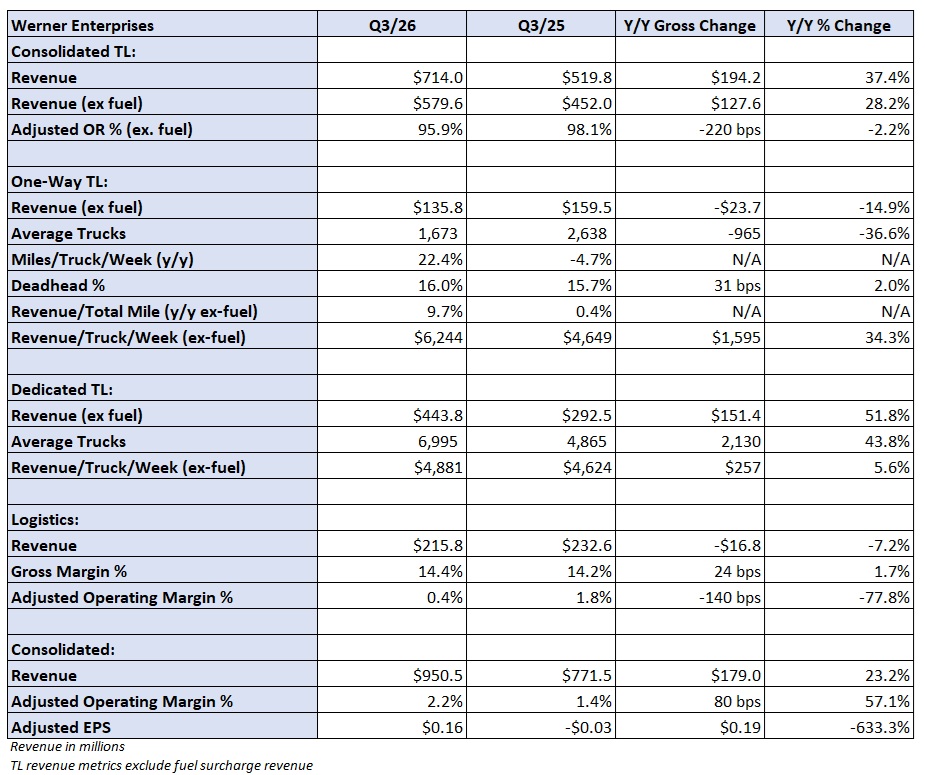
Werner reported third-quarter adjusted earnings per share (EPS) of 16 cents, aligning precisely with a profit warning issued earlier in the month. The revised guidance had lowered expectations from a Wall Street consensus estimate of 36 cents down to a band of 15 to 16 cents.
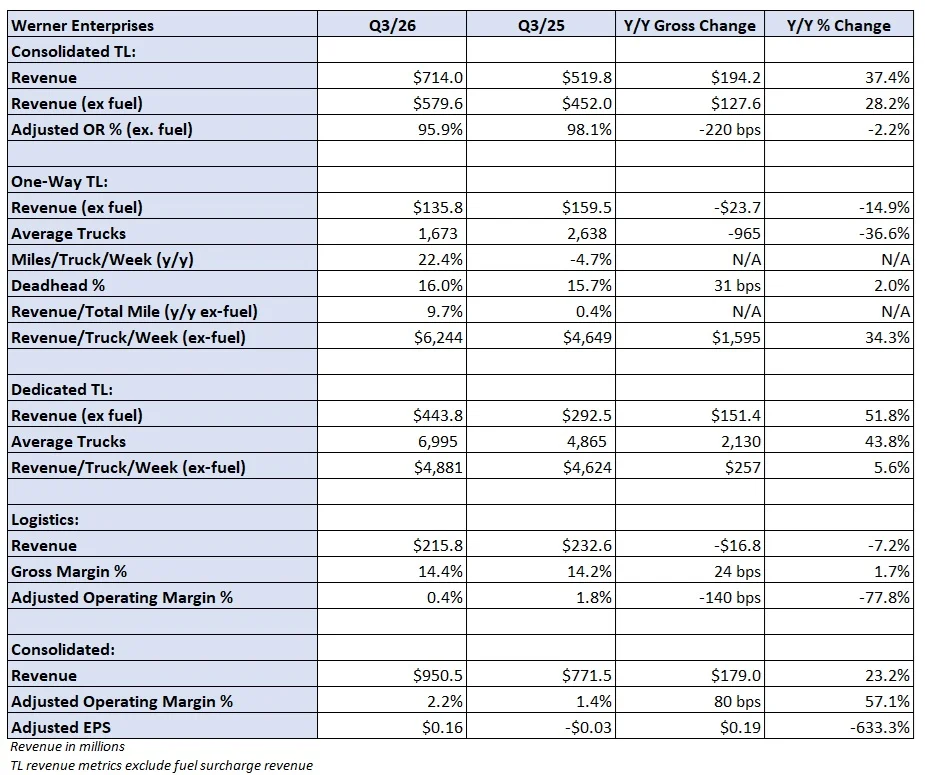
Despite the compressed margins, consolidated revenue for the quarter rose 23% year-over-year to $951 million, hitting the absolute top end of management’s updated outlook (which ranged from $946 million to $951 million). This top-line expansion was primarily catalyzed by higher fuel surcharges across the board and the strategic January acquisition of dedicated carrier FirstFleet for $245 million—a move that fundamentally altered Werner’s footprint in the dedicated sector.
However, profitability took a direct hit from sequential cost increases spanning elevated diesel fuel prices, escalating driver procurement expenses, and a retroactive reserve adjustment for prior insurance claims. Together, these elements created an 18-cent EPS drag during the third quarter. Offsetting these headwinds slightly were asset sale gains, which ticked up from $4.5 million in the prior-year period to $8 million, providing a 4-cent tailwind. By comparison, Werner posted an adjusted net loss of 3 cents per share in the third quarter of the previous year.
Chronology of Financial Pressures and Fleet Restructuring
The trajectory of Werner’s third-quarter performance was dictated by a sequence of aggressive operational adjustments and volatile market dynamics:
Early 2026: Werner executed a sweeping restructuring of its one-way fleet, actively pruning non-profitable accounts and repurposing under-utilized assets to maximize efficiency.
January 2026: The company completed its acquisition of FirstFleet, instantly absorbing over 2,400 tractors and unlocking roughly $615 million in annual revenue potential.
July – September 2026: Retail diesel prices experienced dramatic fluctuations, remaining relatively flat in July before climbing sequentially by 10% in August and another 15% in September. Because truckload fuel surcharges operate on a one-week lag, this sudden acceleration severely squeezed operating margins.
Late Q3 2026: Werner made the calculated decision to front-load investments in driver recruitment and onboarding, absorbing the upfront costs of adding 130 dedicated trucks and drivers just as the quarter drew to a close.
Mid-October 2026: Management issued a profit warning, alerting investors to the 16-cent EPS realization, before officially reporting the finalized results after the market closed on Tuesday.
Supporting Data: Segment Breakdown and Key Performance Indicators
Werner’s operational units experienced divergent fortunes during the third quarter, highlighting the complex mechanics of post-recession fleet management.
Dedicated Fleet Operations
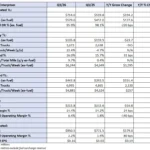
The dedicated segment, which now accounts for a commanding 81% of Werner’s total truck fleet, proved to be a powerful revenue engine.
Fleet Expansion: The average truck count in this segment expanded by 44% year-over-year to nearly 7,000 units, heavily bolstered by the FirstFleet integration.
Productivity: Revenue per truck per week (ex-fuel) rose 6% year-over-year. Management has now elevated its full-year 2026 outlook, expecting dedicated revenue per truck per week to increase by 4% to 5%, up from prior projections of 3% to 5%.
One-Way Fleet Operations
Following its earlier structural overhaul, the one-way unit posted strong gains in efficiency and utilization, even as its physical footprint contracted.
Fleet Size and Volume: Average truck count in the one-way fleet declined 37% year-over-year, driving a 15% year-over-year drop in ex-fuel one-way revenue.
Utilization: Miles per truck jumped 22%, pushing revenue per truck per week (ex-fuel) up 34% year-over-year.
Rate Dynamics: Revenue per total mile (ex-fuel) increased 10%, though this metric faced minor dilution due to a 116-mile increase in the average length of haul (longer hauls typically command lower per-mile rates).
Margins and Future Outlook: The one-way unit achieved more than 800 basis points of year-over-year margin improvement. Looking ahead, roughly 60% of the one-way revenue book is scheduled to renew in the first half of 2027, with management targeting double-digit rate increases across many of these contracts. Werner is now looking to strategically regrow this portion of its fleet.
Consolidated Truckload and Logistics Performance
Truckload (TL) Unit: Combined revenue reached $714 million, representing a 37% year-over-year increase (up 28% excluding fuel surcharges). The unit posted an adjusted operating ratio of 95.9%, translating to a 4.1% adjusted operating margin. While this was a 220-basis-point improvement year-over-year, it marked a 140-basis-point deterioration sequentially compared to the previous quarter, driven by a 200-basis-point cost headwind.
Logistics Unit: Logistics revenue dipped 7% year-over-year to $216 million, but the segment successfully returned to profitability with a 0.4% adjusted operating margin. Truckload brokerage, housed within the logistics division, delivered 600 basis points of sequential operating margin expansion.
Official Responses and Strategic Outlook
Management has offered a conservative financial guide for the final quarter of the year, pointing toward "modest sequential [EPS] improvement" from the 16-cent baseline established in Q3. This projection sits materially below the current Wall Street consensus estimate of 38 cents for the fourth quarter.
Addressing the underlying cost pressures, CEO Derek Leathers emphasized that the expenses weighing down the balance sheet are largely investments in future capacity rather than permanent structural inflation.
"We made the deliberate decision to accelerate investments in driver recruiting and onboarding to capture rising customer demand and support fleet expansion as industry capacity tightens," said Chairman and CEO Derek Leathers. "We remain confident in our trajectory and our ability to capitalize on the early stages of this freight upcycle."
Management clarified that approximately one-third of the 18-cent third-quarter EPS drag was directly tied to driver recruiting and sign-on incentives—costs incurred ahead of revenue generation. For instance, Werner absorbed the overhead of onboarding 130 dedicated trucks and drivers throughout the quarter, while the corresponding revenue streams did not activate until the final days of the period.
The remaining 12-cent drag stemmed from volatile fuel dynamics and insurance reserve adjustments. Executives anticipate that insurance and fuel headwinds will largely dissipate by the fourth quarter. Although Q4 will face additional headwinds from lower asset sale gains (guided to total just $1.7 million), higher interest expenses, and an elevated tax rate, these will be partially counterbalanced by improved contract pricing and a slightly expanded fleet geared up for peak season volume.
Broader Industry Implications
Werner Enterprises’ third-quarter financial report serves as a revealing macroeconomic barometer for the broader transportation sector. It underscores the severe cost pressures currently confronting motor carriers—specifically the whipsaw effect of volatile diesel pricing and the heavy financial lifting required to secure scarce driver talent in a tightening labor market.
Furthermore, Werner’s experience signals that the broader freight industry’s recovery will not follow a linear path. Even as carriers successfully push for higher contract rates and navigate the early phases of an upcycle, profitability remains acutely vulnerable to early-upcycle cost inflation. For shippers and investors alike, Werner’s strategic gamble—sacrificing short-term margins to build scale and secure market share ahead of a broader capacity crunch—will serve as a defining test of endurance and execution in the quarters to come.