





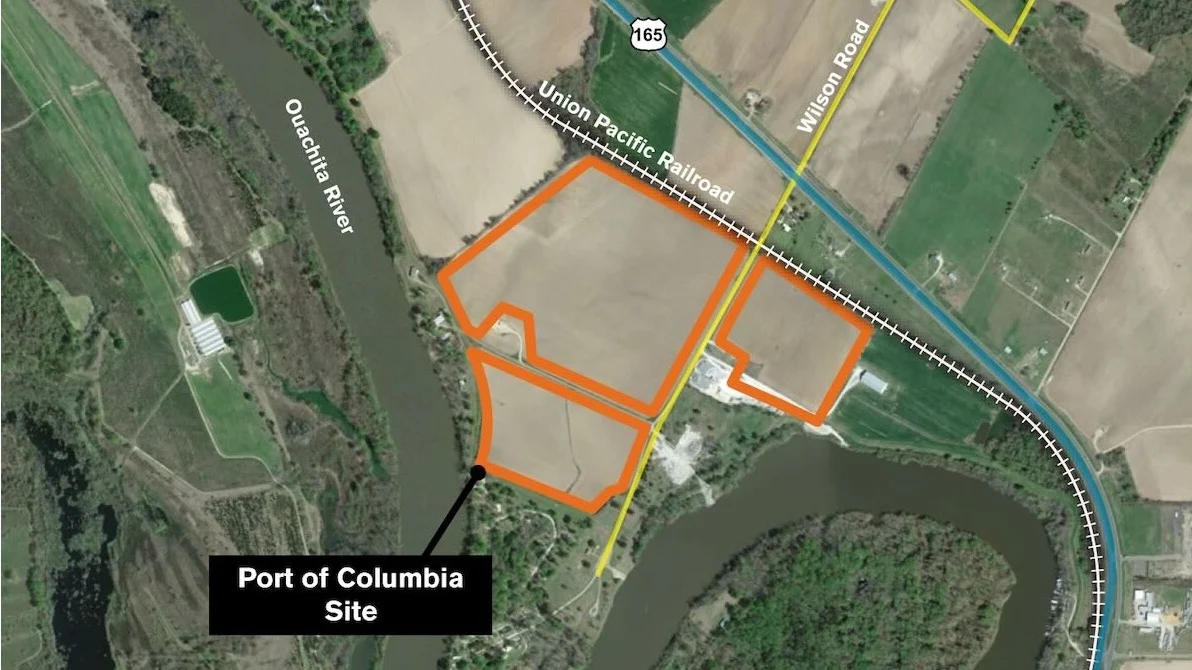
COLUMBIA, La. — Northeast Louisiana’s multimodal logistics capabilities are poised for a significant expansion following a critical financial injection from the state. Louisiana Economic Development (LED) has awarded a $1 million loan through its FastSites program to help finalize funding for a transformative $7 million rail infrastructure project at the Port of Columbia.
The investment will fund the construction of a new rail spur, directly connecting the 400-acre port facility to Union Pacific’s (NYSE: UNP) Monroe Subdivision main line. By bridging a vital funding gap, the state loan clears the path for a project that local leaders believe will reshape regional commerce, attract future industrial development, and offer businesses a seamless bridge between river, road, and rail transportation.
Main Facts: Bridging the Multimodal Gap
The Port of Columbia occupies a strategic geographic footprint in Caldwell Parish, situated approximately 30 miles south of Monroe, Louisiana. Currently, the 400-acre property boasts direct access to the Ouachita River and U.S. Route 165, positioning it as an established hub for barge and truck freight. However, the facility has long lacked a direct, on-site rail connection—a critical disadvantage in a modern supply chain where seamless intermodal transfer is paramount.
The introduction of the new rail spur changes the calculus entirely:
- Total Project Cost: $7 million.
- Key Financial Backing: A $1 million state loan via LED’s FastSites program, alongside pre-committed capital from the Louisiana Department of Transportation and Development (DOTD) and federal funding secured through the Delta Regional Authority’s Community Infrastructure Fund.
- Infrastructure Target: Construction of a dedicated rail spur linking the port directly to Union Pacific’s Monroe Subdivision main line.
- Timeline: Project bidding is slated to open in November, with construction kicking off in the first quarter of 2027 and project completion targeted for 2028.
For rural ports across the American South, securing competitive capital for heavy infrastructure is frequently an uphill battle. The FastSites program was explicitly designed to solve this friction by supplying flexible gap financing, allowing port authorities to transition grand infrastructure blueprints into active construction sites.
Chronology of the Project
The journey toward establishing rail connectivity at the Port of Columbia has been years in the making, relying on a coalition of local, state, and federal entities.
- Pre-Planning and Strategic Vision: Recognizing that the port’s existing river and highway access was insufficient to capture heavy manufacturing and bulk industrial tenants, the Columbia Port Commission began prioritizing rail integration. Proximity to Union Pacific’s Monroe Subdivision main line made the connection physically feasible, provided the necessary capital could be marshaled.
- Securing Initial Grants: Over successive funding cycles, the port successfully secured cornerstone financial commitments. This included allocations from the Louisiana Department of Transportation and Development (DOTD) and federal dollars distributed via the Delta Regional Authority’s Community Infrastructure Fund. Despite these wins, a funding deficit remained.
- The LED FastSites Intervention (Current Phase): To close the remaining deficit, Louisiana Economic Development stepped forward with a $1 million loan through the FastSites program, completing the $7 million financial puzzle.
- November 2026: The Port of Columbia is scheduled to officially open the project up for commercial construction and engineering bids.
- Q1 2027: Groundbreaking and official commencement of construction on the rail spur.
- 2028: Projected completion date, marking the operational launch of rail-to-barge and rail-to-truck freight handling at the facility.
Supporting Data and Regional Logistics Ecosystem
The economic weight of the Port of Columbia project extends far beyond its physical boundaries. Northeast Louisiana has increasingly positioned itself as an emerging logistics corridor, capitalizing on its unique geography where navigable waterways intersect with major interstate and rail arteries.
Strategic Location and Infrastructure Assets
- The Ouachita River: Part of the McClellan-Kerr Arkansas River Navigation System network (via connecting waterways), the river provides cost-effective, high-capacity bulk transport capabilities moving goods toward the Gulf of Mexico.
- U.S. Route 165: A critical north-south commercial corridor in Louisiana, offering rapid truck access to Interstate 20 and regional distribution hubs.
- Union Pacific Railroad: One of North America’s premier Class I railroads, UP’s Monroe Subdivision provides direct connectivity to transcontinental rail networks, opening up markets across the United States, Canada, and Mexico.
Complementary Regional Projects
The injection of rail capabilities directly addresses industrial site-readiness criteria. Modern manufacturers—particularly those in the chemical, energy, and agricultural sectors—demand tri-modal access (water, rail, and highway) to minimize raw material inbound costs and maximize outbound distribution velocity.
By achieving this tri-modal status, the Port of Columbia positions itself to capture spillover investments from major regional initiatives, such as Louisiana Green Fuels, a sustainable aviation fuel project developing facilities in the region that rely heavily on robust, diversified logistics networks.
Official Responses and Stakeholder Perspectives
The announcement has drawn widespread praise from local, regional, and state leaders, who view the rail spur as a masterclass in leveraging state programs for rural economic development.
Columbia Port Commission President Darron McGuffee emphasized the transformative nature of the FastSites funding mechanism:
"For a rural port like Columbia, FastSites provides critical gap financing that allows us to turn committed infrastructure funding into a project under construction. The FastSites investment gives the port the financial flexibility needed to keep the project moving and maintain our construction schedule. More importantly, this rail spur will provide public access to Union Pacific’s main line for our region, creating new transportation opportunities for existing businesses while strengthening our ability to attract future industrial investment like Louisiana Green Fuels."
Louisiana State Senator Glen Womack highlighted the broader economic ripples the project will send across Northeast Louisiana:
"Adding rail access at the Port of Columbia opens another path for businesses across Northeast Louisiana to move goods and reach markets. That kind of connectivity strengthens our ability to support the industries already operating here while creating more possibilities for companies looking to invest in the region."
Industry observers note that public-private and inter-agency cooperation of this caliber is becoming the gold standard for state-backed economic development. By utilizing state loans to unlock federal grants, local ports can bypass the capital constraints that traditionally hamper rural logistics expansion.
Implications for Shippers, Carriers, and the Regional Economy
The completion of the Port of Columbia rail spur by 2028 will carry profound implications for the regional freight landscape, impacting local shippers, Class I rail operations, and the overall economic competitiveness of Louisiana.
1. Diversification of Supply Chains for Local Shippers
For decades, businesses operating in Caldwell Parish and surrounding rural counties have relied almost exclusively on trucking for outbound finished goods and inbound raw materials, or have had to dray goods long distances to intermodal ramps. The new rail spur introduces a cost-effective, high-capacity alternative for heavy commodities—such as lumber, agricultural products, chemicals, and industrial aggregates—dramatically lowering shipping friction and transportation overhead.
2. Enhanced Competitiveness in Industrial Recruitment
Economic development agencies frequently cite "site readiness" as the single most important factor in landing multi-million-dollar manufacturing plants. Industrial prospects routinely eliminate sites that lack direct rail service. With the addition of Union Pacific main line connectivity, the Port of Columbia transforms from a regional barge terminal into a globally competitive industrial park, bolstering the state’s pipeline for major manufacturing and energy projects.
3. Freight Volume Growth for Union Pacific
For Union Pacific, the project represents a valuable organic growth opportunity. By tapping into the Port of Columbia, UP secures a new origin and destination point for industrial carload and intermodal traffic generated within Northeast Louisiana. This aligns with broader national rail trends seeing increased emphasis on localized industrial development and short-line/port partnerships to capture decentralized freight.
4. Intermodal Synergy (Rail-Barge-Truck)
Perhaps the most significant long-term implication is the creation of a true tri-modal logistics hub. Shippers will possess the unique flexibility to bring bulk materials in via rail car, transfer them directly to river barges for low-cost downstream transit to deep-water Gulf ports, or load them onto trucks for regional distribution. This redundancy protects local supply chains against single-mode disruptions, whether caused by highway congestion, trucking capacity crunches, or seasonal river level fluctuations.
As bidding opens this November and construction moves toward its 2027 groundbreaking, the Port of Columbia stands at the threshold of a new economic era—proving that strategic state investments can successfully anchor rural America firmly into the global supply chain.