





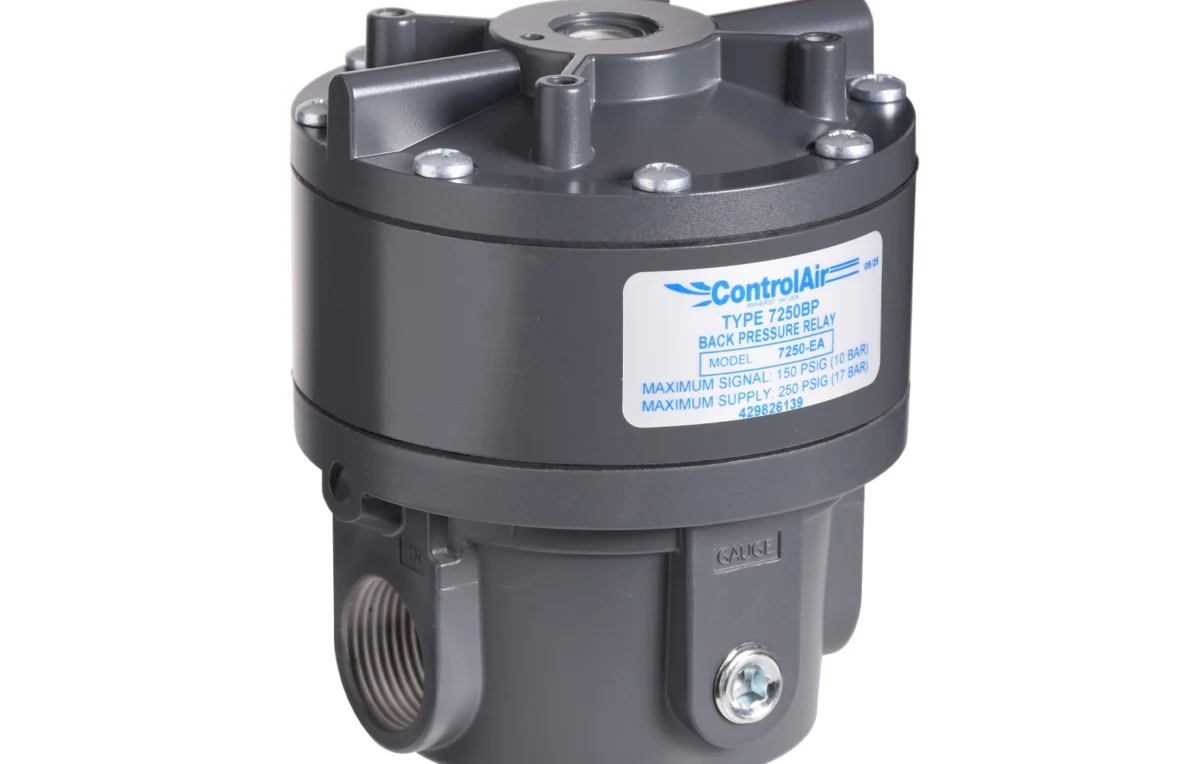
In the demanding landscape of industrial automation and pneumatic systems, the ability to manage pressure with surgical precision is not merely a performance requirement—it is a safety imperative. ControlAir LLC, a global leader in precision pneumatic and electro-pneumatic control products, has officially announced the launch of its latest innovation: the Type 715BP and Type 7250BP signal-operated back pressure regulators. These units are engineered to offer robust, reliable pressure management in environments where upstream over-pressurization poses a risk to critical downstream equipment.
Main Facts: Engineering for Reliability
The introduction of the Type 715BP and Type 7250BP represents a significant step forward in back pressure regulation technology. Both units function as normally closed valves, maintaining a strict 1:1 signal-to-output ratio. Their primary operational mechanism is straightforward yet highly effective: they remain closed until the upstream pressure exceeds the control signal or setpoint provided by the user. Once that threshold is breached, the regulators open to relieve pressure, effectively acting as a safeguard for sensitive downstream components.
Technical Specifications at a Glance:
- Operating Pressure: Up to 250 psig.
- Signal Pressure: Up to 150 psig.
- Core Material: Industrial-grade aluminum bodies designed for durability.
- Versatility: Available in multiple port sizes with optional ATEX certification and extended temperature ranges for hazardous or extreme environments.
The distinction between the two models lies in their specific application profiles. The Type 715BP is tailored for precision-demanding tasks that require moderate flow, while the Type 7250BP serves as a heavy-duty solution for high-flow and high-relief applications.
Chronology: The Evolution of ControlAir’s Regulatory Suite
ControlAir has long established its reputation in the fluid power industry through incremental innovation. The development of the 715BP and 7250BP follows a multi-year trend of refining pneumatic control devices to meet the increasing complexities of Industry 4.0 and automated process control.
- Initial Research Phase: ControlAir engineers identified a market gap for regulators that could integrate more seamlessly with electronic control systems, such as I/P (current-to-pressure) transducers.
- Prototype Development: The focus was placed on isolating control chambers to mitigate the persistent issues of vibration and "hunting" that plague many standard back pressure regulators.
- Testing and Validation: Throughout the past year, the units underwent rigorous field testing in diverse environments, ranging from laboratory settings to heavy industrial production floors, ensuring the units could handle the specified 250 psig limits without failure.
- Market Launch: The official rollout in the second quarter of 2026 marks the culmination of these efforts, positioning the regulators as essential components for modern pneumatic system integration.
Supporting Data: Comparative Performance Metrics
To understand the utility of these new regulators, one must look at the specific performance metrics provided by ControlAir.
The Type 715BP: Precision First
The 715BP is designed for the high-accuracy sector. With a flow capacity of up to 90 SCFM and a sensitivity rating of as low as 1/4 inch water column, this model is intended for applications where even minor pressure fluctuations could result in product waste or system instability. A critical feature is its "in-line maintenance" capability; the internal configuration allows technicians to service the unit without detaching it from the air line, significantly reducing downtime in continuous manufacturing cycles.

The Type 7250BP: High-Flow Capability
For operations requiring mass movement of air or fluid, the 7250BP provides a substantial step up in capacity. Supporting flow rates up to 375 SCFM, this unit is built for rapid response to pressure surges. It is frequently employed in systems that vent excess pressure directly to the atmosphere or actuate emergency shut-off valves. This model is particularly robust, capable of maintaining stability under highly variable flow conditions.
Official Perspectives: The Role of Signal-Operated Regulation
In a statement regarding the product launch, ControlAir engineers highlighted the importance of "Signal-Operated" flexibility. By allowing the regulator to be controlled via an external I/P transducer, the Type 715BP and 7250BP transition from static mechanical devices to dynamic, intelligent components.
"The goal," notes a company spokesperson, "is to bridge the gap between mechanical pneumatic hardware and the digital logic of modern controllers. When an operator can adjust a setpoint via an I/P transducer, they gain the ability to dynamically manage downstream flow rates and upstream pressure limits on the fly. This is not just a safety tool; it is a process optimization tool."
The inclusion of ATEX certification options and extended temperature ranges reflects the company’s commitment to the global industrial sector, particularly in regions where environmental regulations and safety standards for potentially explosive atmospheres are stringent.
Implications for Industry: The Path Forward
The launch of the Type 715BP and 7250BP has broad implications for several industrial sectors:
1. Advancements in Industrial Automation
As factories move toward higher levels of autonomy, the need for components that can be "told" how to behave by a central PLC (Programmable Logic Controller) is growing. These regulators act as the physical muscle for these digital instructions, ensuring that pneumatic pressure is always precisely where it needs to be.

2. Enhanced Safety Standards
The ability to trigger emergency shut-off systems via a back pressure regulator is a vital safety layer. In chemical processing or food and beverage manufacturing, the risk of over-pressurization can be catastrophic. By providing a reliable, high-capacity relief mechanism, ControlAir is offering a turnkey solution for risk mitigation.
3. Maintenance and Cost Efficiency
The design choice to allow in-line maintenance on the 715BP is a direct response to the cost of industrial downtime. In many plants, the hourly cost of an idle line is in the thousands of dollars. The ability to perform routine maintenance without full system depressurization or disassembly is a major value-add for plant managers and maintenance engineers.
4. Broadening Application Scope
While the initial target is general industrial pneumatic applications, the robust construction of these regulators makes them ideal candidates for specialized sectors such as:
- Precision Flow Control: Where specific back pressures are required for coating or spray applications.
- Process Control: Where precise pressure regulation is necessary to balance chemical reactions or fluid mixtures.
- Pneumatic System Protection: Protecting fragile components from the "pressure spikes" often associated with compressor startup or cycling.
Conclusion
ControlAir’s release of the Type 715BP and Type 7250BP is a testament to the continued evolution of pneumatic technology. While these devices operate on fundamental principles of fluid mechanics, their modern design, ease of maintenance, and compatibility with electronic control signals make them indispensable for the next generation of industrial applications.
By providing two distinct models, the company has effectively catered to both ends of the spectrum: those who need the extreme sensitivity of the 715BP and those who require the raw flow-relieving power of the 7250BP. As industry standards for safety and precision continue to rise, these regulators offer a sophisticated, reliable, and highly configurable solution that will likely become a standard fixture in modern pneumatic system architecture.
For engineers and facility managers looking to upgrade their pressure management protocols, the Type 715BP and 7250BP represent a marriage of high-performance engineering and practical, real-world utility. As the industry moves forward, the ability to control, monitor, and maintain these vital systems with such precision will undoubtedly lead to safer, more efficient, and more productive industrial environments.