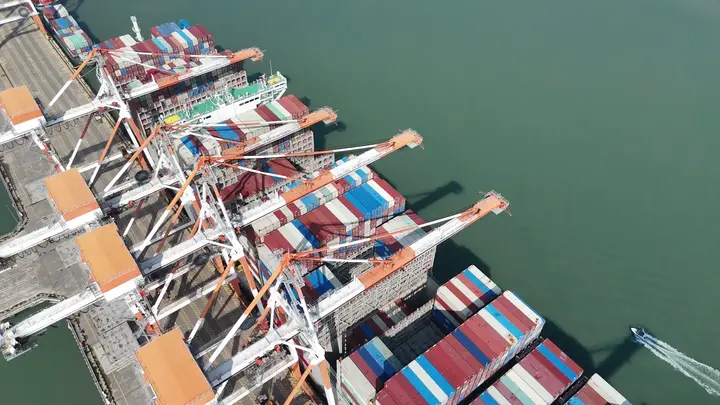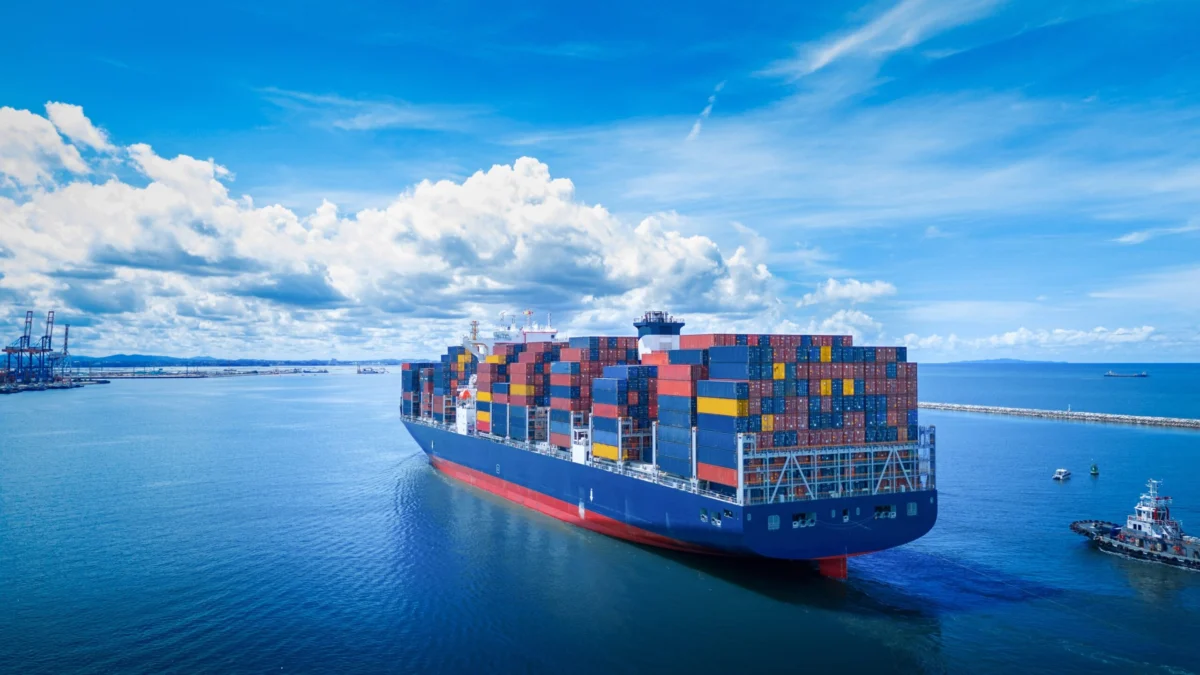
The global container shipping industry, having navigated the turbulent waters of the post-pandemic era and the ongoing geopolitical volatility of 2026, is steering toward a potential structural turning point. According to the latest market analysis from BIMCO, the industry faces a precarious supply-demand imbalance in 2027. As a massive wave of new vessel deliveries hits the water, the artificial capacity absorption—driven by route diversions and regional conflicts—may begin to evaporate, leaving carriers and shippers in a fundamentally transformed market.
Main Facts: A Convergence of Supply and Stability
The current state of the container market is defined by a paradoxical stability. While 2026 has been marked by strong head-haul trade growth—particularly out of East and Southeast Asia—the industry’s capacity to absorb record-breaking fleet additions is hitting its limit.
The global containership fleet has surged past the 34 million TEU (Twenty-foot Equivalent Unit) milestone, representing a staggering 10 million TEU increase in just over five years. Yet, this is only the beginning. With an orderbook currently sitting at 14 million TEUs—nearly 42% of the existing global fleet—the industry is bracing for an unprecedented supply influx. While 2026 saw a manageable 4.6% growth in fleet capacity, BIMCO forecasts this trajectory to accelerate to 9% by 2027.
The critical question for the industry is no longer just "how much cargo is moving," but "how much capacity is effectively tied up." For the past two years, the industry has benefited from a "capacity vacuum" created by ships avoiding the Suez Canal in favor of the longer Cape of Good Hope route. However, as major carriers like Maersk, Hapag-Lloyd, and COSCO begin to test the waters of the Suez again, that vacuum is beginning to fill, potentially flooding the market with latent capacity at the exact moment new vessels are commissioned.
Chronology: The Evolution of the 2026–2027 Market
To understand the looming 2027 outlook, one must trace the timeline of the industry’s recent fluctuations:
- 2024–2025 (The Red Sea Crisis): The diversion of vessels around the Cape of Good Hope became the industry standard, effectively absorbing excess capacity that would have otherwise caused a rate collapse.
- Early 2026: Global container volumes surged, with a 5.1% year-over-year increase in the first seven months. This growth was primarily driven by East/Southeast Asian exports, which buffered the impact of slowing demand in South and West Asia.
- Mid-2026: The industry continued to operate under the assumption that the "long route" would remain the status quo. Carriers maintained high operational efficiency despite the increased sailing time.
- Late 2026 (The Current Pivot): Early signs of a return to the Suez Canal emerged as carriers reassessed security and operational costs. Simultaneously, the delivery schedule for the massive 2024–2025 orderbook reached its peak, setting the stage for a surplus-heavy 2027.
- 2027 (The Projected Outlook): The convergence of high fleet growth and the potential "re-opening" of the Suez route creates a high-risk environment for carriers, with BIMCO predicting a significant weakening of the supply/demand balance.
Supporting Data: The Math of Overcapacity
The mathematical reality facing the shipping sector is unforgiving. BIMCO’s analysis suggests that the industry is caught between two primary drivers: the "Strait of Hormuz" (SoH) factor and the "Suez normalization" factor.
The SoH Scenarios
BIMCO has modeled two distinct paths for 2027 based on the status of the Strait of Hormuz:
- The "SoH Closed" Scenario: If the waterway remains effectively blocked, global economic activity could suffer due to energy price volatility and oil supply constraints. Under this scenario, demand growth is expected to remain sluggish, between 0.5% and 2.5%, while vessel supply continues to grow by 5%–6%.
- The "SoH Open" Scenario: If normal transit resumes, the global economy may see a moderate recovery. However, even with improved demand growth (projected at 2.5% to 4.5%), it will likely fail to outpace the surge in new ship deliveries, which will remain in the 5%–6% range.
The Suez Effect
Perhaps the most significant variable is the return to the Suez Canal. Currently, the "long route" around the Cape of Good Hope acts as a massive drain on global capacity. If these services return to the Suez, the effect is equivalent to an instant increase in supply. BIMCO estimates that a full normalization of Suez transits could reduce the requirement for ship capacity by approximately 10% compared to a "Cape-only" scenario. In practical terms, this would render a large portion of the current fleet redundant, creating a downward pressure on freight rates that could last for several years.
Official Responses and Expert Analysis
Niels Rasmussen, Chief Shipping Analyst at BIMCO, has been clear in his warnings regarding the structural shift. "Disruptions and strong growth in head-haul trades continue to support the container shipping market in 2026, but accelerating fleet growth could weaken the supply/demand balance in 2027," Rasmussen stated.
Industry leaders are in a difficult position. Carriers have invested billions in new, energy-efficient tonnage to comply with environmental regulations and replace aging, less efficient vessels. However, the limited pace of vessel recycling means that older ships are staying in the market longer than expected. "Unless Strait of Hormuz transit conditions normalize, continued oil supply constraints and higher oil prices could weaken global economic growth and container volume growth in 2027," Rasmussen added, highlighting that the macro-economic risks are just as significant as the internal supply-side pressures.
For shipping lines, the strategy is shifting from expansion to optimization. The decision by carriers like Maersk and Hapag-Lloyd to cautiously return to the Suez suggests that they are testing the viability of shorter routes, even if it introduces operational risks.
Implications: A New Era for Shippers and Carriers
The transition toward 2027 holds profound implications for the global supply chain:
For Carriers
The primary challenge for carriers will be managing the oversupply. Historically, the industry has responded to overcapacity through "slow steaming" or the blanking of sailings. However, with a massive influx of new, modern ships, carriers may find themselves unable to control the supply side effectively. If freight rates begin to fall, the focus will likely shift toward market share battles and a renewed emphasis on cost-cutting measures, potentially leading to further consolidation within the industry.
For Shippers
For those who rely on container shipping to move goods, the 2027 outlook is a double-edged sword. On one hand, a potential softening of the market could lead to lower freight rates and better availability of equipment. On the other hand, if the market becomes too volatile, the reliability of services could suffer as carriers scramble to adjust schedules and port calls in response to the changing Suez/Cape routing dynamics.
For the Global Economy
The shipping industry is the circulatory system of global trade. The potential for a "market correction" in 2027 serves as a bellwether for the broader economy. If the supply/demand gap widens significantly, the resulting drop in shipping revenue could have a ripple effect on maritime financing, port operations, and logistics infrastructure.
Conclusion: Preparing for the Turning Point
The container shipping industry is approaching a watershed moment. The combination of a record-breaking orderbook and the potential normalization of key transit routes represents a fundamental shift from the "disruption-led" market of the last three years to a "supply-led" market.
As we move toward 2027, the focus for all stakeholders—from vessel owners and freight forwarders to global retailers—must remain on the variables that define the supply/demand balance. Whether the industry enters a period of sustainable adjustment or a cycle of sharp decline will depend on the pace of vessel deliveries, the evolution of global trade, and, crucially, the stability of the world’s most critical maritime chokepoints. One thing is certain: the era of relying on geopolitical disruptions to buoy the shipping market is nearing its end.